Windsor Castle by William Harrison Ainsworth
BOOK II — HERNE THE HUNTER
CHAPTER IV
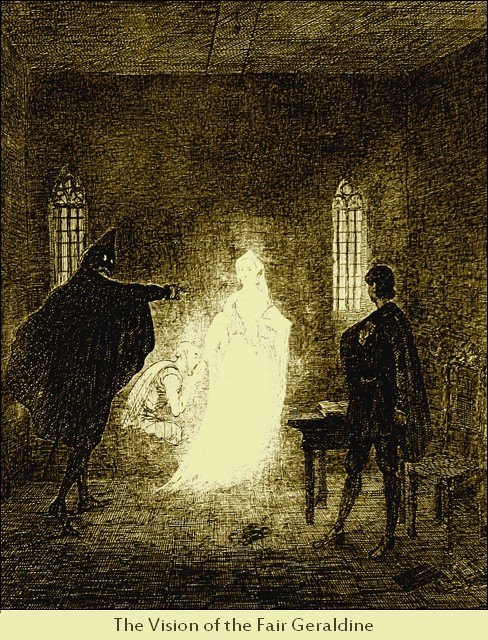
How Herne the Hunter showed the Earl of Surrey the Fair Geraldine in a
Vision.
On the third day after Surrey's imprisonment in the keep, he
was removed to the Norman Tower. The chamber allotted him was square,
tolerably lofty, and had two narrow-pointed windows on either side, looking
on the one hand into the upper quadrangle, and on the other into the middle
ward. At the same time permission was accorded him to take exercise on the
battlements of the Round Tower, or within the dry and grassy moat at its
foot.
The Fair Geraldine, he was informed, had been sent to the royal palace at
Greenwich; but her absence occasioned him little disquietude, because he
knew, if she had remained at Windsor, he would not have been allowed to see
her.
On the same day that Surrey was removed to the Norman Tower, the Duke of
Richmond quitted the castle without assigning any motive for his departure,
or even taking leave of his friend. At first some jealous mistrust that he
might be gone to renew his suit to the Fair Geraldine troubled the earl; but
he strongly combated the feeling, as calculated,if indulged, to destroy his
tranquillity; and by fixing his thoughts sedulously on other subjects, he
speedily succeeded in overcoming it.
On that night, while occupied in a translation of the Aeneid which he had
commenced, he remained at his task till a late hour. The midnight bell had
tolled, when, looking up, he was startled by perceiving a tall figure
standing silent and motionless beside him.
Independently of the difficulty of accounting for its presence, the
appearance of the figure was in itself sufficiently appalling. It was above
the ordinary stature, and was enveloped in a long black cloak, while a tall,
conical black cap, which added to its height, and increased the hideousness
of its features, covered its head.
For a few minutes Surrey remained gazing at the figure in mute
astonishment, during which it maintained the same motionless posture. At
length he was able to murmur forth the interrogation, "Who art thou?"
" A friend," replied the figure, in a sepulchral tone.
"Are you a man or spirit?" demanded Surrey.
"It matters not—I am a friend," rejoined the figure.
"On what errand come you here?" asked Surrey.
"To serve you," replied the figure; "to liberate you. You shall go hence
with me, if you choose."
"On what condition? "rejoined Surrey.
"We will speak of that when we are out of the castle, and on the green sod
of the forest," returned the figure.
"You tempt in vain," cried Surrey. "I will not go with you. I recognise in
you the demon hunter Herne." The figure laughed hollowly—so hollowly
that Surrey's flesh crept upon his bones.
" You are right, lord of Surrey," he said; "I am Herne the Hunter. You
must join me. Sir Thomas Wyat is already one of my band."
"You lie, false fiend!" rejoined Surrey. "Sir Thomas Wyat is in
France."
It is you who lie, lord of Surrey," replied Herne; "Sir Thomas Wyat is now
in the great park. You shall see him in a few minutes, if you will come with
me."
"I disbelieve you, tempter!" cried Surrey indignantly. "Wyat is too good a
Christian, and too worthy a knight, to league with a demon."
Again Herne laughed bitterly.
Sir Thomas Wyat told you he would seek me out," said the demon. "He did
so, and gave himself to me for Anne Boleyn."
"But you have no power over her, demon?" cried Surrey, shuddering.
"You will learn whether I have or not, in due time," replied Herne. "Do
you refuse to go with me?"
I refuse to deliver myself to perdition," rejoined the earl.
"An idle fear," rejoined Herne. " I care not for your soul—you will
destroy it without my aid. I have need of you. You shall be back again in
this chamber before the officer visits it in the morning, and no one shall be
aware of your absence. Come, or I will bear you hence."
"You dare not touch me," replied Surrey, placing his hand upon his breast;
"I am armed with a holy relic."
"I know it," said Herne; "and I feel its power, or I would not have
trifled with you thus long. But it cannot shield you from a rival. You
believe the Fair Geraldine constant—ha?"
"I know her to he so," said Surrey.
A derisive laugh broke from Herne.
"Peace, mocking fiend!" cried Surrey furiously.
I laugh to think how you are deceived," said Herne. "Would you behold your
mistress now?—would you see how she conducts herself during your
absence?"
"If you choose to try me, I will not oppose the attempt," replied Surrey;
"but it will be futile."
"Remove the relic from your person," rejoined Herne. "Place it upon the
table, within your grasp, and you shall see her."
Surrey hesitated; but he was not proof against the low mocking laugh of
the demon.
"No harm can result from it," he cried at length, detaching the relic from
his neck, and laying it on the table.
"Extinguish the light!" cried Herne, in a commanding voice.
Surrey instantly sprang to his feet, and dashed the lamp off the table.
"Behold!" cried the demon.
And instantly a vision, representing the form and lineaments of the Fair
Geraldine to the life, shone forth against the opposite wall of the chamber.
At the feet of the visionary damsel knelt a shape resembling the Duke of
Richmond. He was pressing the hand extended to him by the Fair Geraldine to
his lips, and a smile of triumph irradiated his features.
" Such is man's friendship—such woman's constancy!" cried Herne.
"Are you now satisfied?"
"I am, that you have deceived me, false spirit!" cried the earl. "I would
not believe the Fair Geraldine inconstant, though all hell told me so."
A terrible laugh broke from the demon, and the vision faded away. All
became perfect darkness, and for a few moments the earl remained silent. He
then called to the demon, but receiving no answer, put forth his hand towards
the spot where he had stood. He was gone.
Confounded, Surrey returned to the table, and searched for the relic, but,
with a feeling of indescribable anguish and self-reproach, found that it had
likewise disappeared.