Windsor Castle by William Harrison Ainsworth
BOOK II — HERNE THE HUNTER
CHAPTER VIII
How the King and the Duke of Suffolk were assailed by Herne's Band—
And what followed the Attack.
Henry and Suffolk, on leaving the forester's hut, took their
way for a sort space along the side of the lake, and then turned into a path
leading through the trees up the eminence on the left. The king was in a
joyous mood, and made no attempt to conceal the passion with which the fair
damsel had inspired him.
"I' faith!" he cried, "the cardinal has a quick eye for a pretty wench. I
have heard that he loves one in secret, and I am therefore the more beholden
to him for discovering Mabel to me."
"You forget, my liege, that it is his object to withdraw your regards from
the Lady Anne Boleyn," remarked Suffolk.
" I care not what his motive may be, as long as the result is so
satisfactory," returned Henry. "Confess now, Suffolk, you never beheld a
figure so perfect, a complexion so blooming, or eyes so bright. As to her
lips, by my soul, I never tasted such."
"And your majesty is not inexperienced in such matters," laughed Suffolk.
"For my own part, I was as much struck by her grace as by her beauty, and can
scarcely persuade myself she can be nothing more than a mere forester's
grand-daughter."
"Wolsey told me there was a mystery about her birth," rejoined Henry;
"but, pest on it; her beauty drove all recollection of the matter out of my
head. I will go back, and question her now."
"Your majesty forgets that your absence from the castle will occasion
surprise, if not alarm," said Suffolk. "The mystery will keep till to-
morrow."
"Tut, tut!—I will return," said the king perversely. And Suffolk,
knowing his wilfulness, and that all remonstrance would prove fruitless,
retraced his steps with him. They had not proceeded far when they perceived a
female figure at the bottom of the ascent, just where the path turned off on
the margin of the lake.
"As I live, there she is!" exclaimed the king joyfully. "She has divined
my wishes, and is come herself to tell me her history."
And he sprang forward, while Mabel advanced rapidly towards him.
They met half-way, and Henry would have caught her in his arms, but she
avoided him, exclaiming, in a tone of confusion and alarm, "Thank Heaven, I
have found you, sire!"
"Thank Heaven, too, sweetheart!" rejoined Henry. "I would not hide when
you are the seeker. So you know me—ha?
"I knew you at first," replied Mabel confusedly. "I saw you at the great
hunting party; and, once beheld, your majesty is not easily forgotten."
"Ha! by Saint George! you turn a compliment as soothly as the most
practised dame at court," cried Henry, catching her hand.
"Beseech your majesty, release me!" returned Mabel, struggling to get
free. "I did not follow you on the light errand you suppose, but to warn you
of danger. Before you quitted my grandsire's cottage I told you this part of
the forest was haunted by plunderers and evil beings, and apprehensive lest
some mischance might befall you, I opened the window softly to look after you
-"
"And you overheard me tell the Duke of Suffolk how much smitten I was with
your beauty, ha? " interrupted the king, squeezing her hand -" and how
resolved I was to make you mine—ha! sweetheart?"
"The words I heard were of very different import, my liege," rejoined
Mabel. "You were menaced by miscreants, who purposed to waylay you before you
could reach your steed."
"Let them come," replied Henry carelessly; "they shall pay for their
villainy. How many were there?"
"Two, sire," answered Mabel; "but one of them was Herne, the weird hunter
of the forest. He said he would summon his band to make you captive. What can
your strong arm, even aided by that of the Duke of Suffolk, avail against
numbers?"
"Captive! ha!" exclaimed the king. "Said the knave so?
He did, sire," replied Mabel; "and I knew it was Herne by his antlered
helm."
"There is reason in what the damsel says, my liege," interposed Suffolk.
"If possible, you had better avoid an encounter with the villains."
"My hands itch to give them a lesson," rejoined Henry. "But I will be
ruled by you. God's death! I will return to-morrow, and hunt them down like
so many wolves."
"Where are your horses, sire?" asked Mabel.
"Tied to a tree at the foot of the hill," replied Henry. "But I have
attendants midway between this spot and Snow Hill."
"This way, then!" said Mabel, breaking from him, and darting into a narrow
path among the trees.
Henry ran after her, but was not agile enough to overtake her. At length
she stopped.
"If your majesty will pursue this path," she cried, "you will come to an
open space amid the trees, when, if you will direct your course towards a
large beech-tree on the opposite side, you will find another narrow path,
which will take you where you desire to go."
"But I cannot go alone," cried Henry.
Mabel, however, slipped past him, and was out of sight in an instant.
Henry looked as if he meant to follow her, but Suffolk ventured to arrest
him.
"Do not tarry here longer, my gracious liege," said the duke. "Danger is
to be apprehended, and the sooner you rejoin your attendants the better.
Return with them, if you please, but do not expose yourself further now."
Henry yielded, though reluctantly, and they walked on in silence. Ere long
they arrived at the open space described by Mabel, and immediately perceived
the large beech-tree, behind which they found the path. By this time the moon
had arisen, and as they emerged upon the marsh they easily discovered a
track, though not broader than a sheep-walk, leading along its edge. As they
hurried across it, Suffolk occasionally cast a furtive glance over his
shoulder, but he saw nothing to alarm him. The whole tract of marshy land on
the left was hidden from view by a silvery mist.
In a few minutes the king and his companion gained firmer ground, and
ascending the gentle elevation on the other side of the marsh, made their way
to a little knoll crowned by a huge oak, which commanded a fine view of the
lake winding through the valley beyond. Henry, who was a few yards in advance
of his companion, paused at a short distance from the free, and being
somewhat over-heated, took off his cap to wipe his brow, laughingly observing
-
"In good truth, Suffolk, we must henceforth be rated as miserable
faineants, to be scared from our path by a silly wench's tale of deerstealers
and wild huntsmen. I am sorry I yielded to her entreaties. If Herne be still
extant, he must be more than a century and a half old, for unless the legend
is false, he flourished in the time of my predecessor, Richard the Second. I
would I could see him!"
"Behold him, then!" cried a harsh voice from behind.
Turning at the sound, Henry perceived a tall dark figure of hideous
physiognomy and strange attire, helmed with a huge pair of antlers, standing
between him and the oak-tree. So sudden was the appearance of the figure,
that in spite of himself the king slightly started.
" What art thou—ha?" he demanded.
"What I have said," replied the demon. "I am Herne the Hunter. Welcome to
my domain, Harry of England. You are lord of the castle, but I am lord of the
forest. Ha! ha!"
"I am lord both of the forest and the castle—yea, of all this broad
land, false fiend!" cried the king, "and none shall dispute it with me. In
the name of the most holy faith, of which I am the defender, I command thee
to avoid my path. Get thee backwards, Satan!"
The demon laughed derisively.
"Harry of England, advance towards me, and you advance upon your peril,"
he rejoined.
"Avaunt, I say!" cried the king. "In the name of the blessed Trinity, and
of all holy angels and saints, I strike!
And he whirled the staff round his head. But ere the weapon could descend,
a flash of dazzling fire encircled the demon, amidst which he vanished.
"Heaven protect us!" exclaimed Henry, appalled.
At this juncture the sound of a horn was heard, and a number of wild
figures in fantastic garbs—some mounted on swarthy steeds, and
accompanied by hounds, others on foot-issued from the adjoining covert, and
hurried towards the spot occupied by the king.
"Aha!" exclaimed Henry-" more of the same sort. Hell, it would seem, has
let loose her hosts; but I have no fear of them. Stand by me, Suffolk."
"To the death, sire," replied the duke, drawing his sword. By this time
one of the foremost of the impish crew had reached the king, and commanded
him to yield himself prisoner.
"Dost know whom thou askest to yield, dog?" cried Henry furiously.
"Yea," replied the other, "thou art the king!"
"Then down on thy knees, traitor! " roared Henry; "down all of ye, and sue
for mercy."
"For mercy—ha! ha!" rejoined the other; "it is thy turn to sue for
mercy, tyrant! We acknowledge no other ruler than Herne the Hunter."
"Then seek him in hell! " cried Henry, dealing the speaker a tremendous
blow on the head with his staff, which brought him senseless to the
ground.
The others immediately closed round him, and endeavoured to seize the
king.
"Ha! dogs -ha! traitors!" vociferated Henry, plying his staff with great
activity, and bringing down an assailant at each stroke; "do you dare to lay
hands upon our sacred person? Back! back!"
The determined resistance offered by the king, supported as he was by
Suffolk, paralysed his assailants, who seemed more bent upon securing his
person than doing him injury. But Suffolk's attention was presently diverted
by the attack of a fierce black hound, set upon him by a stout fellow in a
bearded mask. After a hard struggle, and not before he had been severely
bitten in the arm, the duke contrived to despatch his assailant.
"This to avenge poor Bawsey!" cried the man who had set on the hound,
stabbing at Suffolk with his knife.
But the duke parried the blow, and, disarming his antagonist, forced him
to the ground, and tearing off his mask, disclosed the features of Morgan
Fenwolf.
Meanwhile, Henry had been placed in considerable jeopardy. Like Suffolk,
he had slaughtered a hound, and, in aiming a blow at the villain who set it
on, his foot slipped, and he lay at his mercy. The wretch raised his knife,
and was in the act of striking when a sword was passed through his body. The
blow was decisive; the king instantly arose, and the rest of his
assailants-horse as well as foot—disheartened by what had occurred,
beat a hasty retreat. Harry turned to look for his deliverer, and uttered an
exclamation of astonishment and anger.
"Ah! God's death!" he cried, "can I believe my eyes? Is it you, Sir Thomas
Wyat?"
"Ay," replied the other.
"What do you here? Ha!" demanded the king. "You should be in Paris."
"I have tarried for revenge," replied Wyat.
"Revenge!—ha!" cried Henry. "On whom?"
"On you," replied Wyat.
"What!" vociferated Henry, foaming with rage. "Is it you, traitor, who
have devised this damnable plot?—is it you who would make your king a
captive?—you who slay him? Have you leagued yourself with fiends?"
But Wyat made no answer; and though he lowered the point of his sword, he
regarded the king sternly.
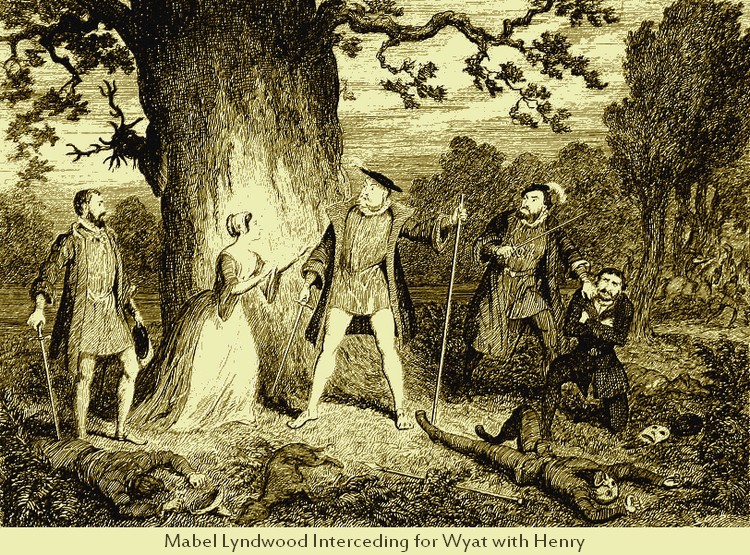
A female figure now rushed forward, and bending before the king, cried in
an imploring voice—
"Spare him, sire—spare him! He is no party to the attack. I was near
him in yon wood, and he stirred not forth till he saw your life in danger. He
then delivered you from the assassin."
"I did so because I reserved him for my own hand," said Wyat.
"You hear him confess his treason," cried Henry; "down on your knees,
villain, or I will strike you to my feet."
"He has just saved your life, my liege," cried the supplicant. "Oh, spare
him!"
"What make you here, Mabel?" cried Henry angrily. "I followed your majesty
unseen," she replied, in some confusion, "and reached yon wood just as the
attack commenced. I did not dare to advance farther."
"You should have gone home—gone home," rejoined the king. "Wyat," he
continued, in a tone of stern reproach, "you were once a loyal subject. What
means this change?"
"It means that you have robbed me of a mistress," replied Wyat; "and for
this cause I have damned myself."
"Pardon him!-oh, pardon him, sire," cried Mabel.
"I cannot understand you, Wyat," said Henry, after a pause; "but I have
myself suffered from the pangs of jealousy. You have saved my life, and I
will spare yours."
"Sire! " cried Wyat.
"Suffolk," exclaimed Henry, looking towards the duke, who was holding
Fenwolf by the throat, "shall I be justified in letting him go free?
"Strike!- strike! " cried a deep voice in Wyat's ear; "your rival is now
in your power."
"Far be it from me to thwart your majesty's generous impulses," rejoined
Suffolk. "It is true that Wyat has saved your life; and if he had been
disposed to take it, you have this moment exposed yourself to him."
"Sir Thomas Wyat," said the king, turning to him, "you have my full and
free pardon. Quit this forest instantly, and make your way to Paris. If you
are found within it to-morrow you will be lodged in the Tower."
Wyat knelt down, and would have pressed Henry's hand to his lips, but the
latter pushed him aside.
"No—no! Not now—on your return."
Thus rebuffed, Wyat strode away, and as he passed the tree he heard a
voice exclaim, " You have escaped him, but think not to escape me!"
"And now, sweetheart," said Henry, turning to Mabel, "since you are so far
on the way, you shall go with me to the castle."
"On no account, my liege," she returned; "my grandsire will wonder what
has become of me. He must already be in great alarm."
"But I will send an attendant to quiet his fears," urged Henry.
"That would only serve to increase them," she rejoined. "Nay, I must
go."
And breaking from him, she darted swiftly down the hill, and glanced
across the marsh like a moonbeam.
"Plague on it!" cried Henry, "I have again forgotten to question her about
her birth."
"Shall I despatch this knave, my liege?" cried Suffolk, pointing with his
sword to Fenwolf.
"By no means," said the king; "something may be learnt from him. Hark
thee, thou felon hound; if thou indeed servest the fiend, thou seest he
deserts thee, as he does all who put faith in him."
"I see it," replied Fenwolf, who, finding resistance vain, had folded his
hands doggedly upon his breast.
"Then confess thy evil practices," said the king.
"Give me my life, and I will," replied Fenwolf. And as he uttered the
words, he caught sight of the dark figure of Herne, stationed at the side of
the oak, with its right arm raised menacingly.
"What seest thou? "cried Henry, remarking his fixed gaze towards the tree,
and glancing in that direction.
Fenwolf made no reply.
Henry went up to the tree, and walked round it, but he could see
nothing.
"I will scour the forest to-morrow," he muttered, "and hang every knave I
find within it who cannot give a good account of himself."
"Ho! ho! ho! "laughed a voice, which seemed to proceed from the branches
of the tree. Henry looked up, but no one was visible.
"God's death—derided! " he roared. "Man or devil, thou shalt feel my
wrath."
"Ho! ho! ho!" again laughed the voice.
Stamping with rage, Henry swore a great oath, and smote the trunk of the
tree with his sword.
"Your majesty will search in vain," said Suffolk; "it is clearly the fiend
with whom you have to deal, and the aid of holy priests must be obtained to
drive him from the forest."
"Ho! ho! ho!" again laughed the voice.
A party of horsemen now appeared in view. They proved to be the royal
attendants, who had ridden forward in search of the king, and were instantly
hailed by Henry and Suffolk. They were headed by Captain Bouchier, who at a
sign from the king instantly dismounted.
"Give me your horse, Bouchier," said Henry, "and do you and half-a- dozen
of your men remain on guard at this tree till I send a troop of arquebusiers
to relieve you. When they arrive, station them near it, and let them remain
here till I return in the morning. If any one appears, make him a
prisoner."
"Your majesty's orders shall be faithfully obeyed," replied Bouchier.
Bound hand and foot, Fenwolf was thrown upon the back of a horse, and
guarded by two halberdiers, who were prepared to strike him dead on the
slightest movement. In this way he was conveyed to the castle, and placed in
the guard-chamber of the lower gate till further orders should be issued
respecting him.