Windsor Castle by William Harrison Ainsworth
BOOK III — THE HISTORY OF THE CASTLE
CHAPTER I
Comprising the First Two Epochs in the History of Windsor Castle.
Amid the gloom hovering over the early history of Windsor
Castle appear the mighty phantoms of the renowned King Arthur and his
knights, for whom it is said Merlin reared a magic fortress upon its heights,
in a great hall whereof, decorated with trophies of war and of the chase, was
placed the famous Round Table. But if the antique tale is now worn out, and
no longer part of our faith, it is pleasant at least to record it, and
surrendering ourselves for a while to the sway of fancy, to conjure up the
old enchanted castle on the hill, to people its courts with warlike and
lovely forms, its forests with fays and giants,
Windsor, or Wyndleshore, so called from the winding banks of the river
flowing past it, was the abode of the ancient Saxon monarchs; and a legend is
related by William of Malmesbury of a woodman named Wulwin, who being
stricken with blindness, and having visited eighty- seven churches and vainly
implored their tutelary saints for relief, was at last restored to sight by
the touch of Edward the Confessor, who further enhanced the boon by making
him keeper of his palace at Windsor. But though this story may be doubted, it
is certain that the pious king above mentioned granted Windsor to the abbot
and monks of Saint Peter at Westminster, "for the hope of eternal reward, the
remission of his sins, the sins of his father, mother, and all his ancestors,
and to the praise of Almighty God, as a perpetual endowment and
inheritance."
But the royal donation did not long remain in the hands of the priesthood.
Struck by the extreme beauty of the spot, "for that it seemed exceeding
profitable and commodious, because situate so near the Thames, the wood fit
for game, and many other particulars lying there, meet and necessary for
kings—yea, a place very convenient for his reception," William the
Conqueror prevailed upon Abbot Edwin to accept in exchange for it Wakendune
and Feringes, in Essex, together with three other tenements in Colchester;
and having obtained possession of the coveted hill, he forthwith began to
erect a castle upon it—occupying a space of about half a hide of land.
Around it he formed large parks, to enable him to pursue his favourite
pastime of hunting; and he enacted and enforced severe laws for the
preservation of the game.
As devoted to the chase as his father, William Rufus frequently hunted in
the forests of Windsor, and solemnised some of the festivals of the Church in
the castle.
In the succeeding reign—namely, that of Henry the First—the
castle was entirely rebuilt and greatly enlarged—assuming somewhat of
the character of a palatial residence, having before been little more than a
strong hunting-seat. The structure then erected in all probability occupied
the same site as the upper and lower wards of the present pile; but nothing
remains of it except perhaps the keep, and of that little beyond its form and
position. In 1109 Henry celebrated the feast of Pentecost with great state
and magnificence within the castle. In 1122 he there espoused his second
wife, Adelicia, daughter of Godfrey, Duke of Louvain; and failing in
obtaining issue by her, assembled the barons at Windsor, and causing them,
together with David, King of Scotland, his sister Adela, and her son Stephen,
afterwards King of England, to do homage to his daughter Maud, widow of the
Emperor Henry the Fifth.
Proof that Windsor Castle was regarded as the second fortress in the realm
is afforded by the treaty of peace between the usurper Stephen and the
Empress Maud, in which it is coupled with the Tower of London under the
designation of Mota de Windsor. At the signing of the treaty it was committed
to the custody of Richard de Lucy, who was continued in the office of keeper
by Henry the Second.
In the reign of this monarch many repairs were made in the castle, to
which a vineyard was attached—the cultivation of the grape being at
this time extensively practised throughout England. Strange as the
circumstance may now appear, Stow mentions that vines grew in abundance in
the home park in the reign. of Richard the Second, the wine made from them
being consumed at the king's table, and even sold.
It is related by Fabian that Henry, stung by the disobedience and
ingratitude of his sons, caused an allegorical picture to be painted,
representing an old eagle assailed by four young ones, which he placed in one
of the chambers of the castle. When asked the meaning of the device, be
replied, "I am the old eagle, and the four eaglets are my sons, Who cease not
to pursue my death. The youngest bird, who is tearing out its parent's eyes,
is my son John, my youngest and best- loved son, and who yet is the most
eager for my destruction."
On his departure for the holy wars Richard Coeur de Lion entrusted the
government of the castle to Hugh de Pudsey, Bishop of Durham and Earl of
Northumberland; but a fierce dispute arising between the warrior- prelate and
his ambitious colleague, William Longchamp, Bishop of Ely, he was seized and
imprisoned by the latter, and compelled to surrender the castle. After an
extraordinary display of ostentation, Longchamp was ousted in his turn. On
the arrival of the news of Richard's capture and imprisonment in Austria, the
castle was seized by Prince John; but it was soon afterwards taken possession
of in the king's behalf by the barons, and consigned to the custody of
Eleanor, the queen-dowager.
In John's reign the castle became the scene of a foul and terrible event
William de Braose, a powerful baron, having offended the king, his wife Maud
was ordered to deliver up her son a hostage for her husband. But instead of
complying with the injunction, she rashly returned for answer—"that she
would not entrust her child to the person who could slay his own nephew."
Upon which the ruthless king seized her and her son, and enclosing them in a
recess in the wall of the castle, built them up within it.
Sorely pressed by the barons in 1215, John sought refuge within the
castle, and in the same year signed the two charters, Magna Charta and Charta
de Foresta, at Runnymede— a plain between Windsor and Staines. A
curious account of his frantic demeanour, after divesting himself of so much
power and extending so greatly the liberties of the subject, is given by
Holinshed:—"Having acted so far contrary to his mind, the king was
right sorrowful in heart, cursed his mother that bare him, and the hour in
which he was born; wishing that he had received death by violence of sword or
knife instead of natural nourishment. He whetted his teeth, and did bite now
on one staff, now on another, as he walked, and oft brake the same in pieces
when he had done, and with such disordered behaviour and furious gestures he
uttered his grief, that the noblemen very well perceived the inclination of
his inward affection concerning these things before the breaking-up of the
council, and therefore sore lamented the state of the realm, guessing what
would follow of his impatience, and displeasant taking of the matter." The
faithless king made an attempt to regain his lost power, and war breaking out
afresh in the following year, a numerous army, under the command of William
de Nivernois, besieged the castle, which was stoutly defended by Inglehard de
Achie and sixty knights. The barons, however, learning that John was marching
through Norfolk and Suffolk, and ravaging the country, hastily raised the
siege and advanced to meet him. But he avoided them, marched to Stamford and
Lincoln, and from thence towards Wales. On his return from this expedition he
was seized with the distemper of which he died.
Henry the Third was an ardent encourager of architecture, and his reign
marks the second great epoch in the annals of the castle. In 1223 eight
hundred marks were paid to Engelhard de Cygony, constable of the castle, John
le Draper, and William the clerk of Windsor, masters of the works, and
others, for repairs and works within the castle;. the latter, it is
conjectured, referring to the erection of a new great hall within the lower
ward, there being already a hall of small dimensions in the upper court. The
windows of the new building were filled with painted glass, and at the upper
end, upon a raised dais, was a gilt throne sustaining a statue of the king in
his robes. Within this vast and richly decorated chamber, in 1240, on the day
of the Nativity, an infinite number of poor persons were collected and fed by
the king's command.
During the greater part of Henry's long and eventful reign the works
within the castle proceeded with unabated activity. Carpenters were
maintained on the royal establishment; the ditch between the hall and the
lower ward was repaired; a new kitchen was built; the bridges were repaired
with timber procured from the neighbouring forests; certain breaches in the
wall facing the garden were stopped; the fortifications were surveyed, and
the battlements repaired. At the same time the queen's chamber was painted
and wainscoted, and iron bars were placed before the windows of Prince
Edward's chamber. In 1240 Henry commenced building an apartment for his own
use near the wall of the castle, sixty feet long and twenty-eight high;
another apartment for the queen contiguous to it; and a chapel, seventy feet
long and twenty- eight feet wide, along the same wall, but with a grassy
space between it and the royal apartments. The chapel, as appears from an
order to Walter de Grey, Archbishop of York, had a Galilee and a cloister, a
lofty wooden roof covered with lead, and a stone turret in front holding
three or four bells. Withinside it was made to appear like stone-work with
good ceiling and painting, and it contained four gilded images.
This structure is supposed to have been in existence, under the
designation of the Old College Church, in the latter part of the reign of
Henry the Seventh, by whom it was pulled down to make way for the tomb-house.
Traces of its architecture have been discovered by diligent antiquarian
research in the south ambulatory of the Dean's Cloister, and in the door
behind the altar in St. George's Chapel, the latter of which is conceived to
have formed the principal entrance to the older structure, and has been
described as exhibiting "one of the most beautiful specimens which time and
innovation have respected of the elaborate ornamental work of the
period."
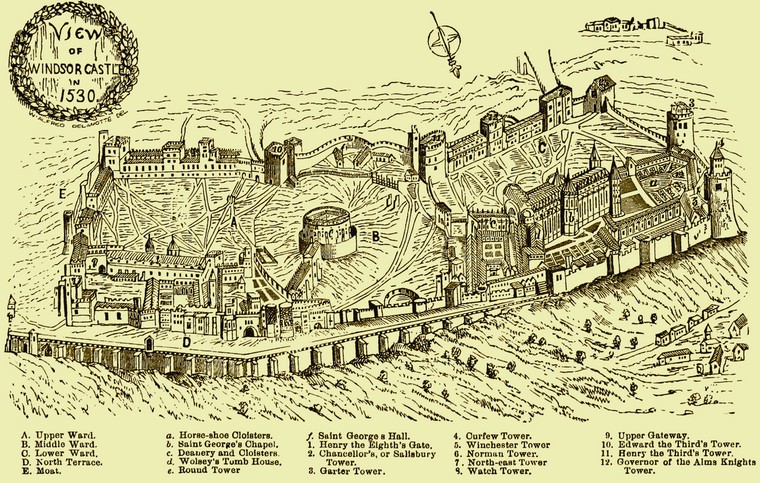
In 1241 Henry commenced operations upon the outworks of the castle, and
the three towers on the western side of the lower ward—now known as the
Curfew, the Garter, and the Salisbury Towers—were erected by him. He
also continued the walls along the south side of the lower ward, traces of
the architecture of the period being discoverable in the inner walls of the
houses of the alms-knights as far as the tower now bearing his name. From
thence it is concluded that the ramparts ran along the east side of the upper
ward to a tower occupying the site of the Wykeham or Winchester Tower.
The three towers at the west end of the lower ward, though much
dilapidated, present unquestionable features of the architecture of the
thirteenth century. The lower storey of the Curfew Tower, which has been but
little altered, consists of a large vaulted chamber, twenty-two feet wide,
with walls of nearly thirteen feet in thickness, and having arched recesses
terminated by loopholes. The walls are covered with the inscriptions of
prisoners who have been confined within it. The Garter Tower, though in a
most ruinous condition, exhibits high architectural beauty in its moulded
arches and corbelled passages. The Salisbury Tower retains only externally,
and on the side towards the town, its original aspect. The remains of a
fourth tower are discernible in the Governor of the Alms-Knights' Tower; and
Henry the Third's Tower, as before observed, completes what remains of the
original chain of fortifications.
On the 24th of November 1244 Henry issued a writ enjoining "the clerks of
the works at Windsor to work day and night to wainscot the high chamber upon
the wall of the castle near our chapel in the upper bailey, so that it may be
ready and properly wainscoted on Friday next [the 24th occurring on a
Tuesday, only two days were allowed for the task], when we come there, with
boards radiated and coloured, so that nothing be found reprehensible in that
wainscot; and also to make at each gable of the said chamber one glass
window, on the outside of the inner window of each gable, so that when the
inner window shall be closed the glass windows may be seen outside."
The following year the works were suspended, but they were afterwards
resumed and continued, with few interruptions; the keep was new constructed;
a stone bench was fixed in the wall near the grass-plot by the king's
chamber; a bridge was thrown across the ditch to the king's garden, which lay
outside the walls; a barbican was erected, to which a portcullis was
subsequently attached; the bridges were defended by strong iron chains; the
old chambers in the upper ward were renovated; a conduit and lavatory were
added; and a fountain was constructed in the garden.
In this reign, in all probability, the Norman Tower, which now forms a
gateway between the middle and the upper ward, was erected. This tower, at
present allotted to the house keeper of the castle, Lady Mary Fox, was used
as a prison-lodging during the civil wars of Charles the First's time; and
many noble and gallant captives have left mementoes of their loyalty and ill
fate upon its walls.
In 1260 Henry received a visit to Windsor from his daughter Margaret, and
her husband, Alexander the Third, King of Scotland. The queen gave birth to a
daughter during her stay at the castle.
In 1264, during the contest between Henry and the barons, the valiant
Prince Edward, his son, returning from a successful expedition into Wales,
surprised the citizens of London, and. carrying off their military chest, in
which was much treasure, retired to Windsor Castle and strongly garrisoned
it. The Queen Eleanor, his mother, would fain have joined him there, but she
was driven back by the citizens at London Bridge, and compelled to take
sanctuary in the palace of the Bishop of London, at St. Paul's.
Compelled at length to surrender the castle to the barons, and to depart
from it with his consort, Eleanor of Castile, the brave prince soon
afterwards recovered it, but was again forced to deliver it up to Simon de
Montford, Earl of Leicester, who appointed Geoffrey de Langele governor. But
though frequently wrested from him at this period, Windsor Castle was never
long out of Henry's possession; and in 1265 the chief citizens of London were
imprisoned till they had paid the heavy fine imposed upon them for their
adherence to Simon de Montford, who had been just before slain at the battle
of Evesham.
During this reign a terrific storm of wind and thunder occurred, which
tore up several great trees in the park, shook the castle, and blew down a
part of the building in which the queen and her family were lodged, but
happily without doing them injury.
Four of the children of Edward the First, who was blessed with a numerous
offspring, were born at Windsor; and as he frequently resided at the castle,
the town began to increase in importance and consideration. By a charter
granted in 1276 it was created a free borough, and various privileges were
conferred on its inhabitants. Stow tells us that in 1295, on the last day of
February, there suddenly arose such a fire in the castle of Windsor that many
offices were therewith consumed, and many goodly images, made to beautify the
buildings, defaced and deformed.
Edward the Second, and his beautiful but perfidious queen, Isabella of
France, made Windsor Castle their frequent abode; and here, on the 13th day
of November 1312 at forty minutes past five in the morning, was born a
prince, over whose nativity the wizard Merlin must have presided. Baptized
within the old chapel by the name of Edward, this prince became afterwards
the third monarch of the name, and the greatest, and was also styled, from
the place of his birth, EDWARD OF WINDSOR.