Windsor Castle by William Harrison Ainsworth
BOOK III — THE HISTORY OF THE CASTLE
CHAPTER V
The Last Great Epoch in the History of the
Castle.
A prince of consummate taste and fine conceptions, George
the Fourth meditated, and, what is better, accomplished the restoration of
the castle to more than its original grandeur. lie was singularly fortunate
in his architect. Sir Jeffry Wyatville was to him what William of Wykeham had
been to Edward the Third. All the incongruities of successive reigns were
removed: all, or nearly all, the injuries inflicted by time repaired; and
when the work so well commenced was finished, the structure took its place as
the noblest and most majestic palatial residence in existence.
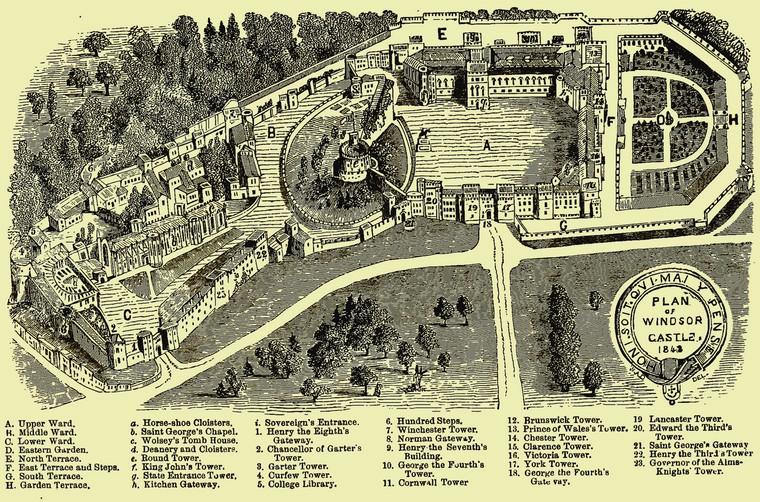
To enter into a full detail of Wyatville's achievements is beyond the
scope of the present work; but a brief survey may be taken of them. Never was
lofty design more fully realised. View the castle on the north, with its
grand terrace of nearly a thousand feet in length, and high embattled walls;
its superb facade, comprehending the stately Brunswick Tower; the Cornwall
Tower, with its gorgeous window; George the Fourth's Tower, including the
great oriel window of the state drawing-room; the restored Stuart buildings,
and those of Henry the Seventh and of Elizabeth; the renovated Norman Tower;
the Powder Tower, with the line of walls as far as the Winchester
Tower;—view this, and then turn to the east, and behold another front
of marvellous beauty extending more than four hundred feet from north to
south, and displaying the Prince of Wales's Tower, the Chester, Clarence, and
Victoria Towers—all of which have been raised above their former level,
and enriched by great projecting windows;—behold also the beautiful
sunken garden, with its fountain and orangery, its flights of steps, and
charming pentagonal terrace;—proceed to the south front, of which the
Victoria Tower, with its machicolated battlements and oriel window, forms so
superb a feature at the eastern corner, the magnificent gateway receiving its
name from George the Fourth, flanked by the York and Lancaster Towers, and
opening in a continued line from the Long Walk; look at Saint George's Gate,
Edward the Third's renovated tower, and the octagon tower beyond it; look at
all these, and if they fail to excite a due appreciation of the genius that
conceived them, gaze at the triumph of the whole, and which lords over all
the rest—the Round Tower—gaze at it, and not here alone, but from
the heights of the great park, from the vistas of the home park, from the
bowers of Eton, the meads of Clewer and Datchet, from the Brocas, the gardens
of the naval knights—from a hundred points; view it at sunrise when the
royal standard is hoisted, or at sunset when it is lowered, near or at a
distance, and it will be admitted to be the work of a prodigious
architect!
But Wyatville's alterations have not yet been fully considered. Pass
through Saint George's Gateway, and enter the grand quadrangle to which it
leads. Let your eye wander round it, beginning with the inner sides of Edward
the Third's Tower and George the Fourth's Gateway, and proceeding to the
beautiful private entrance to the sovereign's apartments, the grand range of
windows of the eastern corridor, the proud towers of the gateway to the
household, the tall pointed windows of Saint George's Hall, the state
entrance tower, with its noble windows, until it finally rests upon the
Stuart buildings and King John's Tower, at the angle of the pile.
Internally the alterations made by the architects have been of
corresponding splendour and importance. Around the south and east sides of
the court at which you are gazing, a spacious corridor has been constructed,
five hundred and fifty feet in length, and connected with the different
suites of apartments on these sides of the quadrangle; extensive alterations
have been made in the domestic offices; the state apartments have been
repaired and rearranged; Saint George's Hall has been enlarged by the
addition of the private chapel (the only questionable change), and restored
to the Gothic style; and the Waterloo Chamber built to contain George the
Fourth's munificent gift to the nation of the splendid collection of
portraits now occupying it.
"The first and most remarkable characteristic of operations of Sir Jeffry
Wyatville on the exterior," observes Mr. Poynter, "is the judgment with which
he has preserved the castle of Edward the Third. Some additions have been
made to it, and with striking effect—as the Brunswick Tower, and the
western tower of George the Fourth's Gate-way which so nobly terminates the
approach from the great park. The more modern buildings on the north side
have also been assimilated to the rest; but the architect has yielded to no
temptation to substitute his own design for that of William of Wykeham, and
no small difficulties have been combated and overcome for the sake of
preserving the outline of the edifice, and maintaining the towers in their
original position."
The Winchester Tower, originally inhabited by William of Wykeham, was
bestowed upon Sir Jeffry Wyatville as a residence by George the Fourth; and,
on the resignation of the distinguished architect, was continued to him for
life by the present queen.
The works within the castle were continued during the reign of William the
Fourth, and at its close the actual cost of the buildings had reached the sum
of 771,000, pounds and it has been asserted that the general expenditure up
to the present time has exceeded a million and a half of money.
The view from the summit of the Round Tower is beyond description
magnificent, and commands twelve counties—namely, Middlesex, Essex,
Hertford, Berks, Bucks, Oxford, Wilts, Hants, Surrey, Sussex, Kent, and
Bedford; while on a clear day the dome of Saint Paul's may be distinguished
from it. This tower was raised thirty-three feet by Sir Jeffry Wyatville,
crowned with a machicolated battlement, and surmounted with a flag-tower.
The circumference of the castle is 4180 feet; the length from east to
west, 1480 feet; and the area, exclusive of the terraces, about twelve
acres.
For the present the works are suspended. But it is to be hoped that the
design of Sir Jeffry Wyatville will be fully carried out in the lower ward,
by the removal of such houses on the north as would lay Saint George's Chapel
open to view from this side; by the demolition of the old incongruous
buildings lying westward of the bastion near the Hundred Steps, by the
opening out of the pointed roof of the library; the repair and reconstruction
in their original style of the Curfew, the Garter, and the Salisbury Towers;
and the erection of a lower terrace extending outside the castle, from the
bastion above mentioned to the point of termination of the improvements, and
accessible from the town; the construction of which terrace would necessitate
the removal of the disfiguring and encroaching houses on the east side of
Thames Street. This accomplished, Crane's ugly buildings removed, and the
three western towers laid open to the court, the Horse-shoe Cloisters
consistently repaired, Windsor Castle would indeed be complete. And fervently
do we hope that this desirable event may be identified with the reign of
Victoria.