Windsor Castle by William Harrison Ainsworth
BOOK V — MABEL LYNDWOOD
CHAPTER VII
How the Train was fired, and what followed the Explosion.
About ten o'clock in the night under consideration, Surrey
and Richmond, accompanied by the Duke of Shoreditch, and half a dozen other
archers, set out from the castle, and took their way along the great park, in
the direction of the lake.
They had not ridden far, when they were overtaken by two horsemen who, as
far as they could be discerned in that doubtful light, appeared stalwart
personages, and well mounted, though plainly attired. The new-comers very
unceremoniously joined them.
"There are ill reports of the park, my masters," said the foremost of
these persons to Surrey, " and we would willingly ride with you across
it"
"But our way may not be yours, friend," replied Surrey, who did not
altogether relish this proposal. "We are not going farther than the
lake."
"Our road lies in that direction," replied the other, " and, if you
please, we will bear you company as far as we go. Come, tell me frankly," he
added, after a pause," are you not in search of Herne the Hunter?"
"Why do you ask, friend?" rejoined the earl somewhat angrily.
"Because if so," replied the other, "I shall be right glad to join you,
and so will my friend, Tony Cryspyn, who is close behind me. I have an old
grudge to settle with this Herne, who has more than once attacked me, and I
shall be glad to pay it."
"If you will take my advice, Hugh Dacre, you will ride on, and leave the
achievement of the adventure to these young galliards," interposed
Cryspyn.
"Nay, by the mass! that shall never be," rejoined Dacre, "if they have no
objection to our joining them. If they have, they have only to say so, and we
will go on."
"I will be plain with you, my masters," said Surrey. "We are determined
this night, as you have rightly conjectured, to seek out Herne the Hunter;
and we hope to obtain such clue to him as will ensure his capture. If,
therefore, you are anxious to join us, we shall be glad of your aid. But you
must be content to follow, and not lead—and to act as you are
directed—or you will only be in the way, and we would rather dispense
with your company."
"We are content with the terms—are we not, Tony?" said Dacre.
His companion answered somewhat sullenly in the affirmative.
"And now that the matter is arranged, may I ask when you propose to go?
"he continued.
"We are on our way to a hut on the lake, where we expect a companion to
join us," replied Surrey.
"What! Tristram Lyndwood's cottage?" demanded Dacre.
"Ay," replied the earl, "and we hope to recover his fair granddaughter
from the power of the demon."
"Ha! say you so?" cried Dacre; "that were a feat, indeed!"
The two strangers then rode apart for a few moments, and conversed
together in a low tone, during which Richmond expressed his doubts of them to
Surrey, adding that he was determined to get rid of them.
The new-comers, however, were not easily shaken off. As soon as they
perceived the duke's design, they stuck more pertinaciously to him and the
earl than before, and made it evident they would not be dismissed.
By this time they had passed Spring Hill, and were within a mile of the
valley in which lay the marsh, when a cry for help was heard in the thicket
on the left, and the troop immediately halted. The cry was repeated, and
Surrey, bidding the others follow him, dashed off in the direction of the
sound.
Presently, they perceived two figures beneath the trees, whom they found,
on a nearer approach, were Sir Thomas Wyat, with Mabel in a state of
insensibility in his arms.
Dismounting by the side of his friend, Surrey hastily demanded how he came
there, and what had happened?
"It is too long a story to relate now," said Wyat; "but the sum of it is,
that I have escaped, by the aid of this damsel, from the clutches of the
demon. Our escape was effected on horseback, and we had to plunge into the
lake. The immersion deprived my fair preserver of sensibility, so that as
soon as I landed, and gained a covert where I fancied myself secure, I
dismounted, and tried to restore her. While I was thus occupied, the steed I
had brought with me broke his bridle, and darted off into the woods. After a
while, Mabel opened her eyes, but she was so weak that she could not move,
and I was fain to make her a couch in the fern, in the hope that she would
speedily revive. But the fright and suffering had been too much for her, and
a succession of fainting-fits followed, during which I thought she would
expire. This is all. Now, let us prepare a litter for her, and convey her
where proper assistance can be rendered."
Meanwhile, the others had come up, and Hugh Dacre, flinging himself from
his horse, and pushing Surrey somewhat rudely aside, advanced towards Mabel,
and, taking her hand, said, in a voice of some emotion, "Alas! poor girl! I
did not expect to meet thee again in this state."
"You knew her, then?" said Surrey.
Dacre muttered an affirmative.
"Who is this man? "asked Wyat of the earl.
"I know him not," answered Surrey. "He joined us on the road hither."
"I am well known to Sir Thomas Wyat," replied Dacre, in a significant
tone, "as he will avouch when I recall certain matters to his mind. But do
not let us lose time here. This damsel claims our first attention. She must
be conveyed to a place of safety, and where she can be well tended. We can
then return to search for Herne."
Upon this, a litter of branches were speedily made, and Mabel being laid
upon it, the simple conveyance was sustained by four of the archers. The
little cavalcade then quitted the thicket, and began to retrace its course
towards the castle. Wyat had been accommodated with a horse by one of the
archers, and rode in a melancholy manner by the side of the litter.
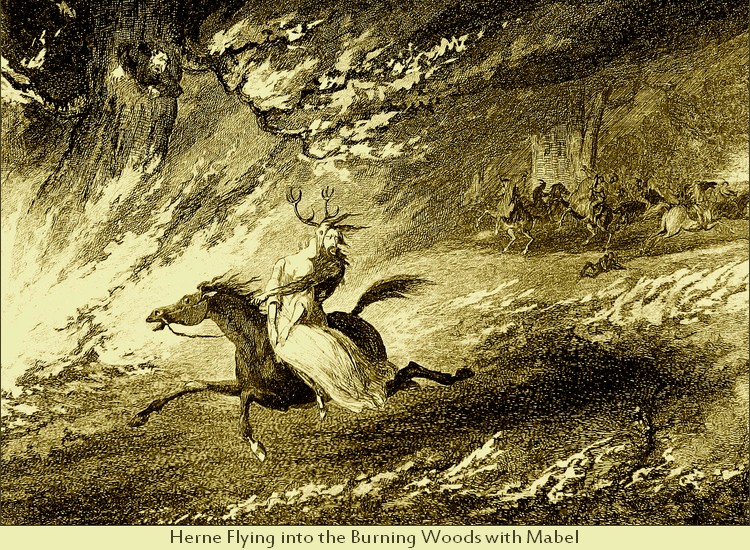
They had got back nearly as far as the brow of Spring Hill, when a
horseman, in a wild garb, and mounted on a coal black steed, lashed suddenly
and at a furious pace, out of the trees on the right. He made towards the
litter, over-turning Sir Thomas Wyat, and before any opposition could be
offered him, seized the inanimate form of Mabel, and placing her before him
on his steed, dashed off as swiftly as he came, and with a burst of loud,
exulting laughter.
"It is Herne! it is Herne!" burst from every lip. And they all started in
pursuit, urging the horses to their utmost speed. Sir Thomas Wyat had
instantly remounted his steed, and he came up with the others.
Herne's triumphant and demoniacal laugh was heard as he scoured with the
swiftness of the wind down the long glade. But the fiercest determination
animated his pursuers, who, being all admirably mounted, managed to keep him
fully in view.
Away! away! he speeded in the direction of the lake; and after him they
thundered, straining every sinew in the desperate chase. It was a wild and
extraordinary sight, and partook of the fantastical character of a dream.
At length Herne reached the acclivity, at the foot of which lay the waters
of the lake glimmering in the starlight; and by the time he had descended to
its foot, his pursuers had gained its brow.
The exertions made by Sir Thomas Wyat had brought him a little in advance
of the others. Furiously goading his horse, he dashed down the hillside at a
terrific pace.
All at once, as he kept his eye on the flying figure of the demon, he was
startled by a sudden burst of flame in the valley. A wide circle of light was
rapidly described, a rumbling sound was heard like that preceding an
earth-quake, and a tremendous explosion followed, hurling trees and fragments
of rock into the air.
Astounded at the extraordinary occurrence, and not knowing what might
ensue, the pursuers reined in their steeds. But the terror of the scene was
not yet over. The whole of the brushwood had caught fire, and blazed up with
the fury and swiftness of lighted flax. The flames caught the parched
branches of the trees, and in a few seconds the whole grove was on fire.
The sight was awfully grand, for the wind, which was blowing strongly,
swept the flames forward, so that they devoured all before them.
When the first flash was seen the demon had checked his steed and backed
him, so that he had escaped without injury, and he stood at the edge of the
flaming circle watching the progress of the devastating element; but at last,
finding that his pursuers had taken heart and were approaching him, he
bestirred himself, and rode round the blazing zone.
Having by this time recovered from their surprise, Wyat and Surrey dashed
after him, and got so near him that they made sure of his capture. But at the
very moment they expected to reach him, he turned his horse's head, and
forced him to leap over the blazing boundary.
In vain the pursuers attempted to follow. Their horses refused to
encounter the flames; while Wyat's steed, urged on by its frantic master,
reared bolt upright, and dislodged him.
But the demon held on his way, apparently unscathed in the midst of the
flames, casting a look of grim defiance at his pursuers. As he passed a tree,
from which volumes of fire were bursting, the most appalling shrieks reached
his ear, and he beheld Morgan Fenwolf emerging from a hole in the trunk. But
without bestowing more than a glance upon his unfortunate follower, he dashed
forward, and becoming involved in the wreaths of flame and smoke, was lost to
sight.
Attracted by Fenwolf's cries, the beholders perceived him crawl out of the
hole, and clamber into the upper part of the tree, where he roared to them
most piteously for aid. But even if they had been disposed to render it, it
was impossible to do so now; and after terrible and protracted suffering, the
poor wretch, half stifled with smoke, and unable longer to maintain his hold
of the branch to which he crept, fell into the flames beneath, and
perished.
Attributing its outbreak to supernatural agency, the party gazed on in
wonder at the fire, and rode round it as closely as their steeds would allow
them. But though they tarried till the flames had abated, and little was left
of the noble grove but a collection of charred and smoking stumps, nothing
was seen of the fiend or of the hapless girl he had carried off. It served to
confirm the notion of the supernatural origin of the fire, in that it was
confined within the mystic circle, and did not extend farther into the
woods.
At the time that the flames first burst forth, and revealed the
countenances of the lookers—on, it was discovered that the self-styled
Dacre and Cryspyn were no other than the king and the Duke of Suffolk.
"If this mysterious being is mortal, he must have perished now," observed
Henry; "and if he is not, it is useless to seek for him further."
Day had begun to break as the party quitted the scene of devastation. The
king and Suffolk, with the archers, returned to the castle; but Wyat, Surrey,
and Richmond rode towards the lake, and proceeded along its banks in the
direction of the forester's hut.
Their progress was suddenly arrested by the sound of lamentation, and they
perceived, in a little bay overhung by trees, which screened it from the
path, an old man kneeling beside the body of a female, which he had partly
dragged out of the lake. It was Tristram Lyndwood, and the body was that of
Mabel. Her tresses were dishevelled, and dripping with wet, as were her
garments; and her features white as marble. The old man was weeping
bitterly.
With Wyat, to dismount and grasp the cold hand of the hapless maiden was
the work of a moment.
"She is dead!" he cried, in a despairing voice, removing the dank tresses
from her brow, and imprinting a reverent kiss upon it. "Dead!— lost to
me for ever!"
"I found her entangled among those water-weeds," said Tristram, in tones
broken by emotion," and had just dragged her to shore when you came up. As
you hope to prosper, now and hereafter, give her a decent burial. For me all
is over."
And, with a lamentable cry, he plunged into the lake, struck out to a
short distance, and then sank to rise no more.