Windsor Castle by William Harrison Ainsworth
BOOK VI — JANE SEYMOUR
CHAPTER V
What happened at the Jousts.
The first of May arrived; and though destined to set in
darkness and despair, it arose in sunshine and smiles.
All were astir at an early hour within the castle, and preparations were
made for the approaching show. Lists were erected in the upper quadrangle,
and the whole of the vast area was strewn with sand. In front of the royal
lodgings was raised a gallery, the centre of which, being set apart for the
queen and her dames, was covered with cloth of gold and crimson velvet, on
which the royal arms were gorgeously emblazoned. The two wings were likewise
richly decorated, and adorned with scutcheons and pennons, while from the
battlements of the eastern side of the court were hung a couple of long
flags.
As soon as these preparations were completed, a throng of pages, esquires,
armourers, archers, and henchmen, entered it from the Norman gateway, and
took up positions within the barriers, the space without the pales being kept
by a double line of halberdiers. Next came the trumpeters, mounted on richly
caparisoned horses, and having their clarions decorated with silken bandrols,
fringed with gold. Stationing themselves at the principal entrance of the
lists, they were speedily joined by the heralds, pursuivants, and other
officers of the tilt-yard.
Presently afterwards, the Duke of Suffolk, who was appointed judge of the
lists, appeared, and rode round the arena to see that all was in order.
Apparently well satisfied with the survey, he dismounted, and proceeded to
the gallery.
Meanwhile, the crowd within the court was increased by a great influx of
the different members of the household, amongst whom were Shoreditch,
Paddington, and Hector Cutbeard.
"Marry, this promises to be a splendid sight!" said the clerk of the
kitchen; "the king will, no doubt, do his devoir gallantly for the sake of
the bright eyes that will look upon him."
"You mean the queen's, of course? "said Shoreditch.
"I mean hers who may be queen," replied Cutbeard; "Mistress Jane
Seymour."
"May be queen!" exclaimed Shoreditch. "You surely do not think the king
will divorce his present consort?"
"Stranger things have happened," replied Cutbeard significantly. "If I am
not greatly out of my reckoning," he added, " these are the last jousts Queen
Anne will behold."
"The saints forefend!" cried Shoreditch; "what reason have you for
thinking so?"
"That I may not declare," replied Cutbeard; "but before the jousts are
over you will see whether I have been rightly informed or not."
"Hush!" exclaimed Shoreditch."There is a tall monk eyeing us strangely;
and I am not certain that he has not overheard what you have said."
"He is welcome to the intelligence," replied Cutbeard; "the end will prove
its truth."
Though this was uttered in a confident tone, he nevertheless glanced with
some misgiving at the monk, who stood behind Paddington. The object of the
investigation was a very tall man, with a cowl drawn over his brow. He had a
ragged black beard, fierce dark eyes, and a complexion like bronze. Seeing
Cutboard's glance anxiously fixed upon him, he advanced towards him, and said
in a low tone -
"You have nothing to fear from me; but talk not so loud if you value your
head."
"So saying he proceeded to another part of the lists.
"Who is that tall monk?" asked Paddington.
"Devil knows!" answered Cutbeard; "I never saw him before. But he has a
villainous cut-throat look."
Soon afterwards a flourish of trumpets was heard, and amid their joyous
bruit the queen, sumptuously arrayed in cloth of gold and ermine, and having
a small crown upon her brow, entered the gallery, and took her seat within
it. Never had she looked more beautiful than on this fatal morning, and in
the eyes of all the beholders she completely eclipsed her rival, Jane
Seymour. The latter, who stood on her right hard, and was exquisitely
attired, had a thoughtful and anxious air, as if some grave matter weighed
upon her
While the queen's attendants were taking their places, Lord Rochford,
accompanied by Sir Henry Norris and the Earls of Surrey and Essex, entered
the lists. The four knights were completely armed, and mounted on powerful
steeds barded with rich cloth of gold, embroidered with silver letters. Each
had a great crimson plume in his helmet. They rode singly round the arena,
and bowed as they passed the royal gallery, Norris bending almost to his
saddle-bow while performing his salutation to the queen.
The field being thus taken by the challengers, who retired to the upper
end of the court, a trumpet was thrice sounded by a herald, and an answer was
immediately made by another herald stationed opposite Henry the Seventh's
buildings. When the clamour ceased, the king fully armed, and followed by the
Marquis of Dorset, Sir Thomas Wyat, and the Lord Clifford, rode into the
lists.
Henry was equipped in a superb suit of armour, inlaid with gold, and
having a breastplate of the globose form, then in vogue; his helmet was
decorated with a large snow-white plume. The trappings of his steed were of
crimson velvet, embroidered with the royal arms, and edged with great letters
of massive gold bullion, full of pearls and precious stones. He was attended
by a hundred gentlemen, armourers, and other officers, arrayed in white
velvet.
Having ridden round the court like the others, and addressed his
salutation exclusively to Jane Seymour, Henry took his station with his
companions near the base of the Round Tower, the summit of which was covered
with spectators, as were the towers and battlements around.
A trumpet was now sounded, and the king and the Lord Rochford having each
taken a lance from his esquire, awaited the signal to start from the Duke of
Suffolk, who was seated in the left wing of the royal gallery. It was not
long delayed. As the clarion sounded clearly and loudly for the third time,
he called out that the champions might go.
No sooner were the words uttered, than the thundering tramp of the steeds
resounded, and the opponents met midway. Both their lances were shivered; but
as the king did not, in the slightest degree, change his position, he was
held to have the best of it. Courses were then run by the others, with varied
success, the Marquis of Dorset being unhorsed by Sir Henry Norris, whose
prowess was rewarded by the plaudits of the assemblage, and what was
infinitely more dear to him, by the smiles of the queen.
"You have ridden well, Norris," cried Henry, advancing towards him. "Place
yourself opposite me, and let us splinter a lance together."
As Norris reined back his steed, in compliance with the injunction, the
tall monk stepped from out the line, and drawing near him, said, "If you wish
to prove victorious, aim at the upper part of the king's helmet." And with
these words he withdrew.
By the time Norris had placed his lance in the rest, the trumpet sounded.
The next moment the word was given, and the champions started. Henry rode
with great impetuosity, and struck Norris in the gorget with such good will
that both he and his steed were shaken.
But Norris was more fortunate. Following the advice of the monk, he made
the upper part of the king's helmet his mark, and the blow was so well dealt,
that, though he did not dislodge the royal horseman, it drove back his steed
on its haunches.
The success was so unequivocal that Norris was at once declared the victor
by the judge. No applause, however, followed the decision, from a fear of
giving offence to the king.
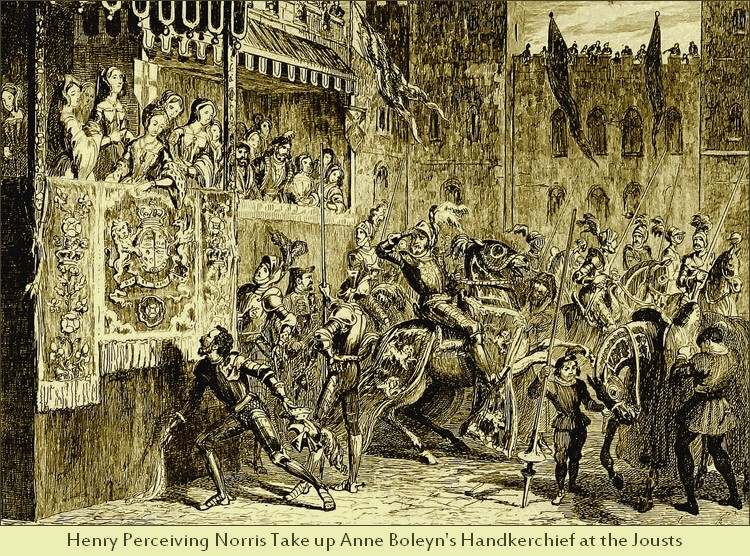
Norris dismounted, and committing his steed to the care of an esquire, and
his lance to a page, took off his helmet and advanced towards the royal
gallery, near which the Earl of Surrey and Sir Thomas Wyat were standing
talking with the other dames. As Norris drew near, Anne leaned over the edge
of the gallery, and smiled at him tenderly, and, whether by design or
accident, let fall her embroidered handkerchief.
Norris stooped to pick it up, regarding her as he did so with a glance of
the most passionate devotion. A terrible gaze, however, was fixed on the
unfortunate pair at that moment. It was that of the king. While Henry was
careering in front of the gallery to display himself before Jane Seymour, a
tall monk approached him, and said, "Look at Sir Henry Norris!"
Thus addressed, Henry raised his beaver, that he might see more
distinctly, and beheld Norris take up the embroidered handkerchief, which he
recognised as one that he had given, in the early days of his affection, to
the queen.
The sight stung him almost to madness, and he had great difficulty in
repressing his choler. But if this slight action, heightened to importance,
as it was, by the looks of the parties, roused his ire, it was nothing to
what followed. Instead of restoring it to the queen, Norris, unconscious of
the danger in which he stood, pressed the handkerchief fervently to his
lips.
"I am hitherto the victor of the jousts," he said; "may I keep this as the
prize?"
Anne smiled assent.
"It is the proudest I ever obtained," pursued Norris. And he placed it
within his helmet.
Does your majesty see that?" cried the tall monk, who still remained
standing near the king
"Death of my life!" exclaimed Henry, "it is the very handkerchief I gave
her before our union! I can contain myself no longer, and must perforce
precipitate matters. What ho!" he cried, riding up to that part of the
gallery where the Duke of Suffolk was seated -" let the jousts be
stopped!"
"Wherefore, my dear liege?" said Suffolk. "The Earl of Surrey and Sir
Thomas Wyat are about to run a course."
"Let them he stopped I say!" roared Henry, in a tone that admitted of no
dispute. And wheeling round his charger, he dashed into the middle of the
barriers, shouting in loud, authoritative accents, "The jousts are at an end!
Disperse!"
The utmost consternation was occasioned by the announcement. The Duke of
Suffolk instantly quitted his seat, and pressed through the crowd to the
king, who whispered a few hasty words in his ear. Henry then called to the
Earl of Surrey, the Marquis of Dorset, the Lord Clifford, Wyat, and some
others, and bidding them attend him, prepared to quit the court. As he passed
the royal gallery, Anne called to him in an agonised voice- "Oh, Henry! what
is the matter?—what have I done?"
But without paying the slightest attention to her, he dashed through the
Norman Gate, galloped down the lower quadrangle, and quitted the castle.
The confusion that ensued may be imagined. All saw that something
extraordinary and terrible had taken place, though few knew precisely what it
was. Dismay sat in every countenance, and the general anxiety was heightened
by the agitation of the queen, who, uttering a piercing scream, fell back,
and was borne off in a state of insensibility by her attendants.
Unable to control himself at the sight, Norris burst through the guard,
and rushing up the great staircase, soon gained the apartment to which the
queen had been conveyed. Owing to the timely aid afforded her, she was
speedily restored, and the first person her eyes fell upon was her lover. At
the sight of him a glance of affection illumined her features, but it was
instantly changed into an expression of alarm.
At this juncture the Duke of Suffolk, who, with Bouchier and a party of
halberdiers, had entered the room, stepped up to the queen, and said- "Will
it please you, madam, to retire to an inner apartment? I grieve to say you
are under arrest."
"Arrest!" exclaimed Anne; " for what crime, your grace?"
"You are charged with incontinency towards the king's highness," replied
Suffolk sternly.
"But I am innocent!" cried Anne -" as Heaven shall judge me, I am
innocent!"
"I trust you will be able to prove yourself so, madam," said Suffolk. "Sir
Henry Norris, your person is likewise attached."
"Then I am lost indeed!" exclaimed Anne distractedly.
Do not let these false and malignant accusations alarm you, madam," said
Norri. "You have nothing to fear. I will die protesting your innocence."
"Sir Henry Norris," said the duke coldly, "your own imprudence has brought
about this sad result."
"I feel it," replied Norris; "and I deserve the worst punishment that can
be inflicted upon me for it. But I declare to you as I will declare upon the
rack, if I am placed upon it—that the queen is wholly innocent. Let her
not suffer for my fault."
"You hear what Sir Henry says," cried Anne; "and I call upon you to
recollect the testimony he has borne."
"I shall not fail to do so, madam," replied Suffolk. "Your majesty will
have strict justice."
"Justice! "echoed Anne, with a laugh of bitter incredulity. "Justice from
Henry the Eighth?"
"Beseech you, madam, do not destroy yourself," said Norris, prostrating
himself before her. "Recollect by whom you are surrounded. My folly and
madness have brought you into this strait, and I sincerely implore your
pardon for it."
"You are not to blame, Norris," said Anne; "it is fate, not you, that has
destroyed me. The hand that has dealt this blow is that of a queen within the
tomb."
"Captain Bouchier," said the Duke of Suffolk, addressing that officer, who
stood near him," you will convey Sir Henry Norris to the strong- room in the
lower gateway, whence he will be removed to the Tower."
"Farewell for ever, Norris!" cried Anne. "We shall meet no more on earth.
In what has fallen on me I recognise the hand of retribution. But the same
measure which has been meted to me shall be dealt to others. I denounce Jane
Seymour before Heaven! She shall not long retain the crown she is about to
snatch from me!"
"That imprecation had better have been spared, madam," said the duke.
"Be advised, my gracious mistress," cried Norris, "and do not let your
grief and distraction place you in the power of your enemies. All may yet go
well."
"I denounce her!" persisted Anne, wholly disregarding the caution; "and I
also denounce the king. No union of his shall be happy, and other blood than
mine shall flow.
At a sign from the duke she was here borne, half suffocated with emotion,
to an inner apartment, while Norris was conveyed by Bouchier and a company of
halberdiers to the lower gateway, and placed within the prison chamber.