n the 22d of September I was asked
by the World if I could have myself
committed to one of the asylums for
the insane in New York, with a view
to writing a plain and unvarnished
narrative of the treatment of the patients
therein and the methods of
management, etc. Did I think I
had the courage to go through such
an ordeal as the mission would demand?
Could I assume the characteristics
of insanity to such a degree that I could pass
the doctors, live for a week among the insane without
the authorities there finding out that I was only a “chiel
amang ’em takin’ notes?” I said I believed I could. I
had some faith in my own ability as an actress and
thought I could assume insanity long enough to accomplish
any mission intrusted to me. Could I pass a week
in the insane ward at Blackwell’s Island? I said I could
and I would. And I did.
My instructions were simply to go on with my work as
soon as I felt that I was ready. I was to chronicle faithfully
the experiences I underwent, and when once within
the walls of the asylum to find out and describe its inside
6workings, which are always so effectually hidden by white-capped
nurses, as well as by bolts and bars, from the
knowledge of the public. “We do not ask you to go
there for the purpose of making sensational revelations.
Write up things as you find them, good or bad; give praise
or blame as you think best, and the truth all the time.
But I am afraid of that chronic smile of yours,” said the
editor. “I will smile no more,” I said, and I went away
to execute my delicate and, as I found out, difficult mission.
If I did get into the asylum, which I hardly hoped to
do, I had no idea that my experiences would contain
aught else than a simple tale of life in an asylum. That
such an institution could be mismanaged, and that cruelties
could exist ’neath its roof, I did not deem possible. I
always had a desire to know asylum life more thoroughly—a
desire to be convinced that the most helpless of God’s
creatures, the insane, were cared for kindly and properly.
The many stories I had read of abuses in such institutions
I had regarded as wildly exaggerated or else romances,
yet there was a latent desire to know positively.
I shuddered to think how completely the insane were
in the power of their keepers, and how one could weep
and plead for release, and all of no avail, if the keepers
were so minded. Eagerly I accepted the mission to learn
the inside workings of the Blackwell Island Insane
Asylum.
“How will you get me out,” I asked my editor, “after
I once get in?”
“I do not know,” he replied, “but we will get you out if
we have to tell who you are, and for what purpose you
feigned insanity—only get in.”
I had little belief in my ability to deceive the insanity
experts, and I think my editor had less.
All the preliminary preparations for my ordeal were left
to be planned by myself. Only one thing was decided
7upon, namely, that I should pass under the pseudonym
of Nellie Brown, the initials of which would agree with
my own name and my linen, so that there would be no
difficulty in keeping track of my movements and assisting
me out of any difficulties or dangers I might get
into. There were ways of getting into the insane ward,
but I did not know them. I might adopt one of two
courses. Either I could feign insanity at the house of
friends, and get myself committed on the decision of
two competent physicians, or I could go to my goal by
way of the police courts.
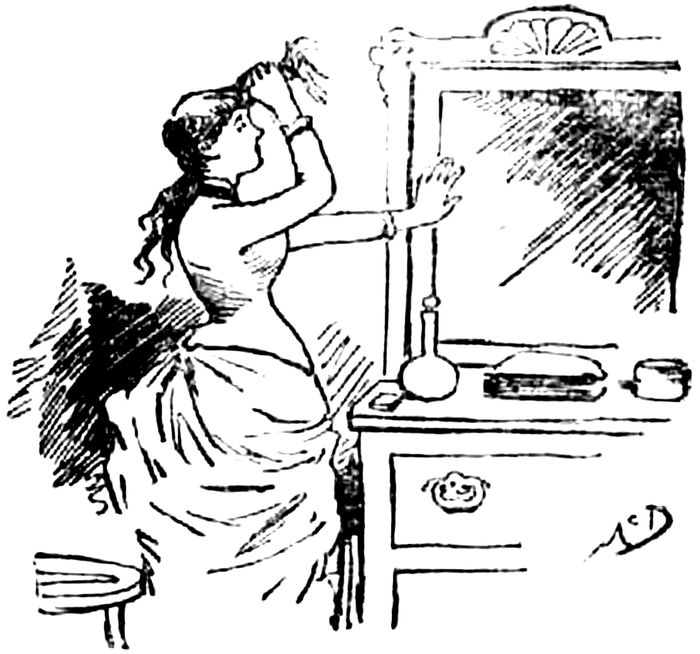
NELLIE PRACTICES INSANITY AT HOME.
On reflection I thought it wiser not to inflict myself
upon my friends or to get any good-natured doctors to
assist me in my purpose. Besides, to get to Blackwell’s
Island my friends would have had to feign poverty, and,
unfortunately for the end I had in view, my acquaintance
with the struggling poor, except my own self, was
only very superficial. So I determined upon the plan
which led me to the successful accomplishment of my
mission. I succeeded in getting committed to the insane
ward at Blackwell’s Island, where I spent ten days
8and nights and had an experience which I shall never
forget. I took upon myself to enact the part of a poor,
unfortunate crazy girl, and felt it my duty not to shirk
any of the disagreeable results that should follow. I became
one of the city’s insane wards for that length of
time, experienced much, and saw and heard more of the
treatment accorded to this helpless class of our population,
and when I had seen and heard enough, my release
was promptly secured. I left the insane ward with pleasure
and regret—pleasure that I was once more able to
enjoy the free breath of heaven; regret that I could not
have brought with me some of the unfortunate women
who lived and suffered with me, and who, I am convinced,
are just as sane as I was and am now myself.
But here let me say one thing: From the moment I entered
the insane ward on the Island, I made no attempt
to keep up the assumed role of insanity. I talked and
acted just as I do in ordinary life. Yet strange to say,
the more sanely I talked and acted the crazier I was
thought to be by all except one physician, whose kindness
and gentle ways I shall not soon forget.