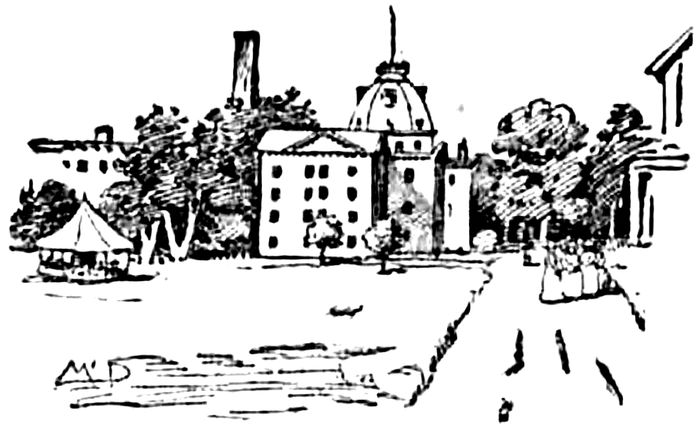
s the wagon was rapidly driven through
the beautiful lawns up to the asylum my
feelings of satisfaction at having attained
the object of my work were greatly dampened
by the look of distress on the faces
of my companions. Poor women, they
had no hopes of a speedy delivery. They
were being driven to a prison, through
no fault of their own, in all probability
for life. In comparison, how much
easier it would be to walk to the gallows
than to this tomb of living horrors! On the wagon sped,
and I, as well as my comrades, gave a despairing farewell
glance at freedom as we came in sight of the long stone
buildings. We passed one low building, and the stench
was so horrible that I was compelled to hold my breath,
and I mentally decided that it was the kitchen. I afterward
found I was correct in my surmise, and smiled at
the signboard at the end of the walk: “Visitors are not
allowed on this road.” I don’t think the sign would be
50necessary if they once tried the road, especially on a warm
day.
The wagon stopped, and the nurse and officer in charge
told us to get out. The nurse added: “Thank God!
they came quietly.” We obeyed orders to go ahead up a
flight of narrow, stone steps, which had evidently been
built for the accommodation of people who climb stairs
three at a time. I wondered if my companions knew
where we were, so I said to Miss Tillie Mayard:
“Where are we?”
“At the Blackwell’s Island Lunatic Asylum,” she answered,
sadly.
“Are you crazy?” I asked.
“No,” she replied; “but as we have been sent here
we will have to be quiet until we find some means of escape.
They will be few, though, if all the doctors, as
Dr. Field, refuse to listen to me or give me a chance to
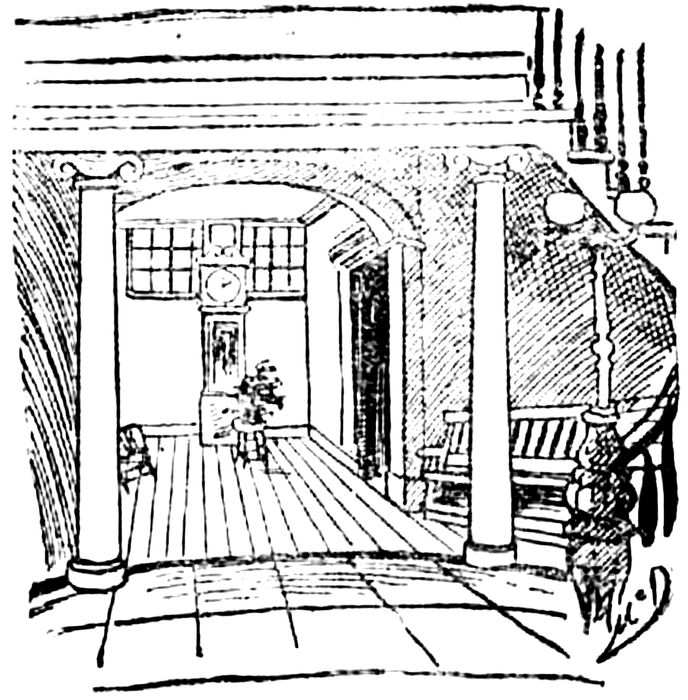
prove my sanity.” We were ushered into a narrow vestibule,
and the door was locked behind us.
In spite of the knowledge of my sanity and the assurance
that I would be released in a few days, my heart gave
a sharp twinge. Pronounced insane by four expert doctors
and shut up behind the unmerciful bolts and bars of
a mad-house! Not to be confined alone, but to be a companion,
day and night, of senseless, chattering lunatics;
to sleep with them, to eat with them, to be considered one
of them, was an uncomfortable position. Timidly we
followed the nurse up the long uncarpeted hall to a room
filled by so-called crazy women. We were told to sit
down, and some of the patients kindly made room for us.
They looked at us curiously, and one came up to me and
asked:
“Who sent you here?”
“The doctors,” I answered.
“What for?” she persisted.
“Well, they say I am insane,” I admitted.
51“Insane!” she repeated, incredulously. “It cannot
be seen in your face.”
This woman was too clever, I concluded, and was glad
to answer the roughly given orders to follow the nurse to
see the doctor. This nurse, Miss Grupe, by the way,
had a nice German face, and if I had not detected certain
hard lines about the mouth I might have expected,
as did my companions, to receive but kindness from her.
She left us in a small waiting-room at the end of the hall,
and left us alone while she went into a small office opening
into the sitting or receiving-room.
“I like to go down in the wagon,” she said to the invisible
party on the inside. “It helps to break up the
day.” He answered her that the open air improved her
looks, and she again appeared before us all smiles and
simpers.
“Come here, Tillie Mayard,” she said. Miss Mayard
obeyed, and, though I could not see into the office, I
could hear her gently but firmly pleading her case. All
her remarks were as rational as any I ever heard, and I
thought no good physician could help but be impressed
with her story. She told of her recent illness, that she
was suffering from nervous debility. She begged that
they try all their tests for insanity, if they had any, and
give her justice. Poor girl, how my heart ached for her!
52I determined then and there that I would try by every
means to make my mission of benefit to my suffering sisters;
that I would show how they are committed without
ample trial. Without one word of sympathy or encouragement
she was brought back to where we sat.
Mrs. Louise Schanz was taken into the presence of Dr.
Kinier, the medical man.
“Your name?” he asked, loudly. She answered in
German, saying she did not speak English nor could she
understand it. However, when he said Mrs. Louise
Schanz, she said “Yah, yah.” Then he tried other
questions, and when he found she could not understand
one word of English, he said to Miss Grupe:
“You are German; speak to her for me.”
Miss Grupe proved to be one of those people who are
ashamed of their nationality, and she refused, saying she
could understand but few words of her mother tongue.
“You know you speak German. Ask this woman
what her husband does,” and they both laughed as if
they were enjoying a joke.
“I can’t speak but a few words,” she protested, but at
last she managed to ascertain the occupation of Mr.
Schanz.
“Now, what was the use of lying to me?” asked the
doctor, with a laugh which dispelled the rudeness.
“I can’t speak any more,” she said, and she did not.
Thus was Mrs. Louise Schanz consigned to the asylum
without a chance of making herself understood. Can
such carelessness be excused, I wonder, when it is so easy
to get an interpreter? If the confinement was but for a
few days one might question the necessity. But here was
a woman taken without her own consent from a free world
to an asylum and there given no chance to prove her sanity.
Confined most probably for life behind asylum bars, without
even being told in her language the why and wherefore.
Compare this with a criminal, who is given every
53chance to prove his innocence. Who would not rather be
a murderer and take the chance for life than be declared
insane, without hope of escape? Mrs. Schanz begged in
German to know where she was, and pleaded for liberty.
Her voice broken by sobs, she was led unheard out to us.
Mrs. Fox was then put through this weak, trifling examination
and brought from the office, convicted. Miss
Annie Neville took her turn, and I was again left to the
last. I had by this time determined to act as I do when
free, except that I would refuse to tell who I was or where
my home was.