Audrey
CHAPTER XV
HUGON SPEAKS HIS MIND
MacLean sprang up from the log, and, joining her, saw indeed two horsemen
galloping toward them, their heads bent and riding cloaks raised to shield
them from the whirlwind of dust, dead leaves, and broken twigs. He knew
Haward's powerful steed Mirza, but the other horse was strange.
The two rode fast. A moment, and they were splashing through the stream;
another, and the horses, startled by Audrey's cry and waving arms and by
the sudden and violent check on the part of their riders, were rearing and
curveting across the road. "What the devil!" cried one of the horsemen.
"Imp or sprite, or whatever you are, look out! Haward, your horse will
trample her!"
But Audrey, with her hand on Mirza's bridle, had no fears. Haward stared
at her in amazement. "Child, what are you doing here? Angus, you too!" as
the storekeeper advanced. "What rendezvous is this? Mirza, be quiet!"
Audrey left her warning to be spoken by MacLean. She was at peace, her
head against Mirza's neck, her eyes upon Haward's face, clear in the
flashing lightning. That gentleman heard the story with his usual
calmness; his companion first swore, and then laughed.
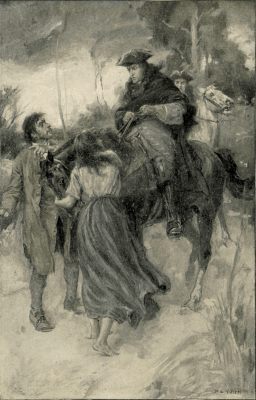
AUDREY LEFT HER WARNING TO BE SPOKEN BY MACLEAN
"Here's a Canterbury tale!" he cried. "Egad, Haward, are we to take this
skipping rope, vault it as though we were courtiers of Lilliput? Neither
of us is armed. I conceive that the longest way around will prove our
shortest way home."
"My dear Colonel, I want to speak with these two gentlemen."
"But at your leisure, my friend, at your leisure, and not in dying tones!
I like not what I hear of Monsieur Jean Hugon's pistols. Flank an ambush;
don't ride into it open-eyed."
"Colonel Byrd is right," said the storekeeper earnestly. "Ride back, the
two of you, and take the bridle path that will carry you to Fair View by
way of the upper bridge. In the mean time, I will run through the woods to
Mr. Taberer's house, cross there, hurry to the quarters, rouse the
overseer, and with a man or two we will recross the creek by the lower
bridge, and coming upon these rogues unawares, give them a taste of their
own medicine! We'll hale them to the great house; you shall have speech of
them in your own hall."
Neither of the riders being able to suggest a better plan, the
storekeeper, with a wave of his hand, plunged into the forest, and was
soon lost to view amidst its serried trunks and waving branches. Haward
stooped from his saddle; Audrey set her bare foot upon his booted one, and
he swung her up behind him. "Put thine arm around me, child," he told her.
"We will ride swiftly through the storm. Now, Colonel, to turn our backs
upon the enemy!"
The lightning was about them, and they raced to the booming of the
thunder. Heavy raindrops began to fall, and the wind was a power to drive
the riders on. Its voice shrilled above the diapason of the thunder; the
forest swung to its long cry. "When the horses turned from the wide into
the narrow road, they could no longer go abreast. Mirza took the lead, and
the bay fell a length behind. The branches now hid the sky; between the
flashes there was Stygian gloom, but when the lightning came it showed far
aisles of the forest. There was the smell of rain upon dusty earth, there
was the wine of coolness after heat, there was the sense of being borne
upon the wind, there was the leaping of life within the veins to meet the
awakened life without. Audrey closed her eyes, and wished to ride thus
forever. Haward, too, traveling fast through mist and rain a road whose
end was hidden, facing the wet wind, hearing the voices of earth and sky,
felt his spirit mount with the mounting voices. So to ride with Love to
doom! On, and on, and on! Left behind the sophist, the apologist, the
lover of the world with his tinsel that was not gold, his pebbles that
were not gems! Only the man thundering on,—the man and his mate that was
meant for him since time began! He raised his face to the strife above, he
drew his breath, his hand closed over the hand of the woman riding with
him. At the touch a thrill ran through them both; had the lightning with a
sword of flame cut the world from beneath their feet, they had passed on,
immortal in their happiness. But the bolts struck aimlessly, and the
moment fled. Haward was Haward again; he recognized his old acquaintance
with a half-humorous, half-disdainful smile. The road was no longer a road
that gleamed athwart all time and space; the wind had lost its trumpet
tone; Love spoke not in the thunder, nor seemed so high a thing as the lit
heaven. Audrey's hand was yet within his clasp; but it was flesh and
blood that he touched, not spirit, and he was glad that it was so. For
her, her cheek burned, and she hid her eyes. She had looked unawares, as
by the lightning glare, into a world of which she had not dreamed. Its
portals had shut; she rode on in the twilight again, and she could not
clearly remember what she had seen. But she was sure that the air of that
country was sweet, she was faint with its beauty, her heart beat with
violence to its far echoes. Moreover, she was dimly aware that in the
moment when she had looked there had been a baptism. She had thought of
herself as a child, as a girl; now and for evermore she was a woman.
They left the forest behind, and came to open fields where the tobacco had
been beaten to earth. The trees now stood singly or in shivering copses.
Above, the heavens were bare to their gaze, and the lightning gave
glimpses of pale castles overhanging steel-gray, fathomless abysses. The
road widened, and the bay was pushed by its rider to Mirza's side. Fields
of corn where the long blades wildly clashed, a wood of dripping cedars, a
patch of Oronoko, tobacco house in midst, rising ground and a vision of
the river, then a swift descent to the lower creek, and the bridge across
which lay the road that ran to the minister's house. Audrey spoke
earnestly to the master of Fair View, and after a moment's hesitation he
drew rein. "We will not cross, Colonel," he declared. "My preserver will
have it that she has troubled us long enough; and indeed it is no great
distance to the glebe house, and the rain has stopped. Have down with
thee, then, obstinate one!"
Audrey slipped to the earth, and pushed back her hair from her eyes.
Colonel Byrd observed her curiously. "Faith," he exclaimed, "'tis the
Atalanta of last May Day! Well, child, I believe thou hast saved our
lives. Come, here are three gold baubles that may pass for Hippomenes'
apples!"
Audrey put her hands behind her. "I want no money, sir. What I did was a
gift; it has no price." She was only Darden's Audrey, but she spoke as
proudly as a princess might have spoken. Haward smiled to hear her; and
seeing the smile, she was comforted. "For he understands," she said to
herself. "He would never hurt me so." It did not wound her that he said no
word, but only lifted his hat, when she curtsied to them both. There was
to-morrow, and he would praise her then for her quickness of wit and her
courage in following Hugon, whom she feared so much.
The riders watched her cross the bridge and turn into the road that led to
the glebe house, then kept their own road in silence until it brought them
to the doors of Fair View.
It was an hour later, and drawing toward dusk, when the Colonel, having
changed his wet riding clothes for a suit of his friend's, came down the
stairs and entered the Fair View drawing-room. Haward, in green, with rich
lace at throat and wrist, was there before him, walking up and down in the
cheerful light of a fire kindled against the dampness. "No sign of our
men," he said, as the other entered. "Come to the fire. Faith, Colonel, my
russet and gold becomes you mightily! Juba took you the aqua vitæ?"
"Ay, in one of your great silver goblets, with a forest of mint atop. Ha,
this is comfort!" He sank into an armchair, stretched his legs before the
blaze, and began to look about him. "I have ever said, Haward, that of
all the gentlemen of my acquaintance you have the most exact taste. I told
Bubb Dodington as much, last year, at Eastbury. Damask, mirrors,
paintings, china, cabinets,—all chaste and quiet, extremely elegant, but
without ostentation! It hath an air, too. I would swear a woman had the
placing of yonder painted jars!"
"You are right," said Haward, smiling. "The wife of the minister of this
parish was good enough to come to my assistance."
"Ah!" said the Colonel dryly. "Did Atalanta come as well? She is his
reverence's servant, is she not?"
"No," answered Haward shortly to the last question, and, leaning across,
stirred the fire.
The light caused to sparkle a jeweled pin worn in the lace of his ruffles,
and the toy caught the Colonel's eye. "One of Spotswood's golden
horseshoes!" he exclaimed. "I had them wrought for him in London. Had they
been so many stars and garters, he could have made no greater pother! 'Tis
ten years since I saw one."
Haward detached the horseshoe-shaped bauble from the lace, and laid it on
the other's palm. The master of Westover regarded it curiously, and read
aloud the motto engraved upon its back: "'Sic Juvat Transcendere Montes.'
A barren exploit! But some day I too shall please myself and cross these
sun-kissing hills. And so the maid with the eyes is not his reverence's
servant? What is she?"
Haward took the golden horseshoe in his own hand, and fell to studying it
in the firelight. "I wore this to-night," he said at length, with
deliberation, "in order that it might bring to your mind that sprightly
ultramontane expedition in which, my dear Colonel, had you not been in
England, you had undoubtedly borne a part. You have asked me a question; I
will answer it with a story, and so the time may pass more rapidly until
the arrival of Mr. MacLean with our friends who set traps." He turned the
mimic horseshoe this way and that, watching the small gems, that simulated
nails, flash in the red light. "Some days to the west of Germanna," he
said, "when about us were the lesser mountains, and before us those that
propped the sky, we came one sunny noon upon a valley, a little valley,
very peaceful below the heights. A stream shone through it, and there were
noble trees, and beside the stream the cabin of a frontiersman."
On went the story. The fire crackled, reflecting itself in mirrors and
polished wood and many small window panes. Outside, the rain had ceased,
but the wind and the river murmured loudly, and the shadows of the night
were gathering. When the narrative was ended, he who had spoken and he who
had listened sat staring at the fire. "A pretty story!" said the Colonel
at last. "Dick Steele should have had it; 'twould have looked vastly well
over against his Inkle and Yarico. There the maid the savior, here the
man; there perfidy, here plain honesty; there for the woman a fate most
tragical, here"—
"Here?" said Haward, as the other paused.
The master of Westover took out his snuffbox. "And here the continued
kindness of a young and handsome preserver," he said suavely, and extended
the box to his host.
"You are mistaken," said Haward. He rose, and stood leaning against the
mantel, his eyes upon the older man's somewhat coldly smiling
countenance. "She is as innocent, as high of soul, and as pure of heart
as—as Evelyn."
The Colonel clicked to the lid of his box. "You will be so good as to
leave my daughter's name out of the conversation."
"As you please," Haward answered, with hauteur.
Another silence, broken by the guest. "Why did you hang that kit-kat of
yourself behind the door, Haward?" he asked amiably. "'Tis too fine a
piece to be lost in shadow. I would advise a change with yonder
shepherdess."
"I do not know why," said Haward restlessly. "A whim. Perhaps by nature I
court shadows and dark corners."
"That is not so," Byrd replied quietly. He had turned in his chair, the
better to observe the distant portrait that was now lightened, now
darkened, as the flames rose and fell. "A speaking likeness," he went on,
glancing from it to the original and back again. "I ever thought it one of
Kneller's best. The portrait of a gentleman. Only—you have noticed, I
dare say, how in the firelight familiar objects change aspect many
times?—only just now it seemed to me that it lost that distinction"—
"Well?" said Haward, as he paused.
The Colonel went on slowly: "Lost that distinction, and became the
portrait of"—
"Well? Of whom?" asked Haward, and, with his eyes shaded by his hand,
gazed not at the portrait, but at the connoisseur in gold and russet.
"Of a dirty tradesman," said the master of Westover lightly. "In a word,
of an own brother to Mr. Thomas Inkle."
A dead silence; then Haward spoke calmly: "I will not take offense,
Colonel Byrd. Perhaps I should not take it even were it not as my guest
and in my drawing-room that you have so spoken. We will, if you please,
consign my portrait to the obscurity from which it has been dragged. In
good time here comes Juba to light the candles and set the shadows
fleeing."
Leaving the fire he moved to a window, and stood looking out upon the
windy twilight. From the back of the house came a sound of voices and of
footsteps. The Colonel put up his snuffbox and brushed a grain from his
ruffles. "Enter two murderers!" he said briskly. "Will you have them here,
Haward, or shall we go into the hall?"
"Light all the candles, Juba," ordered the master. "Here, I think,
Colonel, where the stage will set them off. Juba, go ask Mr. MacLean and
Saunderson to bring their prisoners here."
As he spoke, he turned from the contemplation of the night without to the
brightly lit room. "This is a murderous fellow, this Hugon," he said, as
he took his seat in a great chair drawn before a table. "I have heard
Colonel Byrd argue in favor of imitating John Rolfe's early experiment,
and marrying the white man to the heathen. We are about to behold the
result of such an union."
"I would not have the practice universal," said the Colonel coolly, "but
'twould go far toward remedying loss of scalps in this world, and of
infidel souls hereafter. Your sprightly lover is a most prevailing
missionary. But here is our Huguenot-Monacan."
MacLean, very wet and muddy, with one hand wrapped in a blood-stained rag,
came in first. "We found them hidden in the bushes at the turn of the
road," he said hastily. "The schoolmaster was more peaceably inclined than
any Quaker, but Hugon fought like the wolf that he is. Can't you hang him
out of hand, Haward? Give me a land where the chief does justice while the
king looks the other way!" He turned and beckoned. "Bring them in,
Saunderson."
There was no discomposure in the schoolmaster's dress, and as little in
his face or manner. He bowed to the two gentlemen, then shambled across to
the fire, and as best he could held out his bound hands to the grateful
blaze. "May I ask, sir," he said, in his lifeless voice, "why it is that
this youth and I, resting in all peace and quietness beside a public road,
should be set upon by your servants, overpowered, bound, and haled to your
house as to a judgment bar?"
Haward, to whom this speech was addressed, gave it no attention. His gaze
was upon Hugon, who in his turn glared at him alone. Haward had a subtle
power of forcing and fixing the attention of a company; in crowded rooms,
without undue utterance or moving from his place, he was apt to achieve
the centre of the stage, the head of the table. Now, the half-breed, by
very virtue of the passion which, false to his Indian blood, shook him
like a leaf, of a rage which overmastered and transformed, reached at a
bound the Englishman's plane of distinction. His great wig, of a fashion
years gone by, was pulled grotesquely aside, showing the high forehead and
shaven crown beneath; his laced coat and tawdry waistcoat and ruffled
shirt were torn and foul with mud and mould, but the man himself made to
be forgotten the absurdity of his trappings. Gone, for him, were his
captors, his accomplice, the spectator in gold and russet; to Haward,
also, sitting very cold, very quiet, with narrowed eyes, they were gone.
He was angered, and in the mood to give rein after his own fashion to that
anger. MacLean and the master of Westover, the overseer and the
schoolmaster, were forgotten, and he and Hugon met alone as they might
have met in the forest. Between them, and without a spoken word, the two
made this fact to be recognized by the other occupants of the
drawing-room. Colonel Byrd, who had been standing with his hand upon the
table, moved backward until he joined MacLean beside the closed door:
Saunderson drew near to the schoolmaster: and the centre of the room was
left to the would-be murderer and the victim that had escaped him.
"Monsieur le Monacan," said Haward.
Hugon snarled like an angry wolf, and strained at the rope which bound his
arms.
Haward went on evenly: "Your tribe has smoked the peace pipe with the
white man. I was not told it by singing birds, but by the great white
father at Williamsburgh. They buried the hatchet very deep; the dead
leaves of many moons of Cohonks lie thick upon the place where they buried
it. Why have you made a warpath, treading it alone of your color?"
"Diable!" cried Hugon. "Pig of an Englishman! I will kill you for"—
"For an handful of blue beads," said Haward, with a cold smile. "And I,
dog of an Indian! I will send a Nottoway to teach the Monacans how to lay
a snare and hide a trail."
The trader, gasping with passion, leaned across the table until his eyes
were within a foot of Haward's unmoved face. "Who showed you the trail and
told you of the snare?" he whispered. "Tell me that, you
Englishman,—tell me that!"
"A storm bird," said Haward calmly. "Okee is perhaps angry with his
Monacans, and sent it."
"Was it Audrey?"
Haward laughed. "No, it was not Audrey. And so, Monacan, you have yourself
fallen into the pit which you digged."
From the fireplace came the schoolmaster's slow voice: "Dear sir, can you
show the pit? Why should this youth desire to harm you? Where is the storm
bird? Can you whistle it before a justice of the peace or into a court
room?"
If Haward heard, it did not appear. He was leaning back in his chair, his
eyes fixed upon the trader's twitching face in a cold and smiling regard.
"Well, Monacan?" he demanded.
The half-breed straightened himself, and with a mighty effort strove in
vain for a composure that should match the other's cold self-command,—a
command which taunted and stung now at this point, now at that. "I am a
Frenchman!" he cried, in a voice that broke with passion. "I am of the
noblesse of the land of France, which is a country that is much grander
than Virginia! Old Pierre at Monacan-Town told me these things. My father
changed his name when he came across the sea, so I bear not the de which
is a sign of a great man. Listen, you Englishman! I trade, I prosper, I
buy me land, I begin to build me a house. There is a girl that I see every
hour, every minute, while I am building it. She says she loves me not, but
nevertheless I shall wed her. Now I see her in this room, now in that; she
comes down the stair, she smiles at the window, she stands on the
doorstep to welcome me when I come home from my hunting and trading in
the woods so far away. I bring her fine skins of the otter, the beaver,
and the fawn; beadwork also from the villages and bracelets of copper and
pearl. The flowers bloom around her, and my heart sings to see her upon my
doorstep.... The flowers are dead, and you have stolen the girl away....
There was a stream, and the sun shone upon it, and you and she were in a
boat. I walked alone upon the bank, and in my heart I left building my
house and fell to other work. You laughed; one day you will laugh no more.
That was many suns ago. I have watched"—
Foam was upon his lips, and he strained without ceasing at his bonds.
Already pulled far awry, his great peruke, a cataract of hair streaming
over his shoulders, shading and softening the swarthy features between its
curled waves, now slipped from his head and fell to the floor. The change
which its absence wrought was startling. Of the man the moiety that was
white disappeared. The shaven head, its poise, its features, were Indian;
the soul was Indian, and looked from Indian eyes. Suddenly, for the last
transforming touch, came a torrent of words in a strange tongue, the
tongue of his mother. Of what he was speaking, what he was threatening, no
one of them could tell; he was a savage giving voice to madness and hate.
Haward pushed back his chair from the table, and, rising, walked across
the room to the window. Hugon followed him, straining at the rope about
his arms and speaking thickly. His eyes were glaring, his teeth bared.
When he was so close that the Virginian could feel his hot breath, the
latter turned, and uttering an oath of disgust struck the back of his
hand across his lips. With the cry of an animal, Hugon, bound as he was,
threw himself bodily upon his foe, who in his turn flung the trader from
him with a violence that sent him reeling against the wall. Here
Saunderson, a man of powerful build, seized him by the shoulders, holding
him fast; MacLean, too, hurriedly crossed from the door. There was no
need, for the half-breed's frenzy was spent. He stood with glittering eyes
following Haward's every motion, but quite silent, his frame rigid in the
overseer's grasp.
Colonel Byrd went up to Haward and spoke in a low voice: "Best send them
at once to Williamsburgh."
Haward shook his head. "I cannot," he said, with a gesture of impatience.
"There is no proof."
"No proof!" exclaimed his guest sharply. "You mean"—
The other met his stare of surprise with an imperturbable countenance.
"What I say," he answered quietly. "My servants find two men lurking
beside a road that I am traveling. Being somewhat over-zealous, they take
them up upon suspicion of meaning mischief and bring them before me. It is
all guesswork why they were at the turn of the road, and what they wanted
there. There is no proof, no witness"—
"I see that there is no witness that you care to call," said the Colonel
coldly.
Haward waved his hand. "There is no witness," he said, without change of
tone. "And therefore, Colonel, I am about to dismiss the case."
With a slight bow to his guest he left the window, and advanced to the
group in the centre of the room. "Saunderson," he said abruptly, "take
these two men to the quarter and cut their bonds. Give them a start of
fifty yards, then loose the dogs and hunt them from the plantation. You
have men outside to help you? Very well; go! Mr. MacLean, will you see
this chase fairly started?"
The Highlander, who had become very thoughtful of aspect since entering
the room, and who had not shared Saunderson's start of surprise at the
master's latest orders, nodded assent. Haward stood for a moment gazing
steadily at Hugon, but with no notice to bestow upon the bowing
schoolmaster; then walked over to the harpsichord, and, sitting down,
began to play an old tune, soft and slow, with pauses between the notes.
When he came to the final chord he looked over his shoulder at the
Colonel, standing before the mantel, with his eyes upon the fire. "So they
have gone," he said. "Good riddance! A pretty brace of villains!"
"I should be loath to have Monsieur Jean Hugon for my enemy," said the
Colonel gravely.
Haward laughed. "I was told at Williamsburgh that a party of traders go to
the Southern Indians to-morrow, and he with them. Perhaps a month or two
of the woods will work a cure."
He fell to playing again, a quiet, plaintive air. When it was ended, he
rose and went over to the fire to keep his guest company; but finding him
in a mood for silence, presently fell silent himself, and took to viewing
structures of his own building in the red hollows between the logs. This
mutual taciturnity lasted until the announcement of supper, and was
relapsed into at intervals during the meal; but when they had returned to
the drawing-room the two talked until it was late, and the fire had sunken
to ash and embers. Before they parted for the night it was agreed that
the master of Westover should remain with the master of Fair View for a
day or so, at the end of which time the latter gentleman would accompany
the former to Westover for a visit of indefinite length.
