Audrey
CHAPTER XIX
THE GOVERNOR'S BALL
For an hour it had been very quiet, very peaceful, in the small white
house on Palace Street. Darden was not there; for the Commissary had sent
for him, having certain inquiries to make and a stern warning to deliver.
Mistress Deborah had been asked to spend the night with an acquaintance in
the town, so she also was out and gone. Mistress Stagg and Audrey kept the
lower rooms, while overhead Mr. Charles Stagg, a man that loved his art,
walked up and down, and, with many wavings of a laced handkerchief and
much resort to a gilt snuffbox, reasoned with Plato of death and the soul.
The murmur of his voice came down to the two women, and made the only
sound in the house. Audrey, sitting by the window, her chin upon her hand
and her dark hair shadowing her face, looked out upon the dooryard and the
Palace Street beyond. The street was lit by torches, and people were going
to the ball in coaches and chariots, on foot and in painted chairs. They
went gayly, light of heart, fine of person, a free and generous folk.
Laughter floated over to the silent watcher, and the torchlight gave her
glimpses of another land than her own.
Many had been Mistress Stagg's customers since morning, and something had
she heard besides admiration of her wares and exclamation at her prices.
Now, as she sat with some gay sewing beneath her nimble fingers, she
glanced once and again at the shadowed face opposite her. If the look was
not one of curiosity alone, but had in it an admixture of new-found
respect; if to Mistress Stagg the Audrey of yesterday, unnoted,
unwhispered of, was a being somewhat lowlier than the Audrey of to-day, it
may be remembered for her that she was an actress of the early eighteenth
century, and that fate and an old mother to support had put her in that
station.
The candles beneath their glass shades burned steadily; the house grew
very quiet; the noises of the street lessened and lessened, for now nearly
all of the people were gone to the ball. Audrey watched the round of light
cast by the nearest torch. For a long time she had watched it, thinking
that he might perhaps cross the circle, and she might see him in his
splendor. She was still watching when he knocked at the garden door.
Mistress Stagg, sitting in a dream of her own, started violently. "La,
now, who may that be?" she exclaimed. "Go to the door, child. If 'tis a
stranger, we shelter none such, to be taken up for the harboring of
runaways!"
Audrey went to the door and opened it. A moment's pause, a low cry, and
she moved backward to the wall, where she stood with her slender form
sharply drawn against the white plaster, and with the fugitive, elusive
charm of her face quickened into absolute beauty, imperious for attention.
Haward, thus ushered into the room, gave the face its due. His eyes,
bright and fixed, were for it alone. Mistress Stagg's curtsy went
unacknowledged save by a slight, mechanical motion of his hand, and her
inquiry as to what he lacked that she could supply received no answer. He
was a very handsome man, of a bearing both easy and commanding, and
to-night he was splendidly dressed in white satin with embroidery of gold.
To one of the women he seemed the king, who could do no wrong; to the
other, more learned in the book of the world, he was merely a fine
gentleman, whose way might as well be given him at once, since, spite of
denial, he would presently take it.
Haward sat down, resting his clasped hands upon the table, gazing
steadfastly at the face, dark and beautiful, set like a flower against the
wall. "Come, little maid!" he said. "We are going to the ball together,
you and I. Hasten, or we shall not be in time for the minuet."
Audrey smiled and shook her head, thinking that it was his pleasure to
laugh at her a little. Mistress Stagg likewise showed her appreciation of
the pleasantry. When he repeated his command, speaking in an authoritative
tone and with a glance at his watch, there was a moment of dead silence;
then, "Go your ways, sir, and dance with Mistress Evelyn Byrd!" cried the
scandalized ex-actress. "The Governor's ball is not for the likes of
Audrey!"
"I will be judge of that," he answered. "Come, let us be off, child! Or
stay! hast no other dress than that?" He looked toward the mistress of the
house. "I warrant that Mistress Stagg can trick you out! I would have you
go fine, Audrey of the hair! Audrey of the eyes! Audrey of the full brown
throat! Dull gold,—have you that, now, mistress, in damask or brocade?
Soft laces for her bosom, and a yellow bloom in her hair. It should be
dogwood, Audrey, like the coronal you wore on May Day. Do you remember,
child? The white stars in your hair, and the Maypole all aflutter, and
your feet upon the green grass"—
"Oh, I was happy then!" cried Audrey and wrung her hands. Within a moment,
however, she was calm again, and could look at him with a smile. "I am
only Audrey," she said. "You know that the ball is not for me. Why then do
you tell me that I must go? It is your kindness; I know that it is your
kindness that speaks. But yet—but yet"—She gazed at him imploringly:
then from his steady smile caught a sudden encouragement. "Oh!" she
exclaimed with a gesture of quick relief, and with tremulous laughter in
her face and voice,—"oh, you are mocking me! You only came to show how a
gentleman looks who goes to a Governor's ball!"
For the moment, in her relief at having read his riddle, there slipped
from her the fear of she knew not what,—the strangeness and heaviness of
heart that had been her portion since she came to Williamsburgh. Leaving
the white wall against which she had leaned, she came a little forward,
and with gayety and grace dropped him a curtsy. "Oh, the white satin like
the lilies in your garden!" she laughed. "And the red heels to your shoes,
and the gold-fringed sword knot, and the velvet scabbard! Ah, let me see
your sword, how bright and keen it is!"
She was Audrey of the garden, and Haward, smiling, drew his rapier and
laid it in her hands. She looked at the golden hilt, and passed her brown
fingers along the gleaming blade. "Stainless," she said, and gave it back
to him.
Taking it, he took also the hand that had proffered it. "I was not
laughing, child," he said. "Go to the ball thou shalt, and with me. What!
Thou art young and fair. Shalt have no pleasure"—
"What pleasure in that?" cried Audrey. "I may not go, sir; nay, I will not
go!"
She freed her hand, and stood with heaving bosom and eyes that very slowly
filled with tears. Haward saw no reason for her tears. It was true that
she was young and fair; true, also, that she had few pleasures. Well, he
would change all that. The dance,—was it not woven by those nymphs of
old, those sprites of open spaces in the deep woods, from whose immemorial
company she must have strayed into this present time? Now at the Palace
the candles were burning for her, for her the music was playing. Her
welcome there amidst the tinsel people? Trust him for that: he was what he
was, and could compass greater things than that would be. Go she should,
because it pleased him to please her, and because it was certainly
necessary for him to oppose pride with pride, and before the eyes of
Evelyn demonstrate his indifference to that lady's choice of Mr. Lee for
the minuet and Mr. Lightfoot for the country dance. This last thought had
far to travel from some unused, deep-down quagmire of the heart, but it
came. For the rest, the image of Audrey decked in silk and lace, turned by
her apparel into a dark Court lady, a damsel in waiting to Queen Titania,
caught his fancy in both hands. He wished to see her thus,—wished it so
strongly that he knew it would come to pass. He was a gentleman who had
acquired the habit of having his own way. There had been times when the
price of his way had seemed too dear; when he had shrugged his shoulders
and ceased to desire what he would not buy. To-night he was not able to
count the cost. But he knew—he knew cruelly well—how to cut short this
fruitless protest of a young girl who thought him all that was wise and
great and good.
"So you cannot say 'yes' to my asking, little maid?" he began, quiet and
smiling. "Cannot trust me that I have reasons for the asking? Well, I will
not ask again, Audrey, since it is so great a thing'"—"Oh," cried Audrey,
"you know that I would die for you!" The tears welled over, but she
brushed them away with a trembling hand; then stood with raised face, her
eyes soft and dewy, a strange smile upon her lips. She spoke at last as
simply as a child: "Why you want me, that am only Audrey, to go with you
to the Palace yonder, I cannot tell. But I will go, though I am only
Audrey, and I have no other dress than this"—
Haward got unsteadily to his feet, and lightly touched the dark head that
she bowed upon her hands. "Why, now you are Audrey again," he said
approvingly. "Why, child, I would do you a pleasure!" He turned to the
player's wife. "She must not go in this guise. Have you no finery stowed
away?"
Now, Mistress Stagg, though much scandalized, and very certain that all
this would never do, was in her way an artist, and could see as in a
mirror what bare throat and shoulders, rich hair drawn loosely up, a touch
of rouge, a patch or two, a silken gown, might achieve for Audrey. And
after all, had not Deborah told her that the girl was Mr. Haward's ward,
not Darden's, and that though Mr. Haward came and went as he pleased, and
was very kind to Audrey, so that Darden was sure of getting whatever the
girl asked for, yet she was a good girl, and there was no harm? For the
talk that day,—people were very idle, and given to thinking the forest
afire when there was only the least curl of smoke. And in short and
finally it was none of her business; but with the aid of a certain chest
upstairs, she knew what she could do! To the ball might go a beauty would
make Mistress Evelyn Byrd look to her laurels!
"There's the birthday dress that Madam Carter sent us only last week," she
began hesitatingly. "It's very beautiful, and a'most as good as new, and
'twould suit you to a miracle—But I vow you must not go, Audrey!... To be
sure, the damask is just the tint for you, and there are roses would
answer for your hair. But la, sir, you know 'twill never do, never in this
world."
Half an hour later, Haward rose from his chair and bowed low as to some
highborn and puissant dame. The fever that was now running high in his
veins flushed his cheek and made his eyes exceedingly bright. When he went
up to Audrey, and in graceful mockery of her sudden coming into her
kingdom, took her hand and, bending, kissed it, the picture that they made
cried out for some painter to preserve it. Her hand dropped from his
clasp, and buried itself in rich folds of flowered damask; the quick rise
and fall of her bosom stirred soft, yellowing laces, and made to flash
like diamonds some ornaments of marcasite; her face was haunting in its
pain and bewilderment and great beauty, and in the lie which her eyes gave
to the false roses beneath those homes of sadness and longing. She had no
word to say, she was "only Audrey," and she could not understand. But she
wished to do his bidding, and so, when he cried out upon her melancholy,
and asked her if 'twere indeed a Sunday in New England instead of a
Saturday in Virginia, she smiled, and strove to put on the mind as well
as the garb of a gay lady who might justly go to the Governor's ball.
Half frightened at her own success, Mistress Stagg hovered around her,
giving this or that final touch to her costume; but it was Haward himself
who put the roses in her hair. "A little longer, and we will walk once
more in my garden at Fair View," he said. "June shall come again for us,
and we will tread the quiet paths, my sweet, and all the roses shall bloom
again for us. There, you are crowned! Hail, Queen!"
Audrey felt the touch of his lips upon her forehead, and shivered. All her
world was going round; she could not steady it, could not see aright, knew
not what was happening. The strangeness made her dizzy. She hardly heard
Mistress Stagg's last protest that it would never do,—never in the world;
hardly knew when she left the house. She was out beneath the stars, moving
toward a lit Palace whence came the sound of violins. Haward's arm was
beneath her hand; his voice was in her ear, but it was as the wind's
voice, whose speech she did not understand. Suddenly they were within the
Palace garden, with its winding, torchlit walks, and the terraces at the
side; suddenly again, they had mounted the Palace steps, and the doors
were open, and she was confronted with lights and music and shifting,
dazzling figures. She stood still, clasped her hands, and gave Haward a
piteous look. Her face, for all its beauty and its painted roses, was
strangely the child's face that had lain upon his breast, where he knelt
amid the corn, in the valley between the hills, so long ago. He gave her
mute appeal no heed. The Governor's guests, passing from room to room,
crossed and recrossed the wide hall, and down the stairway, to meet a row
of gallants impatient at its foot, came fair women, one after the other,
the flower of the colony, clothed upon like the lilies of old. Haward,
entering with Audrey, saw Mr. Lee at the stairfoot, and, raising his eyes,
was aware of Evelyn descending alone and somewhat slowly, all in rose
color, and with a smile upon her lips.
She was esteemed the most beautiful woman in Virginia, the most graceful
and accomplished. Wit and charm and fortune were hers, and the little gay
world of Virginia had mated her with Mr. Marmaduke Haward of Fair View.
Therefore that portion of it that chanced to be in the hall of the
Governor's house withdrew for the moment its attention from its own
affairs, and bestowed it upon those of the lady descending the stairs, and
of the gold-and-white gentleman who, with a strange beauty at his side,
stood directly in her path. It was a very wise little world, and since
yesterday afternoon had been fairly bursting with its own knowledge. It
knew all about that gypsy who had come to town from Fair View
parish,—"La, my dear, just the servant of a minister!"—and knew to a
syllable what had passed in the violent quarrel to which Mr. Lee owed his
good fortune.
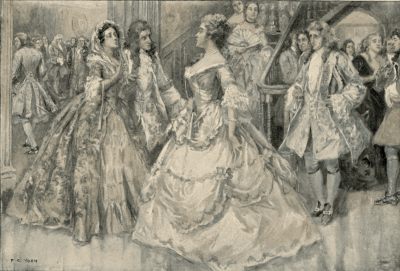
"I DO NOT THINK I HAVE THE HONOR OF KNOWING"—
That triumphant gentleman now started forward, and, with a low bow,
extended his hand to lead to the ballroom this rose-colored paragon and
cynosure of all eyes. Evelyn smiled upon him, and gave him her scarf to
hold, but would not be hurried; must first speak to her old friend Mr.
Haward, and tell him that her father's foot could now bear the shoe, and
that he might appear before the ball was over. This done, she withdrew her
gaze, from Haward's strangely animated, vividly handsome countenance,
and turned it upon the figure at his side. "Pray present me!" she said
quickly. "I do not think I have the honor of knowing"—
Audrey raised her head, that had been bent, and looked again, as she had
looked yesterday, with all her innocent soul and heavy heart, into the
eyes of the princess. The smile died from Evelyn's lips, and a great wave
of indignant red surged over face and neck and bosom. The color fled, but
not the bitter anger. So he could bring his fancy there! Could clothe her
that was a servant wench in a splendid gown, and flaunt her before the
world—before the world that must know—oh, God! must know how she herself
loved him! He could do this after that month at Westover! She drew her
breath, and met the insult fairly. "I withdraw my petition," she said
clearly. "Now that I bethink me, my acquaintance is already somewhat too
great. Mr. Lee, shall we not join the company? I have yet to make my
curtsy to his Excellency."
With head erect, and with no attention to spare from the happy Mr. Lee,
she passed the sometime suitor for her hand and the apple of discord which
it had pleased him to throw into the assembly. A whisper ran around the
hall. Audrey heard suppressed laughter, and heard a speech which she did
not understand, but which was uttered in an angry voice, much like
Mistress Deborah's when she chided. A sudden terror of herself and of
Haward's world possessed her. She turned where she stood in her borrowed
plumage, and clung to his hand and arm. "Let me go," she begged. "It is
all a mistake,—all wrong. Let me go,—let me go."
He laughed at her, shaking his head and looking into her beseeching face
with shining, far-off eyes. "Thou dear fool!" he said. "The ball is made
for thee, and all these folk are here to do thee honor!" Holding her by
the hand, he moved with her toward a wide doorway, through which could be
seen a greater throng of beautifully dressed ladies and gentlemen. Music
came from this room, and she saw that there were dancers, and that beyond
them, upon a sort of dais, and before a great carved chair, stood a fine
gentleman who, she knew, must be his Excellency the Governor of Virginia.
