Audrey
CHAPTER XXX
THE LAST ACT
Before eight of the clock, Mr. Stagg, peering from behind the curtain,
noted with satisfaction that the house was filling rapidly; upon the
stroke of the hour it was crowded to the door, without which might be
heard angry voices contending that there must be yet places for the
buying. The musicians began to play and more candles were lighted. There
were laughter, talk, greetings from one part of the house to another, as
much movement to and fro as could be accomplished in so crowded a space.
The manners of the London playhouses were aped not unsuccessfully. To
compare small things with great, it might have been Drury Lane upon a gala
night. If the building was rude, yet it had no rival in the colonies, and
if the audience was not so gay of hue, impertinent of tongue, or paramount
in fashion as its London counterpart, yet it was composed of the rulers
and makers of a land destined to greatness.
In the centre box sat his Excellency, William Gooch, Lieutenant-Governor
of Virginia, resplendent in velvet and gold lace, and beside him Colonel
Alexander Spotswood, arrived in town from Germanna that day, with his
heart much set upon the passage, by the Assembly, of an act which would
advantage his iron works. Colonel Byrd of Westover, Colonel Esmond of
Castlewood, Colonel Carter, Colonel Page, and Colonel Ludwell were
likewise of the Governor's party, while seated or standing in the pit, or
mingling with the ladies who made gay the boxes, were other gentlemen of
consequence,—Councilors, Burgesses, owners of vast tracts of land, of
ships and many slaves. Of their number some were traveled men, and some
had fought in England's wars, and some had studied in her universities.
Many were of gentle blood, sprung from worthy and venerable houses in that
green island which with fondness they still called home, and many had made
for themselves name and fortune, hewing their way to honor through a
primeval forest of adversities. Lesser personages were not lacking, but
crowded the gallery and invaded the pit. Old fighters of Indians were
present, and masters of ships trading from the Spanish islands or from the
ports of home. Rude lumbermen from Norfolk or the borders of the Dismal
Swamp stared about them, while here and there showed the sad-colored coat
of a minister, or the broad face of some Walloon from Spotswood's
settlement on the Rapidan, or the keener countenances of Frenchmen from
Monacan-Town. The armorer from the Magazine elbowed a great proprietor
from the Eastern shore, while a famous guide and hunter, long and lean and
brown, described to a magnate of Yorktown a buffalo capture in the far
west, twenty leagues beyond the falls. Masters and scholars from William
and Mary were there, with rangers, traders, sailors ashore, small
planters, merchants, loquacious keepers of ordinaries, and with men, now
free and with a stake in the land, who had come there as indentured
servants, or as convicts, runaways, and fugitives from justice. In the
upper gallery, where no payment was exacted, many servants with a
sprinkling of favorite mulatto or mustee slaves; in the boxes the lustre
and sweep of damask and brocade, light laughter, silvery voices, the
flutter of fans; everywhere the vividness and animation of a strangely
compounded society, where the shadows were deep and the lights were high.
Nor did the conversation of so motley an assemblage lack a certain
pictorial quality, a somewhat fantastic opulence of reference and
allusion. Of what might its members speak while they waited for the
drawing aside of the piece of baize which hung between them and an
Oriental camp? There was the staple of their wealth, a broad-leafed plant,
the smoke of whose far-spread burning might have wrapped its native fields
in a perpetual haze as of Indian summer; and there was the warfare,
bequeathed from generation to generation, against the standing armies of
the forest, that subtle foe that slept not, retreated not, whose vanguard,
ever falling, ever showed unbroken ranks beyond. Trapper and trader and
ranger might tell of trails through the wilderness vast and hostile, of
canoes upon unknown waters, of beasts of prey, creatures screaming in the
night-time through the ebony woods. Of Indian villages, also, and of red
men who, in the fastnesses that were left them, took and tortured and slew
after strange fashions. The white man, strong as the wind, drove the red
man before his face like an autumn leaf, but he beckoned to the black man,
and the black man came at his call. He came in numbers from a far country,
and the manner of his coming was in chains. What he had to sell was
valuable, but the purchase price came not into his hands. Of him also
mention was made to-night. The master of the tall ship that had brought
him into the James or the York, the dealer to whom he was consigned, the
officer of the Crown who had cried him for sale, the planter who had
bought him, the divine who preached that he was of a race accursed,—all
were there, and all had interest in this merchandise. Others in the throng
talked of ships both great and small, and the quaintness of their names,
the golden flowers and golden women, the swift birds and beasts, the
namesakes of Fortune or of Providence, came pleasantly upon the ear. The
still-vexed Bermoothes, Barbadoes, and all the Indies were spoken of;
ports to the north and ports to the south, pirate craft and sunken
treasure, a flight, a fight, a chase at sea. The men from Norfolk talked
of the great Dismal and its trees of juniper and cypress, the traders of
trading, the masters from William and Mary of the humanities. The greater
men, authoritative and easy, owners of flesh and blood and much land,
holders of many offices and leaders of the people, paid their respects to
horse-racing and cock-fighting, cards and dice; to building, planting, the
genteelest mode of living, and to public affairs both in Virginia and at
home in England. Old friends, with oaths of hearty affection, and from
opposite quarters of the house, addressed each other as Tom, or Ned, or
Dick, while old enemies, finding themselves side by side, exchanged
extremely civil speeches, and so put a keener edge upon their mutual
disgust. In the boxes where glowed the women there was comfit talk, vastly
pretty speeches, asseverations, denials, windy sighs, the politest oaths,
whispering, talk of the play, and, last but not least, of Mr. Haward of
Fair View, and Darden's Audrey.
Haward, entering the pit, made his way quietly to where a servant was
holding for him a place. The fellow pulled his forelock in response to
his master's nod, then shouldered his way through the press to the
ladder-like stairs that led to the upper gallery. Haward, standing at his
ease, looked about him, recognizing this or that acquaintance with his
slow, fine smile and an inclination of his head. He was much observed, and
presently a lady leaned from her box, smiled, waved her fan, and slightly
beckoned to him. It was young Madam Byrd, and Evelyn sat beside her.
Five minutes later, as Haward entered the box of the ladies of Westover,
music sounded, the curtain was drawn back, and the play began. Upon the
ruder sort in the audience silence fell at once: they that followed the
sea, and they that followed the woods, and all the simple folk ceased
their noise and gesticulation, and gazed spellbound at the pomp before
them of rude scenery and indifferent actors. But the great ones of the
earth talked on, attending to their own business in the face of Tamerlane
and his victorious force. It was the fashion to do so, and in the play
to-night the first act counted nothing, for Darden's Audrey had naught to
do with it. In the second act, when she entered as Arpasia, the entire
house would fall quiet, staring and holding its breath.
Haward bent over Madam Byrd's hand; then, as that lady turned from him to
greet Mr. Lee, addressed himself with grave courtesy to Evelyn, clothed in
pale blue, and more lovely even than her wont. For months they had not
met. She had written him one letter,—had written the night of the day
upon which she had encountered Audrey in the Palace walk,—and he had
answered it with a broken line of passionate thanks for unmerited
kindness. Now as he bent over her she caught his wrist lightly with her
hand, and her touch burned him through the lace of his ruffles. With her
other hand she spread her fan; Mr. Lee's shoulder knot also screened them
while Mr. Grymes had engaged its owner's attention, and pretty Madam Byrd
was in animated conversation with the occupants of a neighboring box. "Is
it well?" asked Evelyn, very low.
Haward's answer was as low, and bravely spoken with his eyes meeting her
clear gaze, and her touch upon his wrist. "For me, Evelyn, it is very
well," he said. "For her—may I live to make it well for her, forever and
a day well for her! She is to be my wife."
"I am glad," said Evelyn,—"very glad."
"You are a noble lady," he answered. "Once, long ago, I styled myself your
friend, your equal. Now I know better my place and yours, and as from a
princess I take your alms. For your letter—that letter, Evelyn, which
told me what you thought, which showed me what to do—I humbly thank you."
She let fall her hand from her silken lap, and watched with unseeing eyes
the mimicry of life upon the stage before them, where Selima knelt to
Tamerlane, and Moneses mourned for Arpasia. Presently she said again, "I
am glad;" and then, when they had kept silence for a while, "You will live
at Fair View?"
"Ay," he replied. "I will make it well for her here in Virginia."
"You must let me help you," she said. "So old a friend as I may claim that
as a right. To-morrow I may visit her, may I not? Now we must look at the
players. When she enters there is no need to cry for silence. It comes of
itself, and stays; we watch her with straining eyes. Who is that man in a
cloak, staring at us from the pit? See, with the great peruke and the
scar!"
Haward, bending, looked over the rail, then drew back with a smile. "A
half-breed trader," he said, "by name Jean Hugon. Something of a
character."
"He looked strangely at us," said Evelyn, "with how haggard a face! My
scarf, Mr. Lee? Thank you. Madam, have you the right of the matter from
Kitty Page?"
The conversation became general, and soon, the act approaching its end,
and other gentlemen pressing into the box which held so beautiful a woman,
so great a catch, and so assured a belle as Mistress Evelyn Byrd, Haward
arose and took his leave. To others of the brilliant company assembled in
the playhouse he paid his respects, speaking deferentially to the
Governor, gayly to his fellow Councilors and planters, and bowing low to
many ladies. All this was in the interval between the acts. At the second
parting of the curtain he resumed his former station in the pit. With
intention he had chosen a section of it where were few of his own class.
From the midst of the ruder sort he could watch her more freely, could
exult at his ease in her beauty both of face and mind.
The curtains parted, and the fiddlers strove for warlike music. Tamerlane,
surrounded by the Tartar host, received his prisoners, and the defiant
rant of Bajazet shook the rafters. All the sound and fury of the stage
could not drown the noise of the audience. Idle talk and laughter, loud
comment upon the players, went on,—went on until there entered Darden's
Audrey, dressed in red silk, with a jeweled circlet like a line of flame
about her dark flowing hair. The noise sank, voices of men and women died
away; for a moment the rustle of silk, the flutter of fans, continued,
then this also ceased.
She stood before the Sultan, wide-eyed, with a smile of scorn upon her
lips; then spoke in a voice, low, grave, monotonous, charged like a
passing bell with warning and with solemn woe. The house seemed to grow
more still; the playgoers, box and pit and gallery, leaned slightly
forward: whether she spoke or moved or stood in silence, Darden's Audrey,
that had been a thing of naught, now held every eye, was regnant for an
hour in this epitome of the world. The scene went on, and now it was to
Moneses that she spoke. All the bliss and anguish of unhappy love sounded
in her voice, dwelt in her eye and most exquisite smile, hung upon her
every gesture. The curtains closed; from the throng that had watched her
came a sound like a sigh, after which, slowly, tongues were loosened. An
interval of impatient waiting, then the music again and the parting
curtains, and Darden's Audrey,—the girl who could so paint very love,
very sorrow, very death; the girl who had come strangely and by a devious
path from the height and loneliness of the mountains to the level of this
stage and the watching throng.
At the close of the fourth act of the play, Haward left his station in the
pit, and quietly made his way to the regions behind the curtain, where in
the very circumscribed space that served as greenroom to the Williamsburgh
theatre he found Tamerlane, Bajazet, and their satellites, together with a
number of gentlemen invaders from the front of the house. Mistress Stagg
was there, and Selima, perched upon a table, was laughing with the
aforesaid gentlemen, but no Arpasia. Haward drew the elder woman aside. "I
wish to see her," he said, in a low voice, kindly but imperious. "A moment
only, good woman."
With her finger at her lips Mistress Stagg glanced about her. "She hides
from them always, she's that strange a child: though indeed, sir, as sweet
a young lady as a prince might wed! This way, sir,—it's dark; make no
noise."
She led him through a dim passageway, and softly opened a door. "There,
sir, for just five minutes! I'll call her in time."
The door gave upon the garden, and Audrey sat upon the step in the
moonshine and the stillness. Her hand propped her chin, and her eyes were
raised to the few silver stars. That mock crown which she wore sparkled
palely, and the light lay in the folds of her silken dress. At the opening
of the door she did not turn, thinking that Mistress Stagg stood behind
her. "How bright the moon shines!" she said. "A mockingbird should be
singing, singing! Is it time for Arpasia?"
As she rose from the step Haward caught her in his arms. "It is I, my
love! Ah, heart's desire! I worship you who gleam in the moonlight, with
your crown like an aureole"—
Audrey rested against him, clasping her hands upon his shoulder. "There
were nights like this," she said dreamily. "If I were a little child
again, you could lift me in your arms and carry me home, I am tired ... I
would that I needed not to go back to the glare and noise. The moon shines
so bright! I have been thinking"—
He bent his head and kissed her twice. "Poor Arpasia! Poor tired child!
Soon we shall go home, Audrey,—we two, my love, we two!"
"I have been thinking, sitting here in the moonlight," she went on, her
hands clasped upon his shoulder, and her cheek resting on them. "I was so
ignorant. I never dreamed that I could wrong her ... and when I awoke it
was too late. And now I love you,—not the dream, but you. I know not what
is right or wrong; I know only that I love. I think she
understands—forgives. I love you so!" Her hands parted, and she stood
from him with her face raised to the balm of the night. "I love you so,"
she repeated, and the low cadence of her laugh broke the silver stillness
of the garden. "The moon up there, she knows it. And the stars,—not one
has fallen to-night! Smell the flowers. Wait, I will pluck you hyacinths."
They grew by the doorstep, and she broke the slender stalks and gave them
into his hand. But when he had kissed them he would give them back, would
fasten them himself in the folds of silk, that rose and fell with her
quickened breathing. He fastened them with a brooch which he took from the
Mechlin at his throat. It was the golden horseshoe, the token that he had
journeyed to the Endless Mountains.
"Now I must go," said Audrey. "They are calling for Arpasia. Follow me not
at once. Good-night, good-night! Ah, I love you so! Remember always that I
love you so!"
She was gone. In a few minutes he also reëntered the playhouse, and went
to his former place where, with none of his kind about him, he might watch
her undisturbed. As he made his way with some difficulty through the
throng, he was aware that he brushed against a man in a great peruke, who,
despite the heat of the house, was wrapped in an old roquelaure tawdrily
laced; also that the man was keeping stealthy pace with him, and that when
he at last reached his station the cloaked figure fell into place
immediately behind him.
Haward shrugged his shoulders, but would not turn his head, and thereby
grant recognition to Jean Hugon, the trader. Did he so, the half-breed
might break into speech, provoke a quarrel, make God knew what assertion,
what disturbance. To-morrow steps should be taken—Ah, the curtain!
The silence deepened, and men and women leaned forward holding their
breath. Darden's Audrey, robed and crowned as Arpasia, sat alone in the
Sultan's tent, staring before her with wide dark eyes, then slowly rising
began to speak. A sound, a sigh as of wonder, ran from the one to the
other of the throng that watched her. Why did she look thus, with
contracted brows, toward one quarter of the house? What inarticulate words
was she uttering? What gesture, quickly controlled, did she make of
ghastly fear and warning? And now the familiar words came halting from her
lips:—
"'Sure 'tis a horror, more than darkness brings,
That sits upon the night!'"
With the closing words of her speech the audience burst into a great storm
of applause. 'Gad! how she acts! But what now? Why, what is this?
It was quite in nature and the mode for an actress to pause in the middle
of a scene to curtsy thanks for generous applause, to smile and throw a
mocking kiss to pit and boxes, but Darden's Audrey had hitherto not
followed the fashion. Also it was not uncustomary for some spoiled
favorite of a player to trip down, between her scenes, the step or two
from the stage to the pit, and mingle with the gallants there, laugh,
jest, accept languishing glances, audacious comparisons, and such weighty
trifles as gilt snuffboxes and rings of price. But this player had not
heretofore honored the custom; moreover, at present she was needed upon
the stage. Bajazet must thunder and she defy; without her the play could
not move, and indeed the actors were now staring with the audience. What
was it? Why had she crossed the stage, and, slowly, smilingly, beautiful
and stately in her gleaming robes, descended those few steps which led to
the pit? What had she to do there, throwing smiling glances to right and
left, lightly waving the folk, gentle and simple, from her path, pressing
steadily onward to some unguessed-at goal. As though held by a spell they
watched her, one and all,—Haward, Evelyn, the Governor, the man in the
cloak, every soul in that motley assemblage. The wonder had not time to
dull, for the moments were few between her final leave-taking of those
boards which she had trodden supreme and the crashing and terrible chord
which was to close the entertainment of this night.
Her face was raised to the boxes, and it seemed as though her dark eyes
sought one there. Then, suddenly, she swerved. There were men between her
and Haward. She raised her hand, and they fell back, making for her a
path. Haward, bewildered, started forward, but her cry was not to him. It
was to the figure just behind him,—the cloaked figure whose hand grasped
the hunting-knife which from the stage, as she had looked to where stood
her lover, she had seen or divined. "Jean! Jean Hugon!" she cried.
Involuntarily the trader pushed toward her, past the man whom he meant to
stab to the heart. The action, dragging his cloak aside, showed the
half-raised arm and the gleaming steel. For many minutes the knife had
been ready. The play was nearly over, and she must see this man who had
stolen her heart, this Haward of Fair View, die. Else Jean Hugon's
vengeance were not complete. For his own safety the maddened half-breed
had ceased to care. No warning cried from the stage could have done aught
but precipitate the deed, but now for the moment, amazed and doubtful, he
turned his back upon his prey.
In that moment the Audrey of the woods, a creature lithe and agile and
strong of wrist as of will, had thrown herself upon him, clutching the
hand that held the knife. He strove to dash her from him, but in vain; the
house was in an uproar; and now Haward's hands were at his throat,
Haward's voice was crying to that fair devil, that Audrey for whom he had
built his house, who was balking him of revenge, whose body was between
him and his enemy! Suddenly he was all savage; as upon a night in Fair
View house he had cast off the trammels of his white blood, so now. An
access of furious strength came to him; he shook himself free; the knife
gleamed in the air, descended.... He drew it from the bosom into which he
had plunged it, and as Haward caught her in his arms, who would else have
sunk to the floor, the half-breed burst through the horror-stricken
throng, brandishing the red blade and loudly speaking in the tongue of the
Monacans. Like a whirlwind he was gone from the house, and for a time none
thought to follow him.
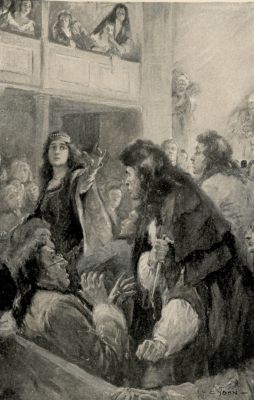
"JEAN! JEAN HUGON!"
They bore her into the small white house, and up the stair to her own
room, and laid her upon the bed. Dr. Contesse came and went away, and came
again. There was a crowd in Palace Street before the theatre. A man
mounting the doorstep so that he might be heard of all, said clearly, "She
may live until dawn,—no longer." Later, one came out of the house and
asked that there might be quiet. The crowd melted away, but throughout the
mild night, filled with the soft airs and thousand odors of the spring,
people stayed about the place, standing silent in the street or sitting on
the garden benches.
In the room upstairs lay Darden's Audrey, with crossed hands and head put
slightly back. She lay still, upon the edge of death, nor seemed to care
that it was so. Her eyes were closed, and at intervals one sitting at the
bed head laid touch upon her pulse, or held before her lips a slight
ringlet of her hair. Mary Stagg sat by the window and wept, but Haward,
kneeling, hid his face in the covering of the bed. The form upon it was
not more still than he; Mistress Stagg, also, stifled her sobs, for it
seemed not a place for loud grief.
In the room below, amidst the tinsel frippery of small wares, waited
others whose lives had touched the life that was ebbing away. Now and then
one spoke in a hushed voice, a window was raised, a servant bringing in
fresh candles trod too heavily; then the quiet closed in again. Late in
the night came through the open windows a distant clamor, and presently a
man ran down Palace Street, and as he ran called aloud some tidings.
MacLean, standing near the door, went softly out. When he returned,
Colonel Byrd, sitting at the table, lifted inquiring brows. "They took
him in the reeds near the Capitol landing," said the Highlander grimly.
"He's in the gaol now, but whether the people will leave him there"—
The night wore on, grew old, passed into the cold melancholy of its latest
hour. Darden's Audrey sighed and stirred, and a little strength coming to
her parting spirit, she opened her eyes and loosed her hands. The
physician held to her lips the cordial, and she drank a very little.
Haward lifted his head, and as Contesse passed him to set down the cup,
caught him by the sleeve. The other looked pityingly at the man into whose
face had come a flush of hope. "'T is but the last flickering of the
flame," he said. "Soon even the spark will vanish."
Audrey began to speak. At first her words were wild and wandering, but,
the mist lifting somewhat, she presently knew Mistress Stagg, and liked to
have her take the doctor's place beside her. At Haward she looked
doubtfully, with wide eyes, as scarce understanding. When he called her
name she faintly shook her head, then turned it slightly from him and
veiled her eyes. It came to him with a terrible pang that the memory of
their latest meetings was wiped from her brain, and that she was afraid of
his broken words and the tears upon her hand.
When she spoke again it was to ask for the minister. He was below, and
Mistress Stagg went weeping down the stairs to summon him. He came, but
would not touch the girl; only stood, with his hat in his hand, and looked
down upon her with bleared eyes and a heavy countenance.
"I am to die, am I not?" she asked, with her gaze upon him.
"That is as God wills, Audrey," he answered.
"I am not afraid to die."
"You have no need," he said, and going out of the room and down the
stairs, made Stagg pour for him a glass of aqua vitæ.
Audrey closed her eyes, and when she opened them again there seemed to be
many persons in the room. One was bending over her whom at first she
thought was Molly, but soon she saw more clearly, and smiled at the pale
and sorrowful face. The lady bent lower yet, and kissed her on the
forehead. "Audrey," she said, and Audrey looking up at her answered,
"Evelyn."
When the dawn came glimmering in the windows, when the mist was cold and
the birds were faintly heard, they raised her upon her pillows, and wiped
the death dew from her forehead. "Audrey, Audrey, Audrey!" cried Haward,
and caught at her hands.
She looked at him with a faint and doubtful smile, remembering nothing of
that hour in the room below, of those minutes in the moonlit garden.
"Gather the rosebuds while ye may," she said; and then, "The house is
large. Good giant, eat me not!"
The man upon his knees beside her uttered a cry, and began to speak to
her, thickly, rapidly, words of agony, entreaty, and love. To-morrow and
for all life habit would resume its sway, and lost love, remorse, and vain
regrets put on a mask that was cold and fine and able to deceive. To-night
there spoke the awakened heart. With her hands cold in his, with his
agonized gaze upon the face from which the light was slowly passing, he
poured forth his passion and his anguish, and she listened not. They
moistened her lips, and one opened wide the window that gave upon the
east. "It was all a dream," she said; and again, "All a dream." A little
later, while the sky flushed slowly and the light of the candles grew
pale, she began suddenly, and in a stronger voice, to speak as Arpasia:—
"'If it be happiness, alas! to die,
To lie forgotten in the silent grave'"—
"Forgotten!" cried Haward. "Audrey, Audrey, Audrey! Go not from me! Oh,
love, love, stay awhile!"
"The mountains," said Audrey clearly. "The sun upon them and the lifting
mist."
"The mountains!" he cried. "Ay, we will go to them, Audrey, we will go
together! Why, you are stronger, sweetheart! There is strength in your
voice and your hands, and a light in your eyes. Oh, if you will live,
Audrey, I will make you happy! You shall take me to the mountains—we will
go together, you and I! Audrey, Audrey"—
But Audrey was gone already.
