Audrey
CHAPTER IV
THE ROAD TO WILLIAMSBURGH
April had gone out in rain, and though the sun now shone brightly from a
cloudless sky, the streams were swollen and the road was heavy. The
ponderous coach and the four black horses made slow progress. The creeping
pace, the languid warmth of the afternoon, the scent of flowering trees,
the ceaseless singing of redbird, catbird, robin, and thrush, made it
drowsy in the forest. In the midst of an agreeable dissertation upon May
Day sports of more ancient times the Colonel paused to smother a yawn; and
when he had done with the clown, the piper, and the hobby-horse, he yawned
again, this time outright.
"What with Ludwell's Burgundy, piquet, and the French peace, we sat late
last night. My eyes are as heavy as the road. Have you noticed, my dear,
how bland and dreamy is the air? On such an afternoon one is content to be
in Virginia, and out of the world. It is a very land of the Lotophagi,—a
lazy clime that Ulysses touched at, my love."
The equipage slowly climbed an easy ascent, and as slowly descended to the
level again. The road was narrow, and now and then a wild cherry-tree
struck the coach with a white arm, or a grapevine swung through the window
a fragrant trailer. The woods on either hand were pale green and silver
gray, save where they were starred with dogwood, or where rose the pink
mist of the Judas-tree. At the foot of the hill the road skirted a mantled
pond, choked with broad green leaves and the half-submerged trunks of
fallen trees. Upon these logs, basking in the sunlight, lay small
tortoises by the score. A snake glided across the road in front of the
horses, and from a bit of muddy ground rose a cloud of yellow butterflies.
The Colonel yawned for the third time, looked at his watch, sighed, lifted
his finely arched brows with a whimsical smile for his own somnolence;
then, with an "I beg your pardon, my love," took out a lace handkerchief,
spread it over his face and head, and, crossing his legs, sunk back into
the capacious corner of the coach. In three minutes the placid rise and
fall of his ruffles bore witness that he slept.
The horseman, who, riding beside the lowered glass, had at intervals
conversed with the occupants of the coach, now glanced from the sleeping
gentleman to the lady, in whose dark, almond-shaped eyes lurked no sign of
drowsiness. The pond had been passed, and before them, between low banks
crowned with ferns and overshadowed by beech-trees, lay a long stretch of
shady road.
Haward drew rein, dismounted, and motioned to the coachman to check the
horses. When the coach had come to a standstill, he opened the door with
as little creaking as might be, and held out a petitionary hand. "Will you
not walk with me a little way, Evelyn?" he asked, speaking in a low voice
that he might not wake the sleeper. "It is much pleasanter out here, with
the birds and the flowers."
His eyes and the smile upon his lips added, "and with me." From what he
had been upon a hilltop, one moonlight night eleven years before, he had
become a somewhat silent, handsome gentleman, composed in manner,
experienced, not unkindly, looking abroad from his apportioned mountain
crag and solitary fortress upon men, and the busy ways of men, with a
tolerant gaze. That to certain of his London acquaintance he was simply
the well-bred philosopher and man of letters; that in the minds of others
he was associated with the peacock plumage of the world of fashion, with
the flare of candles, the hot breath of gamesters, the ring of gold upon
the tables; that one clique had tales to tell of a magnanimous spirit and
a generous hand, while yet another grew red at mention of his name, and
put to his credit much that was not creditable, was perhaps not strange.
He, like his neighbors, had many selves, and each in its turn—the
scholar, the man of pleasure, the indolent, kindly, reflective self, the
self of pride and cool assurance and stubborn will—took its place behind
the mask, and went through its allotted part. His self of all selves, the
quiet, remote, crowned, and inscrutable I, sat apart, alike curious and
indifferent, watched the others, and knew how little worth the while was
the stir in the ant-hill.
But on a May Day, in the sunshine and the blossoming woods and the company
of Mistress Evelyn Byrd, it seemed, for the moment, worth the while. At
his invitation she had taken his hand and descended from the coach. The
great, painted thing moved slowly forward, bearing the unconscious
Colonel, and the two pedestrians walked behind it: he with his horse's
reins over his arm and his hat in his hand; she lifting her silken skirts
from contact with the ground, and looking, not at her companion, but at
the greening boughs, and at the sunlight striking upon smooth, pale beech
trunks and the leaf-strewn earth beneath. Out of the woods came a sudden
medley of bird notes, clear, sweet, and inexpressibly joyous.
"That is a mockingbird," said Haward. "I once heard one of a moonlight
night, beside a still water"—
He broke off, and they listened in silence. The bird flew away, and they
came to a brook traversing the road, and flowing in wide meanders through
the forest. There were stepping-stones, and Haward, crossing first, turned
and held out his hand to the lady. When she was upon his side of the
streamlet, and before he released the slender fingers, he bent and kissed
them; then, as there was no answering smile or blush, but only a quiet
withdrawal of the hand and a remark about the crystal clearness of the
brook, looked at her, with interrogation in his smile.
"What is that crested bird upon yonder bough," she asked,—"the one that
gave the piercing cry?"
"A kingfisher," he answered, "and cousin to the halcyon of the ancients.
If, when next you go to sea, you take its feathers with you, you need have
no fear of storms."
A tree, leafless, but purplish pink with bloom, leaned from the bank above
them. He broke a branch and gave it to her. "It is the Judas-tree," he
told her. "Iscariot hanged himself thereon."
Around the trunk of a beech a lizard ran like a green flame, and they
heard the distant barking of a fox. Large white butterflies went past
them, and a hummingbird whirred into the heart of a wild honeysuckle that
had hasted to bloom. "How different from the English forests!" she said.
"I could love these best. What are all those broad-leaved plants with the
white, waxen flowers?"
"May-apples. Some call them mandrakes, but they do not rise shrieking, nor
kill the wight that plucks them. Will you have me gather them for you?"
"I will not trouble you," she answered, and presently turned aside to pull
them for herself.
He looked at the graceful, bending figure and lifted his brows; then,
quickening his pace until he was up with the coach, he spoke to the negro
upon the box. "Tyre, drive on to that big pine, and wait there for your
mistress and me. Sidon,"—to the footman,—"get down and take my horse. If
your master wakes, tell him that Mistress Evelyn tired of the coach, and
that I am picking her a nosegay."
Tyre and Sidon, Haward's steed, the four black coach horses, the
vermilion-and-cream coach, and the slumbering Colonel, all made a progress
of an hundred yards to the pine-tree, where the cortége came to a halt.
Mistress Evelyn looked up from the flower-gathering to find the road bare
before her, and Haward, sitting upon a log, watching her with something
between a smile and a frown.
"You think that I, also, weigh true love by the weight of the purse," he
said. "I do not care overmuch for your gold, Evelyn."
She did not answer at once, but stood with her head slightly bent,
fingering the waxen flowers with a delicate, lingering touch. Now that
there was no longer the noise of the wheels and the horses' hoofs, the
forest stillness, which is composed of sound, made itself felt. The call
of birds, the whir of insects, the murmur of the wind in the treetops,
low, grave, incessant, and eternal as the sound of the sea, joined
themselves to the slow waves of fragrance, the stretch of road whereon
nothing moved, the sunlight lying on the earth, and made a spacious quiet.
"I think that there is nothing for which you care overmuch," she said at
last. "Not for gold or the lack of it, not for friends or for enemies, not
even for yourself."
"I have known you for many years," he answered. "I have watched you grow
from a child into a gracious and beautiful woman. Do you not think that I
care for you, Evelyn?"
Near where he sat so many violets were blooming that they made a purple
carpet for the ground. Going over to them, she knelt and began to pluck
them. "If any danger threatened me," she began, in her clear, low voice,
"I believe that you would step between me and it, though at the peril of
your life. I believe that you take some pleasure in what you are pleased
to style my beauty, some pride in a mind that you have largely formed. If
I died early, it would grieve you for a little while. I call you my
friend."
"I would be called your lover," he said.
She laid her fan upon the ground, heaped it with violets, and turned again
to her reaping. "How might that be," she asked, "when you do not love me?
I knew that you would marry me. What do the French call it,—mariage de
convenance?"
Her voice was even, and her head was bent so that he could not see her
face. In the pause that followed her words treetop whispered to treetop,
but the sunshine lay very still and bright upon the road and upon the
flowers by the wayside.
"There are worse marriages," Haward said at last. Rising from the log, he
moved to the side of the kneeling figure. "Let the violets rest, Evelyn,
while we reason together. You are too clear-eyed. Since they offend you,
I will drop the idle compliments, the pretty phrases, in which neither of
us believes. What if this tinted dream of love does not exist for us? What
if we are only friends—dear and old friends"—
He stooped, and, taking her by the busy hands, made her stand up beside
him. "Cannot we marry and still be friends?" he demanded, with something
like laughter in his eyes. "My dear, I would strive to make you happy; and
happiness is as often found in that temperate land where we would dwell as
in Love's flaming climate." He smiled and tried to find her eyes, downcast
and hidden in the shadow of her hat. "This is no flowery wooing such as
women love," he said; "but then you are like no other woman. Always the
truth was best with you."
Upon her wrenching her hands from his, and suddenly and proudly raising
her head, he was amazed to find her white to the lips.
"The truth!" she said slowly. "Always the truth was best! Well, then, take
the truth, and afterwards and forever and ever leave me alone! You have
been frank; why should not I, who, you say, am like no other woman, be so,
too? I will not marry you, because—because"—The crimson flowed over her
face and neck; then ebbed, leaving her whiter than before. She put her
hands, that still held the wild flowers, to her breast, and her eyes, dark
with pain, met his. "Had you loved me," she said proudly and quietly, "I
had been happy."
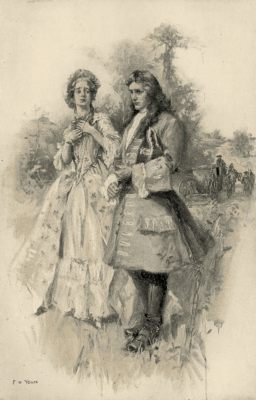
"HAD YOU LOVED ME—I HAD BEEN HAPPY"
Haward stepped backwards until there lay between them a strip of sunny
earth. The murmur of the wind went on and the birds were singing, and yet
the forest seemed more quiet than death. "I could not guess," he said,
speaking slowly and with his eyes upon the ground. "I have spoken like a
brute. I beg your pardon."
"You might have known! you might have guessed!" she cried, with passion.
"But, you walk an even way; you choose nor high nor low; you look deep
into your mind, but your heart you keep cool and vacant. Oh, a very
temperate land! I think that others less wise than you may also be less
blind. Never speak to me of this day! Let it die as these blooms are dying
in this hot sunshine! Now let us walk to the coach and waken my father. I
have gathered flowers enough."
Side by side, but without speaking, they moved from shadow to sunlight,
and from sunlight to shadow, down the road to the great pine-tree. The
white and purple flowers lay in her hand and along her bended arm; from
the folds of her dress, of some rich and silken stuff, chameleon-like in
its changing colors, breathed the subtle fragrance of the perfume then
most in fashion; over the thin lawn that half revealed, half concealed
neck and bosom was drawn a long and glossy curl, carefully let to escape
from the waved and banded hair beneath the gypsy hat. Exquisite from head
to foot, the figure had no place in the unpruned, untrained, savage, and
primeval beauty of those woods. Smooth sward, with jets of water and
carven nymphs embowered in clipped box or yew, should have been its
setting, and not this wild and tangled growth, this license of bird and
beast and growing things. And yet the incongruous riot, the contrast of
profuse, untended beauty, enhanced the value of the picture, gave it
piquancy and a completer charm.
When they were within a few feet of the coach and horses and negroes, all
drowsing in the sunny road, Haward made as if to speak, but she stopped
him with her lifted hand. "Spare me," she begged. "It is bad enough as it
is, but words would make it worse. If ever a day might come—I do not
think that I am unlovely; I even rate myself so highly as to think that I
am worthy of your love. If ever the day shall come when you can say to me,
'Now I see that love is no tinted dream; now I ask you to be my wife
indeed,' then, upon that day—But until then ask not of me what you asked
back there among the violets. I, too, am proud"—Her voice broke.
"Evelyn!" he cried. "Poor child—poor friend"—
She turned her face upon him. "Don't!" she said, and her lips were
smiling, though her eyes were full of tears. "We have forgot that it is
May Day, and that we must be light of heart. Look how white is that
dogwood-tree! Break me a bough for my chimney-piece at Williamsburgh."
He brought her a branch of the starry blossoms. "Did you notice," she
asked, "that the girl who ran—Audrey—wore dogwood in her hair? You could
see her heart beat with very love of living. She was of the woods, like a
dryad. Had the prizes been of my choosing, she should have had a gift more
poetical than a guinea."
Haward opened the coach door, and stood gravely aside while she entered
the vehicle and took her seat, depositing her flowers upon the cushions
beside her. The Colonel stirred, uncrossed his legs, yawned, pulled the
handkerchief from his face, and opened his eyes.
"Faith!" he exclaimed, straightening himself, and taking up his radiant
humor where, upon falling-asleep, he had let it drop. "The way must have
suddenly become smooth as a road in Venice, for I've felt no jolting this
half hour. Flowers, Evelyn? and Haward afoot? You've been on a woodland
saunter, then, while I enacted Solomon's sluggard!" The worthy parent's
eyes began to twinkle. "What flowers did you find? They have strange
blooms here, and yet I warrant that even in these woods one might come
across London pride and none-so-pretty and forget-me-not"—
His daughter smiled, and asked him some idle question about the May-apple
and the Judas-tree. The master of Westover was a treasure house of
sprightly lore. Within ten minutes he had visited Palestine, paid his
compliments to the ancient herbalists, and landed again in his own coach,
to find in his late audience a somewhat distraite daughter and a friend
in a brown study. The coach was lumbering on toward Williamsburgh, and
Haward, with level gaze and hand closed tightly upon his horse's reins,
rode by the window, while the lady, sitting in her corner with downcast
eyes, fingered the dogwood blooms that were not paler than her face.
The Colonel's wits were keen. One glance, a lift of his arched brows, the
merest ghost of a smile, and, dragging the younger man with him, he
plunged into politics. Invective against a refractory House of Burgesses
brought them a quarter of a mile upon their way; the necessity for an act
to encourage adventurers in iron works carried them past a milldam; and
frauds in the customs enabled them to reach a crossroads ordinary, where
the Colonel ordered a halt, and called for a tankard of ale. A slipshod,
blue-eyed Cherry brought it, and spoke her thanks in broad Scotch for the
shilling which the gay Colonel flung tinkling into the measure.
That versatile and considerate gentleman, having had his draught, cried to
the coachman to go on, and was beginning upon the question of the militia,
when Haward, who had dismounted, appeared at the coach door. "I do not
think that I will go on to Williamsburgh with you, sir," he said. "There's
some troublesome business with my overseer that ought not to wait. If I
take this road and the planter's pace, I shall reach Fair View by sunset.
You do not return to Westover this week? Then I shall see you at
Williamsburgh within a day or two. Evelyn, good-day."
Her hand lay upon the cushion nearest him. He would have taken it in his
own, as for years he had done when he bade her good-by; but though she
smiled and gave him "Good-day" in her usual voice, she drew the hand away.
The Colonel's eyebrows went up another fraction of an inch, but he was a
discreet gentleman who had bought experience. Skillfully unobservant, his
parting words were at once cordial and few in number; and after Haward had
mounted and had turned into the side road, he put his handsome, periwigged
head out of the coach window and called to him some advice about the
transplanting of tobacco. This done, and the horseman out of sight, and
the coach once more upon its leisurely way to Williamsburgh, the model
father pulled out of his pocket a small book, and, after affectionately
advising his daughter to close her eyes and sleep out the miles to
Williamsburgh, himself retired with Horace to the Sabine farm.
