CHAPTER III
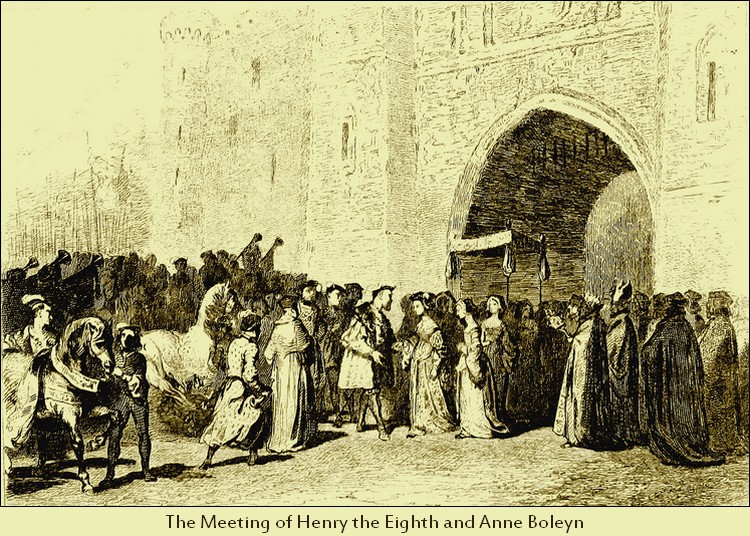
Of the Grand Procession to Windsor Castle—Of the Meeting of King Henry
the Eighth and Anne Boleyn at the Lower Gate-Of their Entrance into the
Castle—And how the Butcher was Hanged from the Curfew Tower.
A joyous day was it for Windsor and great were the
preparations made by its loyal inhabitants for a suitable reception to their
sovereign. At an early hour the town was thronged with strangers from the
neighbouring villages, and later on crowds began to arrive from London, some
having come along the highway on horseback, and others having rowed in
various craft up the river. All were clad in holiday attire, and the streets
presented an appearance of unwonted bustle and gaiety. The Maypole in
Bachelors' Acre was hung with flowers. Several booths, with flags floating
above them, were erected in the same place, where ale, mead, and hypocras,
together with cold pasties, hams, capons, and large joints of beef and
mutton, might be obtained. Mummers and minstrels were in attendance, and
every kind of diversion was going forward. Here was one party wrestling;
there another, casting the bar; on this side a set of rustics were dancing a
merry round with a bevy of buxom Berkshire lasses; on that stood a fourth
group, listening to a youth playing on the recorders. At one end of the Acre
large fires were lighted, before which two whole oxen were roasting, provided
in honour of the occasion by the mayor and burgesses of the town; at the
other, butts were set against which the Duke of Shoreditch and his
companions, the five marquises, were practising. The duke himself shot
admirably, and never failed to hit the bulls-eye; but the great feat of the
day was performed by Morgan Fenwolf, who thrice split the duke's shafts as
they stuck in the mark.
"Well done!" cried the duke, as he witnessed the achievement; "why, you
shoot as bravely as Herne the Hunter. Old wives tell us he used to split the
arrows of his comrades in that fashion."
"He must have learnt the trick from Herne himself in the forest," cried
one of the bystanders.
Morgan Fenwolf looked fiercely round in search of the speaker, but could
not discern him. He, however, shot no more, and refusing a cup of hypocras
offered him by Shoreditch, disappeared among the crowd.
Soon after this the booths were emptied, the bar thrown down, the Maypole
and the butts deserted, and the whole of Bachelors' Acre cleared of its
occupants—except those who were compelled to attend to the mighty spits
turning before the fires—by the loud discharge of ordnance from the
castle gates, accompanied by the ringing of bells, announcing that the mayor
and burgesses of Windsor, together with the officers of the Order of the
Garter, were setting forth to Datchet Bridge to meet the royal
procession.
Those who most promptly obeyed this summons beheld the lower castle gate,
built by the then reigning monarch, open, while from it issued four
trumpeters clad in emblazoned coats, with silken bandrols depending from
their horns, blowing loud fanfares. They were followed by twelve henchmen,
walking four abreast, arrayed in scarlet tunics, with the royal cypher H.R.
worked in gold on the breast, and carrying gilt poleaxes over their
shoulders. Next came a company of archers, equipped in helm and brigandine,
and armed with long pikes, glittering, as did their steel accoutrements, in
the bright sunshine. They were succeeded by the bailiffs and burgesses of the
town, riding three abreast, and enveloped in gowns of scarlet cloth; after
which rode the mayor of Windsor in a gown of crimson velvet, and attended by
two footmen, in white and red damask, carrying white wands. The mayor was
followed by a company of the town guard, with partisans over the shoulders.
Then came the sheriff of the county and his attendants. Next followed the
twenty-six alms-knights (for such was their number), walking two and two, and
wearing red mantles, with a scutcheon of Saint George on the shoulder, but
without the garter surrounding it. Then came the thirteen petty canons, in
murrey-coloured gowns, with the arms of Saint George wrought in a roundel on
the shoulder; then the twelve canons, similarly attired; and lastly the dean
of the college, in his cope.
A slight pause ensued, and the chief officers of the Garter made their
appearance. First walked the Black Rod, clothed in a russet-coloured mantle,
faced with alternate panes of blue and red, emblazoned with flower-de-luces
of gold and crowned lions. He carried a small black rod, the ensign of his
office, surmounted with the lion of England in silver. After the Black Rod
came the Garter, habited in a gown of crimson satin, paned and emblazoned
like that of the officer who preceded him, hearing a white crown with a
sceptre upon it, and having a gilt crown in lieu of a cap upon his head. The
Garter was followed by the register, a grave personage, in a black gown, with
a surplice over it, covered by a mantelet of furs. Then came the chancellor
of the Order, in his robe of murrey-coloured velvet lined with sarcenet, with
a badge on the shoulder consisting of a gold rose, enclosed in a garter
wrought with pearls of damask gold. Lastly came the Bishop of Winchester, the
prelate of the Order, wearing his mitre, and habited in a robe of crimson
velvet lined with white taffeta, faced with blue, and embroidered on the
right shoulder with a scutcheon of Saint George, encompassed with the Garter,
and adorned with cordons of blue silk mingled with gold.
Brought up by a rear guard of halberdiers, the procession moved slowly
along Thames Street, the houses of which, as well as those in Peascod Street,
were all more or less decorated—the humbler sort being covered with
branches of trees, intermingled with garlands of flowers, while the better
description was hung with pieces of tapestry, carpets, and rich stuffs. Nor
should it pass unnoticed that the loyalty of Bryan Bowntance, the host of the
Garter, had exhibited itself in an arch thrown across the road opposite his
house, adorned with various coloured ribbons and flowers, in the midst of
which was a large shield, exhibiting the letters, b. and h. (in mystic
allusion to Henry and Anne Boleyn) intermingled and surrounded by
love-knots.
Turning off on the left into the lower road, skirting the north of the
castle, and following the course of the river to Datchet, by which it was
understood the royal cavalcade would make its approach, the procession
arrived at an open space by the side of the river, where it came to a halt,
and the dean, chancellor, and prelate, together with other officers of the
Garter, embarked in a barge moored to the bank, which was towed slowly down
the stream in the direction of Datchet Bridge—a band of minstrels
stationed within it playing all the time.
Meanwhile the rest of the cavalcade, having again set for ward, pursued
their course along the banks of the river, proceeding at a foot's pace, and
accompanied by crowds of spectators, cheering them as they moved along. The
day was bright and beautiful, and nothing was wanting to enhance the beauty
of the spectacle. On the left flowed the silver Thames, crowded with craft,
filled with richly-dressed personages of both sexes, amid which floated the
pompous barge appropriated to the officers of the Garter, which was hung with
banners and streamers, and decorated at the sides with targets, emblazoned
with the arms of St. George. On the greensward edging the stream marched a
brilliant cavalcade, and on the right lay the old woods of the Home Park,
with long vistas opening through them, giving exquisite peeps of the towers
and battlements of the castle.
Half an hour brought the cavalcade to Datchet Bridge, at the foot of which
a pavilion was erected for the accommodation of the mayor and burgesses. And
here, having dismounted, they awaited the king's arrival.
Shortly after this a cloud of dust on the Staines Road seemed to announce
the approach of the royal party, and all rushed forth and held themselves in
readiness to meet it. But the dust appeared to have been raised by a company
of horsemen, headed by Captain Bouchier, who rode up the next moment.
Courteously saluting the mayor, Bouchier informed him that Mistress Anne
Boleyn was close behind, and that it was the king's pleasure that she should
be attended in all state to the lower gate of the castle, there to await his
coming, as he himself intended to enter it with her. The mayor replied that
the sovereign's behests should be implicitly obeyed, and he thereupon
stationed himself at the farther side of the bridge in expectation of Anne
Boleyn's arrival.
Presently the sound of trumpets smote his ear, and a numerous and splendid
retinue was seen advancing, consisting of nobles, knights, esquires, and
gentlemen, ranged according to their degrees, and all sumptuously apparelled
in cloths of gold and silver, and velvets of various colours, richly
embroidered. Besides these, there were pages and other attendants in the
liveries of their masters, together with sergeants of the guard and henchmen
in their full accoutrements. Among the nobles were the Dukes of Norfolk and
Suffolk—the king being desirous of honouring as much as possible her
whom he had resolved to make his queen. The former was clothed in tissue,
embroidered with roses of gold, with a baldric across his body of massive
gold, and was mounted on a charger likewise trapped in gold; and the latter
wore a mantle of cloth of silver, pounced in the form of letters, and lined
with blue velvet, while his horse was trapped bardwise in harness embroidered
with bullion gold curiously wrought. Both also wore the collar of the Order
of the Garter. Near them rode Sir Thomas Boleyn, who, conscious of the
dignity to which his daughter was to be advanced, comported himself with
almost intolerable haughtiness.
Immediately behind Sir Thomas Boleyn came a sumptuous litter covered with
cloth of gold, drawn by four white palfreys caparisoned in white damask down
to the ground, and each having a page in white and blue satin at its head.
Over the litter was borne a canopy of cloth of gold supported by four gilt
staves, and ornamented at the corners with silver bells, ringing forth sweet
music as it moved along. Each staff was borne by a knight, of whom sixteen
were in attendance to relieve one another when fatigued.
In this litter sat Anne Boleyn. She wore a surcoat of white tissue, and a
mantle of the same material lined with ermine. Her gown, which, however, was
now concealed by the surcoat, was of cloth of gold tissue, raised with pearls
of silver damask, with a stomacher of purple gold similarly raised, and large
open sleeves lined with chequered tissue. Around her neck she wore a chain of
orient pearls, from which depended a diamond cross. A black velvet cap,
richly embroidered with pearls and other precious stones, and ornamented with
a small white plume, covered her head; and her small feet were hidden in blue
velvet brodequins, decorated with diamond stars.
Anne Boleyn's features were exquisitely formed, and though not regular,
far more charming than if they had been so. Her nose was slightly aquiline,
but not enough so to detract from its beauty, and had a little retrousse;
point that completed its attraction. The rest of her features were delicately
chiselled: the chin being beautifully rounded, the brow smooth and white as
snow, while the rose could not vie with the bloom of her cheek. Her
neck—alas! that the fell hand of the executioner should ever touch
it—was long and slender, her eyes large and blue, and of irresistible
witchery—sometimes scorching the beholder like a sunbeam, anon melting
him with soul-subduing softness.
Of her accomplishments other opportunities will be found to speak; but it
may be mentioned that she was skilled on many instruments, danced and sang
divinely, and had rare powers of conversation and wit. If to these she had
not added the dangerous desire to please, and the wish to hold other hearts
than the royal one she had enslaved, in thraldom, all might, perhaps, have
been well. But, alas like many other beautiful women, she had a strong
tendency to coquetry. How severely she suffered for it, it is the purpose of
this history to relate. An excellent description of her has been given by a
contemporary writer, the Comte de Chateaubriand, who, while somewhat
disparaging her personal attractions, speaks in rapturous terms of her
accomplishments:—
"Anne," writes the Comte, "avait un esprit si
deslié qui c'estoit à qui l'ouiroit desgoiser; et ci venoit-elle a poetiser,
telle qu'Orpheus, elle eust faict les ours et rochers attentifs: puis
saltoit, balloit, et dançoit toutes dances Anglaises ou Estranges, et en
imagina nombre qui ont gardé son nom ou celluy du galant pour qui les feit:
puis sçavoit tous les jeux, qu'elle jouoit avec non plus d'heur que
d'habilité puis chantoit comme syrène, s'accompagnant de luth; harpoit
mieuelx que le roy David, et manioit fort gentilment fleuste et rebec; puis
s'accoustroit de tant et si merveilleuses façons, que ses inventions,
faisoient d'elle le parangon de toutes des dames les plus sucrées de la
court; mais nulle n'avoit sa grace, laquelle, au dire d'un ancien, passe
venusté."
Such was the opinion of one who knew her well during her residence at the
French court, when in attendance on Mary of England, consort of Louis XII.,
and afterwards Duchess of Suffolk.
At this moment Anne's eyes were fixed with some tenderness upon one of the
supporters of her canopy on the right—a very handsome young man,
attired in a doublet and hose of black tylsent, paned and cut, and whose
tall, well-proportioned figure was seen to the greatest advantage, inasmuch
as he had divested himself of his mantle, for his better convenience in
walking.
"I fear me you will fatigue yourself, Sir Thomas Wyat," said Anne Boleyn,
in tones of musical sweetness, which made the heart beat and the colour mount
to the cheeks of him she addressed. "You had better allow Sir Thomas Arundel
or Sir John Hulstone to relieve you."
"I can feel no fatigue when near you, madam," replied Wyat, in a low
tone.
A slight blush overspread Anne's features, and she raised her embroidered
kerchief to her lips.
"If I had that kerchief I would wear it at the next lists, and defy all
comers," said Wyat.
"You shall have it, then," rejoined Anne. "I love all chivalrous exploits,
and will do my best to encourage them."
"Take heed, Sir Thomas," said Sir Francis Weston, the knight who held the
staff on the other side," or we shall have the canopy down. Let Sir Thomas
Arundel relieve you."
"No," rejoined Wyat, recovering himself; "I will not rest till we come to
the bridge."
"You are in no haste to possess the kerchief," said Anne petulantly.
"There you wrong me, madam! "cried Sir Thomas eagerly.
"What ho, good fellows!" he shouted to the attendants at the palfreys'
heads, "your lady desires you to stop."
And I desire them to go on—I, Will Sommers, jester to the high and
mighty King Harry the Eighth!" cried a voice of mock authority behind the
knight. "What if Sir Thomas Wyat has undertaken to carry the canopy farther
than any of his companions, is that a reason he should be relieved? Of a
surety not—go on, I say!"
The person who thus spoke then stepped forward, and threw a glance so full
of significance at Anne Boleyn that she did not care to dispute the order,
but, on the contrary, laughingly acquiesced in it.
Will Sommers—the king's jester, as he described himself—was a
small middle-aged personage, with a physiognomy in which good nature and
malice, folly and shrewdness, were so oddly blended, that it was difficult to
say which predominated. His look was cunning and sarcastic, but it was
tempered by great drollery and oddity of manner, and he laughed so heartily
at his own jests and jibes, that it was scarcely possible to help joining
him. His attire consisted of a long loose gown of spotted crimson silk, with
the royal cipher woven in front in gold; hose of blue cloth, guarded with red
and black cloth; and red cordovan buskins. A sash tied round his waist served
him instead of a girdle, and he wore a trencher-shaped velvet cap on his
head, with a white tufted feather in it. In his hand he carried a small horn.
He was generally attended by a monkey, habited in a crimson doublet and hood,
which sat upon his shoulder, and played very diverting tricks, but the animal
was not with him on the present occasion.
Will Sommers was a great favourite with the king, and ventured upon
familiarities which no one else dared to use with him. The favour in which he
stood with his royal master procured him admittance to his presence at all
hours and at all seasons, and his influence, though seldom exerted, was very
great. He was especially serviceable in turning aside the edge of the king's
displeasure, and more frequently exerted himself to allay the storm than to
raise it. His principal hostility was directed against Wolsey, whose
arrogance and grasping practices were the constant subjects of his railing.
It was seldom, such was his privileged character, and the protection he
enjoyed from the sovereign, that any of the courtiers resented his remarks;
but Sir Thomas Wyat's feelings being now deeply interested, he turned sharply
round, and said, "How now, thou meddling varlet, what business hast thou to
interfere?"
"I interfere to prove my authority, gossip Wyat," replied Sommers, " and
to show that, varlet as I am, I am as powerful as Mistress Anne Boleyn—
nay, that I am yet more powerful, because I am obeyed, while she is not."
"Were I at liberty," said Sir Thomas angrily, "I would make thee repent
thine insolence."
"But thou art not at liberty, good gossip," replied the jester, screaming
with laughter; " thou art tied like a slave to the oar, and cannot free
thyself from it—ha! ha!" Having enjoyed the knight's discomposure for a
few seconds, he advanced towards him, and whispered in his ear, "Don't
mistake me, gossip. I have done thee good service in preventing thee from
taking that kerchief. Hadst thou received it in the presence of these
witnesses, thou wouldst have been lodged in the Round Tower of Windsor Castle
to-morrow, instead of feasting with the knights- companions in Saint George's
Hall."
"I believe thou art right, gossip,"said Wyat in the same tone.
Rest assured I am," replied Sommers; "and I further more counsel thee to
decline this dangerous gift altogether, and to think no more of the fair
profferer, or if thou must think of her, let it be as of one beyond thy
reach. Cross not the lion's path; take a friendly hint from the jackal."
And without waiting for a reply, he darted away, and mingled with the
cavalcade in the rear.
Immediately behind Anne Boleyn's litter rode a company of henchmen of the
royal household, armed with gilt partisans. Next succeeded a chariot covered
with red cloth of gold, and drawn by four horses richly caparisoned,
containing the old Duchess of Norfolk and the old Marchioness of Dorset. Then
came the king's natural son, the Duke of Richmond—a young man formed on
the same large scale, and distinguished by the same haughty port, and the
same bluff manner, as his royal sire. The duke's mother was the Lady Talboys,
esteemed one of the most beautiful women of the age, and who had for a long
time held the capricious monarch captive. Henry was warmly attached to his
son, showered favours without number upon him, and might have done yet more
if fate had not snatched him away at an early age.
Though scarcely eighteen, the Duke of Richmond looked more than twenty,
and his lips and chin were clothed with a well-grown though closely-clipped
beard. He was magnificently habited in a doublet of cloth of gold of
bawdekin, the placard and sleeves of which were wrought with flat gold, and
fastened with aiglets. A girdle of crimson velvet, enriched with precious
stones, encircled his waist, and sustained a poniard and a Toledo sword,
damascened with gold. Over all he wore a loose robe, or housse, of scarlet
mohair, trimmed with minever, and was further decorated with the collar of
the Order of the Garter. His cap was of white velvet, ornamented with
emeralds, and from the side depended a small azure plume. He rode a
magnificent black charger, trapped in housings of cloth of gold, powdered
with ermine.
By the duke's side rode the Earl of Surrey attired—as upon the
previous day, and mounted on a fiery Arabian, trapped in crimson velvet
fringed with Venetian gold. Both nobles were attended by their esquires in
their liveries.
Behind them came a chariot covered with cloth of silver, and drawn, like
the first, by four horses in rich housings, containing two very beautiful
damsels, one of whom attracted so much of the attention of the youthful
nobles, that it was with difficulty they could preserve due order of march.
The young dame in question was about seventeen; her face was oval in form,
with features of the utmost delicacy and regularity. Her complexion was fair
and pale, and contrasted strikingly with her jetty brows and magnificent
black eyes, of oriental size, tenderness, and lustre. Her dark and luxuriant
tresses were confined by a cap of black velvet faced with white satin, and
ornamented with pearls. Her gown was of white satin worked with gold, and had
long open pendent sleeves, while from her slender and marble neck hung a
cordeliere—a species of necklace imitated from the cord worn by
Franciscan friars, and formed of crimson silk twisted with threads of
Venetian gold..
This fair creature was the Lady Elizabeth Fitzgerald, daughter of Gerald
Fitzgerald, ninth Earl of Kildare, who claimed descent from the Geraldi
family of Florence; but she was generally known by the appellation of the
Fair Geraldine—a title bestowed upon her, on account of her beauty, by
the king, and by which she still lives, and will continue to live, as long as
poetry endures, in the deathless and enchanting strains of her lover, the
Earl of Surrey. At the instance of her mother, Lady Kildare, the Fair
Geraldine was brought up with the Princess Mary, afterwards Queen of England;
but she had been lately assigned by the royal order as one of the
attendants—a post equivalent to that of maid of honour—to Anne
Boleyn.
Her companion was the Lady Mary Howard, the sister of the Earl of Surrey,
a nymph about her own age, and possessed of great personal attractions,
having nobly-formed features, radiant blue eyes, light tresses, and a
complexion of dazzling clearness. Lady Mary Howard nourished a passion for
the Duke of Richmond, whom she saw with secret chagrin captivated by the
superior charms of the Fair Geraldine. Her uneasiness, however, was in some
degree abated by the knowledge, which as confidante of the latter she had
obtained, that her brother was master of her heart. Lady Mary was dressed in
blue velvet, cut and lined with cloth of gold, and wore a headgear of white
velvet, ornamented with pearls.
Just as the cavalcade came in sight of Datchet Bridge, the Duke of
Richmond turned his horse's head, and rode up to the side of the chariot on
which the Fair Geraldine was sitting.
"I am come to tell you of a marvellous adventure that befell Surrey in the
Home Park at Windsor last night," he said. "He declares he has seen the demon
hunter, Herne."
"Then pray let the Earl of Surrey relate the adventure to us himself,"
replied the Fair Geraldine. "No one can tell a story so well as the hero of
it."
The duke signed to the youthful earl, who was glancing rather wistfully at
them, and he immediately joined them, while Richmond passed over to the Lady
Mary Howard. Surrey then proceeded to relate what had happened to him in the
park, and the fair Geraldine listened to his recital with breathless
interest.
"Heaven shield us from evil spirits!" she exclaimed, crossing herself.
"But what is the history of this wicked hunter, my lord? and why did he incur
such a dreadful doom?"
"I know nothing more than that he was a keeper in the forest, who, having
committed some heinous crime, hanged himself from a branch of the oak beneath
which I found the keeper, Morgan Fenwolf, and which still bears his name,"
replied the earl. "For this unrighteous act he cannot obtain rest, but is
condemned to wander through the forest at midnight, where he wreaks his
vengeance in blasting the trees."
"The legend I have heard differs from yours," observed the Duke of
Richmond: "it runs that the spirit by which the forest is haunted is a
wood-demon, who assumes the shape of the ghostly hunter, and seeks to tempt
or terrify the keepers to sell their souls to him."
"Your grace's legend is the better of the two," said Lady Mary Howard, "or
rather, I should say, the more probable. I trust the evil spirit did not make
you any such offer, brother of Surrey?"
The earl gravely shook his head.
"If I were to meet him, and he offered me my heart's dearest wish, I fear
he would prevail with me," observed the duke, glancing tenderly at the Fair
Geraldine.
"Tush!—the subject is too serious for jesting, Richmond," said
Surrey almost sternly.
"His grace, as is usual in compacts with the fiend, might have reason to
rue his bargain," observed Lady Mary Howard peevishly.
"If the Earl of Surrey were my brother," remarked the Fair Geraldine to
the Lady Mary, "I would interdict him from roaming in the park after
nightfall."
"He is very wilful," said Lady Mary, smiling, "and holds my commands but
lightly."
"Let the Fair Geraldine lay hers upon me, and she shall not have to
reproach me with disobedience," rejoined the earl.
I must interpose to prevent their utterance," cried Richmond, with a
somewhat jealous look at his friend, "for I have determined to know more of
this mystery, and shall require the earl's assistance to unravel it. I think
I remember Morgan Fenwolf, the keeper, and will send for him to the castle,
and question him. But in any case, I and Surrey will visit Herne's Oak
to-night."
The remonstrances of both ladies were interrupted by the sudden appearance
of Will Sommers.
"What ho! my lords—to your places! to your places!" cried the
jester, in a shrill angry voice. "See ye not we are close upon Datchet
Bridge? Ye can converse with these fair dames at a more fitting season; but
it is the king's pleasure that the cavalcade should make a goodly show. To
your places, I say!"
Laughing at the jester's peremptory injunction, the two young nobles
nevertheless obeyed it, and, bending almost to the saddle-bow to the ladies,
resumed their posts.
The concourse assembled on Datchet Bridge welcomed Anne Boleyn's arrival
with loud acclamations, while joyous strains proceeded from sackbut and
psaltery, and echoing blasts from the trumpets. Caps were flung into the air,
and a piece of ordnance was fired from the barge, which was presently
afterwards answered by the castle guns. Having paid his homage to Anne
Boleyn, the mayor rejoined the company of bailiffs and burgesses, and the
whole cavalcade crossed the bridge, winding their way slowly along the banks
of the river, the barge, with the minstrels playing in it, accompanying them
the while. In this way they reached Windsor; and as Anne Boleyn gazed up at
the lordly castle above which the royal standard now floated, proud and
aspiring thoughts swelled her heart, and she longed for the hour when she
should approach it as its mistress. Just then her eye chanced on Sir Thomas
Wyat, who was riding behind her amongst the knights, and she felt, though it
might cost her a struggle, that love would yield to ambition.
Leaving the barge and its occupants to await the king's arrival, the
cavalcade ascended Thames Street, and were welcomed everywhere with
acclamations and rejoicing. Bryan Bowntance, who had stationed himself on the
right of the arch in front of his house, attempted to address Anne Boleyn,
but could not bring forth a word. His failure, how ever, was more successful
than his speech might have been, inasmuch as it excited abundance of
merriment.
Arrived at the area in front of the lower gateway, Anne Boleyn's litter
was drawn up in the midst of it, and the whole of the cavalcade grouping
around her, presented a magnificent sight to the archers and arquebusiers
stationed on the towers and walls.
Just at this moment a signal gun was heard from Datchet Bridge, announcing
that the king had reached it, and the Dukes of Suffolk, Norfolk, and
Richmond, together with the Earl of Surrey, Sir Thomas Wyat, and a few of
their gentle men, rode back to meet him. They had scarcely, however, reached
the foot of the hill when the royal party appeared in view, for the king with
his characteristic impatience, on drawing near the castle, had urged his
attendants quickly forward.
First came half a dozen trumpeters, with silken bandrols fluttering in the
breeze, blowing loud flourishes. Then a party of halberdiers, whose leaders
had pennons streaming from the tops of their tall pikes. Next came two
gentlemen ushers bareheaded, but mounted and richly habited, belonging to the
Cardinal of York, who cried out as they pressed forward, "On before, my
masters, on before!—make way for my lord's grace."
Then came a sergeant-of-arms bearing a great mace of silver, and two
gentlemen carrying each a pillar of silver. Next rode a gentleman carrying
the cardinal's hat, and after him came Wolsey himself, mounted on a mule
trapped in crimson velvet, with a saddle covered with the same stuff, and
gilt stirrups. His large person was arrayed in robes of the finest crimson
satin engrained, and a silk cap of the same colour contrasted by its
brightness with the pale purple tint of his sullen, morose, and bloated
features. The cardinal took no notice of the clamour around him, but now and
then, when an expression of dislike was uttered against him, for he had
already begun to be unpopular with the people, he would raise his eyes and
direct a withering glance at the hardy speaker. But these expressions were
few, for, though tottering, Wolsey was yet too formidable to be insulted with
impunity. On either side of him were two mounted attend ants, each caring a
gilt poleaxe, who, if he had given the word, would have instantly chastised
the insolence of the bystanders, while behind him rode his two cross-bearers
upon homes trapped in scarlet.
Wolsey's princely retinue was followed by a litter of crimson velvet, in
which lay the pope's legate, Cardinal Campeggio, whose infirmities were so
great that he could not move without assistance. Campeggio was likewise
attended by a numerous train.
After a long line of lords, knights, and esquires, came Henry the Eighth.
He was apparelled in a robe of crimson velvet furred with ermines, and wore a
doublet of raised gold, the placard of which was embroidered with diamonds,
rubies, emeralds, large pearls, and other precious stones. About his neck was
a baldric of balas rubies, and over his robe he wore the collar of the Order
of the Garter. His horse, a charger of the largest size, and well able to
sustain his vast weight, was trapped in crimson velvet, purfled with ermines.
His knights and esquires were clothed in purple velvet, and his henchmen in
scarlet tunics of the same make as those worn by the warders of the Tower at
the present day.
Henry was in his thirty-eighth year, and though somewhat overgrown and
heavy, had lost none of his activity, and but little of the grace of his
noble proportions. His size and breadth of limb were well displayed in his
magnificent habiliment. His countenance was handsome and manly, with a
certain broad burly look, thoroughly English in its character, which won him
much admiration from his subjects; and though it might be objected that the
eyes were too small, and the mouth somewhat too diminutive, it could not be
denied that the general expression of the face was kingly in the extreme. A
prince of a more "royal presence" than Henry the Eighth was never seen, and
though he had many and grave faults, want of dignity was not amongst the
number.
Henry entered Windsor amid the acclamations of the spectators, the
fanfares of trumpeters, and the roar of ordnance from the castle walls.
Meanwhile, Anne Boleyn, having descended from her litter, which passed
through the gate into the lower ward, stood with her ladies beneath the
canopy awaiting his arrival.
A wide clear space was preserved before her, into which, however, Wolsey
penetrated, and, dismounting, placed himself so that he could witness the
meeting between her and the king. Behind him stood the jester, Will Sommers,
who was equally curious with himself. The litter of Cardinal Campeggio passed
through the gateway and proceeded to the lodgings reserved for his
eminence.
Scarcely had Wolsey taken up his station than Henry rode up, and,
alighting, consigned his horse to a page, and, followed by the Duke of
Richmond and the Earl of Surrey, advanced towards Anne Boleyn, who
immediately stepped forward to meet him.
"Fair mistress," he said, taking her hand, and regarding her with a look
of passionate devotion, "I welcome you to this my castle of Windsor, and
trust soon to make you as absolute mistress of it as I am lord and
master."
Anne Boleyn blushed, and cast down her eyes, and Sir Thomas Wyat, who
stood at some little distance with his hand upon his saddle, regarding her,
felt that any hopes he might have entertained were utterly annihilated.
"Heard you that, my lord cardinal?" said Will Sommers to Wolsey. "She will
soon be mistress here. As she comes in, you go out—mind that!"
The cardinal made no answer further than was conveyed by the deepened
colour of his cheeks.
Amid continued fanfares and acclamations, Harry then led Anne Boleyn
through the gateway, followed by the ladies in waiting, who were joined by
Richmond and Surrey. The prelate, chancellor, register, black rod, and other
officers of the Garter, together with the whole of the royal retinue who had
dismounted, came after them. A vast concourse of spectators, extending almost
as far as the Lieutenant's Tower, was collected in front of the alms-knights'
houses; but a wide space had been kept clear by the henchmen for the passage
of the sovereign and his train, and along this Henry proceeded with Anne
Boleyn, in the direction of the upper ward. Just as he reached the Norman
Tower, and passed the entrance to the keep, the Duke of Shoreditch, who was
standing beneath the gateway, advanced towards him and prostrated himself on
one knee.
"May it please your majesty," said Shoreditch, "I last night arrested a
butcher of Windsor for uttering words highly disrespectful of your highness,
and of the fair and virtuous lady by your side."
"Ah! God's death! " exclaimed the king. "Where is the traitor? Bring him
before us."
"He is here," replied Shoreditch.
And immediately Mark Fytton was brought forward by a couple of
halberdiers. He still preserved his undaunted demeanour, and gazed sternly at
the king.
"So, fellow, thou hast dared to speak disrespectfully of us—ha!"
cried Henry.
I have spoken the truth," replied the butcher fearlessly. "I have said you
were about to divorce your lawful consort, Catherine of Arragon, and to take
the minion, Anne Boleyn, who stands beside you, to your bed. And I added, it
was a wrongful act."
"Foul befall thy lying tongue for saying so!" replied Henry furiously. "I
have a mind to pluck it from thy throat, and cast it to the dogs. What ho!
guards, take this caitiff to the summit of the highest tower of the
castle—the Curfew Tower—and hang him from it, so that all my
loyal subjects in Windsor may see how traitors are served."
"Your highness has judged him justly," said Anne Boleyn. "You say so now,
Mistress Anne Boleyn," rejoined the butcher; "but you yourself shall one day
stand in as much peril of your life as I do, and shall plead as vainly as I
should, were I to plead at all, which I will never do to this inexorable
tyrant. You will then remember my end."
Away with him! " cried Henry. " I myself will go to the Garter Tower to
see it done. Farewell for a short while, sweetheart. I will read these
partisans of Catherine a terrible lesson."
As the butcher was hurried off to the Curfew Tower, the king proceeded
with his attendants to the Garter Tower, and ascended to its summit.
In less than ten minutes a stout pole, like the mast of a ship, was thrust
through the battlements of the Curfew Tower, on the side looking towards the
town. To this pole a rope, of some dozen feet in length, and having a noose
at one end, was firmly secured. The butcher was then brought forth, bound
hand and foot, and the noose was thrown over his neck.
While this was passing, the wretched man descried a person looking at him
from a window in a wooden structure projecting from the side of the
tower.
"What, are you there, Morgan Fenwolf?" he cried. "Remember what passed
between us in the dungeon last night, and be warned l You will not meet your
end as firmly as I meet mine?'
"Make thy shrift quickly, fellow, if thou hast aught to say," interposed
one of the halberdiers.
"I have no shrift to make," rejoined the butcher. "I have already settled
my account with Heaven. God preserve Queen Catherine!"
As he uttered these words, he was thrust off from the battlements by the
halberdiers, and his body swung into the abyss amid the hootings and
execrations of the spectators below.
Having glutted his eyes with the horrible sight, Henry descended from the
tower, and returned to Anne Boleyn.