CHAPTER IV
How King Henry the Eighth held a Chapter of the Garter—How he attended
Vespers and Matins in Saint George's Chapel—And how he feasted with the
Knights—Companions in Saint George's Hall.
From a balcony overlooking the upper ward, Anne Boleyn
beheld the king's approach on his return from the Garter Tower, and waving
her hand smilingly to him, she withdrew into the presence-chamber. Hastening
to her, Henry found her surrounded by her ladies of honour, by the chief of
the nobles and knights who had composed her train from Hampton Court, and by
the Cardinals Wolsey and Campeggio; and having exchanged a few words with
her, he took her hand, and led her to the upper part of the chamber, where
two chairs of state were set beneath a canopy of crimson velvet embroidered
with the royal arms, and placed her in the seat hitherto allotted to
Catherine of Arragon. A smile of triumph irradiated Anne's lovely countenance
at this mark of distinction, nor was her satisfaction diminished as Henry
turned to address the assemblage.
"My lords," he said, "ye are right well aware of the scruples of
conscience I entertain in regard to my marriage with my brother's widow,
Catherine of Arragon. The more I weigh the matter, the more convinced am I of
its unlawfulness; and were it possible to blind myself to my sinful
condition, the preachers, who openly rebuke me from the pulpit, would take
care to remind me of it. Misunderstand me not, my lords. I have no ground of
complaint against the queen. Far otherwise. She is a lady of most excellent
character—full of devotion, loyalty, nobility, and gentleness. And if I
could divest myself of my misgivings, so far from seeking to put her from me,
I should cherish her with the greatest tenderness. Ye may marvel that I have
delayed the divorce thus long. But it is only of late that my eyes have been
opened; and the step was hard to take. Old affections clung to me—old
chains restrained me—nor could I, without compunction, separate myself
from one who has ever been to me a virtuous and devoted consort."
"Thou hast undergone a martyrdom, gossip," observed Will Sommers, who had
posted himself at the foot of the canopy, near the king, " and shalt
henceforth be denominated Saint Henry"
The gravity of the hearers might have been discomposed by this remark, but
for the stern looks of the king.
"Ye may make a jest of my scruples, my lords," he continued, "and think I
hold them lightly; but my treatise on the subject, which has cost me much
labour and meditation, will avouch to the contrary. What would befall this
realm if my marriage were called in question after my decease? The same
trouble and confusion would ensue that followed on the death of my noble
grandfather, King Edward the Fourth. To prevent such mischance I have
resolved, most reluctantly, to put away my present queen, and to take another
consort, by whom I trust to raise up a worthy successor and inheritor of my
kingdom."
A murmur of applause followed this speech, and the two cardinals exchanged
significant glances, which were not unobserved by the king.
"I doubt not ye will all approve the choice I shall make," he pursued,
looking fiercely at Wolsey, and taking Anne Boleyn's hand, who arose as he
turned to her. "And now, fair mistress," he added to her, "as an earnest of
the regard I have for you, and of the honours I intend you, I hereby create
you Marchioness of Pembroke, and bestow upon you a thousand marks a year in
land, and another thousand to be paid out of my treasury to support your
dignity."
"Your majesty is too generous," replied Anne, bending the knee, and
kissing his hand.
"Not a whit, sweetheart—not a whit," replied Henry, tenderly raising
her; "this is but a slight mark of my goodwill. Sir Thomas Boleyn," he added
to her father, "henceforth your style and title will be that of Viscount
Rochford, and your patent will be made out at the same time as that of your
daughter, the Marchioness of Pembroke. I also elect you a knight- companion
of the most honourable Order of the Garter, and your investiture and
installation will take place to-day."
Having received the thanks and homage of the newly-created noble, Henry
descended from the canopy, and passed into an inner room with the Lady Anne,
where a collation was prepared for them. Their slight meal over, Anne took up
her lute, and playing a lively prelude, sang two or three French songs with
so much skill and grace, that Henry, who was passionately fond of music, was
quite enraptured. Two delightful hours having passed by, almost
imperceptibly, an usher approached the king, and whispering a few words to
him, he reluctantly withdrew, and Anne retired with her ladies to an inner
apartment.
On reaching his closet, the king's attendants proceeded to array him in a
surcoat of crimson velvet, powdered with garters embroidered in silk and
gold, with the motto—honi soit qui mal y pense—wrought
within them. Over the surcoat was thrown a mantle of blue velvet with a
magnificent train, lined with white damask, and having on the left shoulder a
large garter, wrought in pearls and Venice twists, containing the motto, and
encircling the arms of Saint George—argent, a cross gules. The royal
habiliments were completed by a hood of the same stuff as the surcoat,
decorated like it with small embroidered garters, and lined with white satin.
From the king's neck was suspended the collar of the Great George, composed
of pieces of gold, fashioned like garters, the ground of which was enamelled,
and the letters gold.
While Henry was thus arrayed, the knights-companions, robed in their
mantles, hoods, and collars, entered the closet, and waiting till he was
ready, marched before him into the presence-chamber, where were assembled the
two provincial kings-at-arms, Clarenceux and Norroy, the heralds, and
pursuivants, wearing their coats-of-arms, together with the band of
pensioners, carrying gilt poleaxes, and drawn up in two lines. At the king's
approach, one of the gentlemen-ushers who carried the sword of state, with
the point resting upon the ground, delivered it to the Duke of
Richmond,—the latter having been appointed to bear it before the king
during all the proceedings of the feast. Meanwhile, the knights-companions
having drawn up on either side of the canopy, Henry advanced with a slow and
stately step towards it, his train borne by the Earl of Surrey, Sir Thomas
Wyat, and other nobles and knights. As he ascended the canopy, and faced the
assemblage, the Duke of Richmond and the chief officers of the Order drew up
a little on his right. The knights-companions then made their salutation to
him, which he returned by removing his jewelled cap with infinite grace and
dignity, and as soon as he was again covered they put on their caps, and
ranging themselves in order, set forward to Saint George's Chapel.
Quitting the royal lodgings, and passing through the gateway of the Norman
Tower, the procession wound its way along the base of the Round Tower, the
battlements of which bristled with spearmen, as did the walls on the right,
and the summit of the Winchester Tower, and crossing the middle ward, skirted
the tomb-house, then newly erected by Wolsey, and threading a narrow passage
between it and Saint George's Chapel, entered the north-east door of the
latter structure.
Dividing, on their entrance into the chapel, into two lines, the
attendants of the knights-companions flanked either side of the north aisle;
while between them walked the alms-knights, the verger, the prebends of the
college, and the officers-of-arms, who proceeded as far as the west door of
the choir, where they stopped. A slight pause then ensued, after which the
king, the knights-companions, and the chief officers of the Order, entered
the chapter-house—a chamber situated at the north-east corner of the
chapel—leaving the Duke of Richmond, the sword-bearer, Lard Rochford,
the knight-elect, the train-bearers, and pensioners outside. The door of the
chapter-house being closed by the black-rod, the king proceeded to the upper
end of the vestments-board— as the table was designated—where a
chair, cushions, and cloth of state were provided for him; the
knights-companions, whose stalls in the choir were on the same side as his
own, seating themselves on his right, and those whose posts were on the
prince's side taking their places on the left. The prelate and the chancellor
stood at the upper end of the table; the Garter and register at the foot;
while the door was kept by the black-rod.
As soon as the king and the knights were seated, intimation was given by
an usher to the black-rod that the newly elected knight, Lord Rochford, was
without. The intelligence being communicated to the king, he ordered the
Dukes of Suffolk and Norfolk to bring him into his presence. The injunction
was obeyed, and the knight-elect presently made his appearance, the Garter
marching before him to the king. Bowing reverently to the sovereign,
Rochford, in a brief speech, expressed his gratitude for the signal honour
conferred upon him, and at its close set his left foot upon a gilt stool,
placed for him by the Garter, who pronounced the following
admonition:—" My good lord, the loving company of the Order of the
Garter have received you as their brother and fellow. In token whereof, they
give you this garter, which God grant you may receive and wear from
henceforth to His praise and glory, and to the exaltation and honour of the
noble Order and yourself."
Meanwhile the garter was girded on the leg of the newly-elected knight,
and buckled by the Duke of Suffolk. This done, he knelt before the king, who
hung a gold chain, with the image of Saint George attached to it, about his
neck, while another admonition was pronounced by the chancellor. Rochford
then arose, bowed to the monarch, to the knights- companions, who returned
his salutations, and the investiture was complete.
Other affairs of the chapter were next discussed. Certain officers
nominated since the last meeting, were sworn; letters from absent
knights-companions, praying to be excused from attendance, were
read—and their pleas, except in the instance of Sir Thomas Cheney,
allowed. After reading the excuse of the latter, Henry uttered an angry oath,
declaring he would deprive him of his vote in the chapter-house, banish him
from his stall, and mulct him a hundred marks, to be paid at Saint George's
altar, when Will Sommers, who was permitted to be present, whispered in his
ear that the offender was kept away by the devices of Wolsey, because he was
known to be friendly to the divorce, and to the interests of the lady
Anne.
"Aha! by Saint Mary, is it so?" exclaimed Henry, knitting his brows. "This
shall be looked into. I have hanged a butcher just now. Let the butcher's son
take warning by his fate. He has bearded me long enough. See that Sir Thomas
Cheney be sent for with all despatch. I will hear the truth from his own
lips."
He then arose, and quitting the chapter-house, proceeded with the
knights-companions to the choir—the roof and walls of the sacred
structure resounding with the solemn notes of the organ as they traversed the
aisle. The first to enter the choir were the aIms-knights, who passed through
the door in a body, and making low obeisances toward the altar and the royal
stall, divided into two lines. They were succeeded by the prebends of the
College, who, making similar obeisances, stationed themselves in front of the
benches before the stalls of the knights-companions. Next followed the
pursuivants, heralds, and provincial kings-of-arms, making like reverences,
and ranging themselves with the alms-knights. Then came the knights-
companions, who performed double reverences like the others, and took their
stations under their stalls; then came the black-rod, Garter, and register,
who having gone through the same ceremony as the others, proceeded to their
form, which was placed on the south side of the choir before the sovereign's
stall; then came the chancellor and prelate, whose form was likewise placed
before the royal stall, but nearer to it than that allotted to the other
officers; and, lastly, Henry himself, with the sword borne before him by the
Duke of Richmond, who as he approached the steps of his stall bowed
reverently towards the altar, and made another obeisance before seating
himself.
Meanwhile the Duke of Richmond posted himself in front of the royal stall,
the Earl of Oxford, as lord chamberlain, taking his station on the king's
right, and the Earl of Surrey, as vice-chamberlain, on the left. As these
arrangements were made, the two cardinals arrived, and proceeded to the
altar.
Mass was then said, and nothing could be more striking than the appearance
of the chapel during its performance. The glorious choir with its groined and
pendent roof, its walls adorned with the richest stuffs, its exquisitely
carved stalls, above which hung the banners of the knights-companions,
together with their helmets, crests, and swords, its
sumptuously—decorated altar, glittering with costly vessels, its pulpit
hung with crimson damask interwoven with gold, the magnificent and varied
dresses of the assemblage—all these constituted a picture of surpassing
splendour.
Vespers over, the king and his train departed with the same ceremonies and
in the same order as had been observed on their entrance to the choir.
On returning to the royal lodgings, Henry proceeded to his closet, where
having divested himself of his mantle, he went in search of the Lady Anne. He
found her walking with her dames on the stately terrace at the north of the
castle, and the attendants retiring as he joined her, he was left at full
liberty for amorous converse. After pacing the terrace for some time, he
adjourned with Anne to her own apartments, where he remained till summoned to
supper with the knights- companions in Saint George's Hall.
The next morning betimes, it being the day of the Patron Saint of the
Order of the Garter, a numerous cavalcade assembled in the upper ward of the
castle, to conduct the king to hear matins in Saint George's Chapel. In order
to render the sight as imposing as possible, Henry had arranged that the
procession should take place on horseback, and the whole of the retinue were
accordingly mounted. The large quadrangle was filled with steeds and their
attendants, and the castle walls resounded with the fanfares of trumpets and
the beating of kettledrums. The most attractive feature of the procession in
the eyes of the beholders was the Lady Anne, who, mounted on a snow-white
palfrey richly trapped, rode on the right of the king. She was dressed in a
rich gown of raised cloth of gold; and had a coronet of black velvet,
decorated with orient pearls, on her head. Never had she looked so lovely as
on this occasion, and the king's passion increased as he gazed upon her.
Henry himself was more sumptuously attired than on the preceding day. He wore
a robe of purple velvet, made somewhat like a frock, embroidered with flat
damask gold, and small lace intermixed. His doublet was very curiously
embroidered, the sleeves and breast being lined with cloth of gold, and
fastened with great buttons of diamonds and rubies. His sword and girdle were
adorned with magnificent emeralds, and his bonnet glistened with precious
stones. His charger was trapped in cloth of gold, traversed lattice-wise,
square, embroidered with gold damask, pearled on every side, and having
buckles and pendants of fine gold. By his side ran ten footmen, richly
attired in velvet and goldsmith's work. They were followed by the pages of
honour, mounted on great horses, trapped in crimson velvet embroidered with
new devices and knots of gold.
In this state Henry and his favourite proceeded to the great western door
of Saint George's Chapel. Here twelve gentlemen of the privy- chamber
attended with a canopy of cloth of gold, which they bore over the king's
bead, and that of the Lady Anne, as she walked beside him to the entrance of
the choir, where they separated—he proceeding to his stall, and she to
a closet at the north-east corner of the choir over the altar, while her
ladies repaired to one adjoining it.
Matins then commenced, and at the appointed part of the service the dean
of the college took a silver box, containing the heart of Saint George,
bestowed upon King Henry the Fifth by the Emperor Sigismund, and after
incense had been shed upon it by one of the canons, presented it to the king
and the knights-companions to kiss.
After the offertory, a carpet was spread on the steps before the altar,
the alms-knights, pursuivants, and heralds stationing themselves on either
side of it. The Garter then descended from his seat, and waving his rod, the
knights-companions descended likewise, but remained before their stalls. The
black-rod next descended, and proceeding towards the altar, a groom of the
wardrobe brought him a small carpet of cloth of gold, and a cushion of the
same stuff, which were placed on the larger carpet, the cushion being set on
the head of the steps. Taking a large gilt bason to receive the offerings,
the prelate stationed himself with one of the prebends in the midst of the
altar. The king then rose from his stall, and making a reverence as before,
proceeded to the altar, attended by the Garter, register, and chancellor,
together with the Duke of Richmond bearing the sword; and having reached the
upper step, prostrated himself on the cushion, while the black-rod bending
the knee delivered a chain of gold, intended afterwards to be redeemed, to
the Duke of Suffolk, who was appointed to make the royal offering, and who
placed it in the bason held by the prelate. This ceremony over, the king got
up, and with similar reverences returned to his stall. Then the two
provincial kings, Clarenceux and Norroy, proceeded along the choir, and
making due reverences to the altar and the sovereign, bowed to the two senior
knights; who thereupon advanced towards the altar, and kneeling down, made
their offering. The other imitated their example, coming forward according to
their seniority.
The service ended, the officers and knights-companions quitted the chapel
in the same order they had entered it, the king being received under the
canopy at the door of the choir, and passing through the west entrance of the
chapel, where he waited for the Lady Anne. On her arrival they both mounted
their steeds, and rode up to the royal lodgings amid flourishes of trumpets
and acclamations. Dismounting at the great gate, Henry proceeded to the
presence-chamber, where the knights-companions had assembled, and having
received their salutations, retired to his closet. Here he remained in deep
consultation with the Duke of Suffolk for some hours, when it having been
announced to him that the first course of the banquet was served, he came
forth, and proceeded to the presence-chamber, where he greeted the
knights-companions, who were there assembled, and who immediately put
themselves in order of procession. After this, the alms- knights, prebends,
and officers-of-arms passed on through the guard- chamber into Saint George's
Hall. They were followed by the knights- companions, who drew up in double
file, the seniors taking the uppermost place; and through these lines the
king passed, his train borne up as before, until reaching the table set apart
for him beneath a canopy, he turned round and received the knights'
reverences. The Earl of Oxford, as vice-chamberlain, then brought him a ewer
containing water, the Earl of Surrey a bason, and Lord Rochford a napkin.
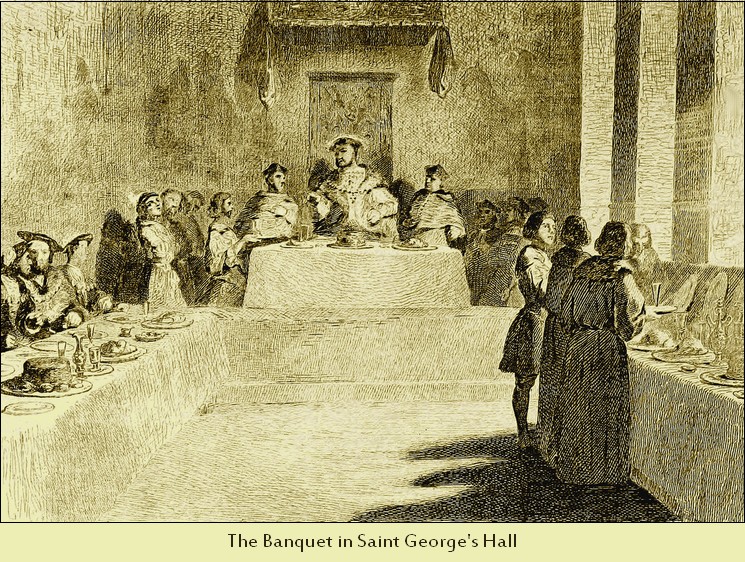
Henry having performed his ablutions, grace was said by the prelate, after
which the king seated himself beneath the canopy in an ancient chair with a
curiously carved back representing the exploit of Saint George, which had
once belonged to the founder, King Edward the Third, and called up the two
cardinals, who by this time had entered the hall, and who remained standing
beside him, one on either hand, during the repast.
As soon as the king was seated, the knights-companions put on their caps,
and retired to the table prepared for them on the right side of the hall,
where they seated themselves according to their degree—the Duke of
Richmond occupying the first place, the Duke of Suffolk the second, and the
Duke of Norfolk the third. On the opposite side of the hall was a long
beaufet covered with flasks of wine, meats, and dishes, for the service of
the knights' table. Before this stood the attendants, near whom were drawn up
two lines of pensioners bearing the second course on great gilt dishes, and
headed by the sewer. In front of the sewer were the treasurer and comptroller
of the household, each bearing a white wand; next them stood the
officers-of-arms in two lines, headed by the Garter. The bottom of the hall
was thronged with yeomen of the guard, halberdiers, and henchmen. In a
gallery at the lower end were stationed a band of minstrels, and near them
sat the Lady Anne and her dames to view the proceedings.
The appearance of the hall during the banquet was magnificent, the upper
part being hung with arras representing the legend of Saint George, placed
there by Henry the Sixth, and the walls behind the knights-companions adorned
with other tapestries and rich stuffs. The tables groaned with the weight of
dishes, some of which may be enumerated for the benefit of modern
gastronomers. There were Georges on horseback, chickens in brewis, cygnets,
capons of high grease, carpes of venison, herons, calvered salmon, custards
planted with garters, tarts closed with arms, godwits, peafowl, halibut
engrailed, porpoise in armour, pickled mullets, perch in foyle, venison
pasties, hypocras jelly, and mainemy royal.
Before the second course was served, the Garter, followed by Clarenceux
and Norroy, together with the heralds and pursuivants, advanced towards the
sovereign's canopy, and cried thrice in a loud voice, "Largesse!"
Upon this, all the knights-companions arose and took off their caps. The
Garter then proceeded to proclaim the king's titles in Latin and French, and
lastly in English, as follows:—" Of the most high, most excellent, and
most mighty monarch, Henry the Eighth, by the grace of God King of England,
France, and Ireland, Defender of the Faith, and Sovereign of the most noble
Order of the Garter."
This proclamation made, the treasurer of the household put ten golden
marks into the Garter's cap, who making a reverence to the sovereign, retired
from the hall with his followers.
"Come, my lord legate," said Henry, when this ceremony was at an end, "we
will drink to my future queen. What ho! wine!" he added to the Earl of
Surrey, who officiated as cup-bearer.
"Your highness is not yet divorced from your present consort," replied
Campeggio. "If it please you, I should prefer drinking the health of
Catherine of Arragon."
"Well, as your eminence pleases," replied the king, taking the goblet from
the hand of Surrey; "I shall not constrain you.
And looking towards the gallery, he fixed his eyes on the Lady Anne and
drained the cup to the last drop.
"Would it were poison," muttered Sir Thomas Wyat, who stood behind the
Earl of Surrey, and witnessed what was passing.
"Give not thy treasonable thoughts vent, gossip," said Will Sommers, who
formed one of the group near the royal table, "or it may chance that some one
less friendly disposed towards thee than myself may overhear them. I tell
thee, the Lady Anne is lost to thee for ever. Think'st thou aught of
womankind would hesitate between a simple knight and a king? My lord duke,"
he added sharply to Richmond, who was looking round at him) "you would rather
be in yonder gallery than here."
"Why so, knave?" asked the duke.
"Because the Fair Geraldine is there," replied the jester. "And yet your
grace is not the person she would most desire to have with her."
"Whom would she prefer? " inquired the duke angrily.
The jester nodded at Surrey, and laughed maliciously.
"You heard the health given by the king just now, my lord," observed the
Duke of Suffolk to his neighbour the Duke of Norfolk; "it was a shrewd hint
to the lord legate which way his judgment should decline. Your niece will
assuredly be Queen of England."
"I did not note what was said, my lord," replied Norfolk; "I pray you
repeat it to me."
Suffolk complied, and they continued in close debate until the termination
of the banquet, when the king, having saluted the company, returned to the
presence-chamber.