Windsor Castle by William Harrison Ainsworth
BOOK II — HERNE THE HUNTER
CHAPTER X
How Herne the Hunter was himself hunted.
On the guard's recovery, information of what had occurred
was immediately conveyed to the king, who had not yet retired to rest, but
was sitting in his private chamber with the Dukes of Suffolk and Norfolk. The
intelligence threw him into a great fury: he buffeted the guard, and ordered
him to be locked up in the dungeon whence the prisoner had escaped;
reprimanded the canon; directed the Duke of Suffolk, with a patrol, to make
search in the neighbourhood of the castle for the fugitive and the friar; and
bade the Duke of Norfolk get together a band of arquebusiers; and as soon as
the latter were assembled, he put himself at their head and again rode into
the forest.
The cavalcade had proceeded about a mile along the great avenue, when one
of the arquebusiers rode up and said that he heard some distant sounds on the
right. Commanding a halt, Henry listened for a moment, and, satisfied that
the man was right, quitted the course he was pursuing, and dashed across the
broad glade now traversed by the avenue called Queen Anne's Ride. As he
advanced the rapid trampling of horses was heard, accompanied by shouts, and
presently afterwards a troop of wild-looking horsemen in fantastic garbs was
seen galloping down the hill, pursued by Bouchier and his followers. The king
immediately shaped his course so as to intercept the flying party, and, being
in some measure screened by the trees, he burst unexpectedly upon them at a
turn of the road.
Henry called to the fugitives to surrender, but they refused, and,
brandishing their long knives and spears, made a desperate resistance. But
they were speedily surrounded and overpowered. Bouchier inquired from the
king what should be done with the prisoners.
"Hang them all upon yon trees! " cried Henry, pointing to two sister oaks
which stood near the scene of strife.
The terrible sentence was immediately carried into execution. Cords were
produced, and in less than half-an-hour twenty breathless bodies were
swinging from the branches of the two trees indicated by the king.
"This will serve to deter others from like offences," observed Henry, who
had watched the whole proceedings with savage satisfaction. "And now,
Bouchier, how came you to let the leader of these villains escape?"
"I did not know he had escaped, my liege," replied Bouchier, in
astonishment.
"Yea, marry, but he has escaped," rejoined Henry; "and he has had the
audacity to show himself in the castle within this hour, and the cunning,
moreover, to set the prisoner free."
And he proceeded to relate what had occurred.
"This is strange indeed, my liege," replied Bouchier, at the close of the
king's recital, "and to my thinking, is proof convincing that we have to do
with a supernatural being."
"Supernatura!—pshaw!- banish the idle notion," rejoined Henry
sternly. "We are all the dupes of some jugglery. The caitiff will doubtless
return to the forest. Continue your search, therefore, for him throughout the
night. If you catch him, I promise you a royal reward."
So saying, he rode back to the castle, somewhat appeased by the wholesale
vengeance he had taken upon the offenders.
In obedience to the orders he had received, Bouchier, with his followers,
continued riding about the forest during the whole night, but without finding
anything to reward his search, until about dawn it occurred to him to return
to the trees on which the bodies were suspended. As he approached them he
fancied he beheld a horse standing beneath the nearest tree, and immediately
ordered his followers to proceed as noiselessly as possible, and to keep
under the cover of the wood. A nearer advance convinced him that his eyes had
not deceived him. It was a swart, wild-looking horse that he beheld, with
eyes that flamed like carbuncles, while a couple of bodies, evidently
snatched from the branches, were laid across his back. A glance at the trees,
too, showed Bouchier that they had been considerably lightened of their
hideous spoil.
Seeing this, Bouchier dashed forward. Alarmed by the noise, the wild horse
neighed loudly, and a dark figure instantly dropped from the tree upon its
back, and proceeded to disencumber it of its load. But before this could be
accomplished, a bolt from a cross-bow, shot by one of Bouchier's followers,
pierced the animal's brain. Rearing aloft, it fell backwards in such manner
as would have crushed an ordinary rider, but Herne slipped off uninjured, and
with incredible swiftness darted among the trees. The others started in
pursuit, and a chase commenced in which the demon huntsman had to sustain the
part of the deer—nor could any deer have afforded better sport.
Away flew the pursued and pursuers over broad glade and through tangled
glen, the woods resounding with their cries. Bouchier did not lose sight of
the fugitive for a moment, and urged his men to push on; but, despite his
alternate proffers and menaces, they gained but little on Herne, who,
speeding towards the home park, cleared its high palings with a single
bound.
Over went Bouchier and his followers, and they then descried him making
his way to a large oak standing almost alone in the centre of a wide glade.
An instant afterwards he reached the tree, shook his arm menacingly at his
pursuers, and vanished.
The next moment Bouchier came up, flung himself from his panting steed,
and, with his drawn sword in hand, forced himself through a rift in its side
into the tree. There was a hollow within it large enough to allow a man to
stand upright, and two funnel-like holes ran upwards into the branches.
Finding nothing, Bouchier called for a hunting-spear, and thrust it as far as
he could into the holes above. The point encountered no obstruction except
such as was offered by the wood itself. He stamped upon the ground, and
sounded it on all sides with the spear, but with no better success.
Issuing forth he next directed his attention to the upper part of the
tree, which, while he was occupied inside, had been very carefully watched by
his followers, and not content with viewing it from below, he clambered into
the branches. But they had nothing to show except their own leafy
covering.
The careful examination of the ground about the tree at length led to the
discovery of a small hole among its roots, about half a dozen yards from the
trunk, and though this hole seemed scarcely large enough to serve for an
entrance to the burrow of a fox, Bouchier deemed it expedient to keep a
careful watch over it.
His investigation completed, he dispatched a sergeant of the guard to the
castle to acquaint the king with what had occurred.
Disturbed by the events of the night, Henry obtained little sleep, and at
an early hour summoned an attendant, and demanded whether there were any
tidings from the forest The attendant replied that a sergeant of the guard
was without, sent by Captain Bouchier with a message for his majesty. The
sergeant was immediately admitted to the royal presence, and on the close of
his marvellous story the king, who had worked himself into a tremendous fury
during its relation, roared out, "What! foiled again? ha! But he shall not
escape, if I have to root up half the trees in the forest. Bouchier and his
fellows must be bewitched. Harkye, knaves: get together a dozen of the best
woodmen and yeomen in the castle—instantly, as you value your lives;
bid them bring axe and saw, pick and spade. D'ye mark me? ha! Stay, I have
not done. I must have fagots and straw, for I will burn this tree to the
ground—burn it to a char. Summon the Dukes of Suffolk and
Norfolk—the rascal archer I dubbed the Duke of Shoreditch and his
mates—the keepers of the forest and their hounds—summon them
quickly, and bid a band of the yeomen of the guard get ready." And he sprang
from his couch.
The king's commands were executed with such alacrity, that by the time he
was fully attired the whole of the persons he had ordered to he summoned were
assembled. Putting himself at their head, he rode forth to the home park, and
found Bouchier and his followers grouped around the tree.
"We are still at fault, my liege," said Bouchier.
"So I see, Sir," replied the king angrily. "Hew down the tree instantly,
knaves," he added to the woodmen. "Fall to—fall to."
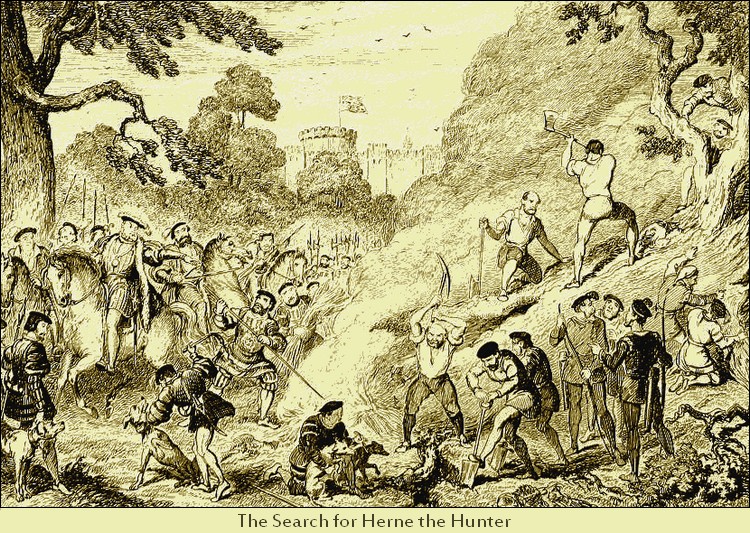
Ropes were then fastened to the head of the tree, and the welkin resounded
with the rapid strokes of the hatchets. It was a task of some difficulty, but
such zeal and energy were displayed by the woodmen that ere long the giant
trunk lay prostrate on the ground. Its hollows were now fully exposed to
view, but they were empty.
"Set fire to the accursed piece of timber!" roared the king, "and burn it
to dust, and scatter it to the wind!"
At these orders two yeomen of the guard advanced, and throwing down a heap
of fagots, straw, and other combustibles on the roots of the tree, soon
kindled a fierce fire.
Meanwhile a couple of woodmen, stripped of their jerkins, and with their
brawny arms bared to the shoulder, mounted on the trunk, and strove to split
it asunder. Some of the keepers likewise got into the branches, and peered
into every crack and crevice, in the hope of making some discovery. Amongst
the latter was Will Sommers, who had posted himself near a great arm of the
tree, which he maintained when lopped off would be found to contain the
demon.
Nor were other expedients neglected. A fierce hound had been sent into the
hole near the roots of the tree by Gabriel Lapp, but after a short absence he
returned howling and terrified, nor could all the efforts of Gabriel,
seconded by a severe scourging with his heavy dog-whip, induce him to enter
it again.
When the hound had come forth, a couple of yeomen advanced to enlarge the
opening, while a third with a pick endeavoured to remove the root, which
formed an impediment to their efforts.
"They may dig, but they'll never catch him," observed Shoreditch, who
stood by, to his companions. "Hunting a spirit is not the same thing as
training and raising a wolf, or earthing and digging out a badger."
"Not so loud, duke," said Islington; "his majesty may think thy jest
irreverent."
"I have an arrow blessed by a priest," said Paddington, "which I shall let
fly at the spirit if he appears."
"Here he is—here he is!" cried Will Sommers, as a great white horned
owl, which had been concealed in some part of the tree, flew forth.
"It may be the demon in that form—shoot! shoot!" cried
Shoreditch.
Paddington bent his bow. The arrow whistled through the air, and in
another moment the owl fell fluttering to the ground completely transfixed;
but it underwent no change, as was expected by the credulous archer.
Meanwhile the fire, being kept constantly supplied with fresh fagots, and
stirred by the yeomen of the guard, burnt bravely. The lower part of the tree
was already consumed, and the flames, roaring through the hollow within with
a sound like that of a furnace, promised soon to reduce it to charcoal.
The mouth of the hole having now been widened, another keeper, who had
brought forward a couple of lurchers, sent them into it; but in a few moments
they returned, as the hound had done, howling and with scared looks. Without
heeding their enraged master, they ran off, with their tails between their
legs, towards the castle.
"I see how it is, Rufus," said Gabriel, patting his hound, who looked
wistfully and half-reproachfully at him. "Thou wert not to blame, poor
fellow! The best dog that ever was whelped cannot be expected to face the
devil."
Though long ere this it had become the general opinion that it was useless
to persevere further in the search, the king, with his characteristic
obstinacy, would not give it up. In due time the whole of the trunk of the
enormous tree was consumed, and its branches cast into the fire. The roots
were rent from the ground, and a wide and deep trench digged around the spot.
The course of the hole was traced for some distance, but it was never of any
size, and was suddenly lost by the falling in of the earth.
At length, after five hours' close watching, Henry's patience was
exhausted, and he ordered the pit to be filled up, and every crevice and
fissure in the ground about to be carefully stopped.
"If we cannot unkennel the fox," he said, " we will at least earth him
up.
"For all your care, gossip Henry," muttered Will Sommers, as he rode after
his royal master to the castle, "the fox will work his way out."