Windsor Castle by William Harrison Ainsworth
BOOK IV — CARDINAL WOLSEY
CHAPTER XI
How Tristram Lyndwood and Mabel were liberated.
Intelligence of the queen's return was instantly conveyed to
Anne Boleyn, and filled her with indescribable alarm. All her visions of
power and splendour seemed to melt away at once. She sent for her father,
Lord Rochford, who hurried to her in a state of the utmost anxiety, and
closely questioned her whether the extraordinary change had not been
occasioned by some imprudence of her own. But she positively denied the
charge, alleging that she had parted with the king scarcely an hour before on
terms of the most perfect amity, and with the full conviction that she had
accomplished the cardinal's ruin.
"You should not have put forth your hand against him till you were sure of
striking the blow," said Rochford. "There is no telling what secret influence
he has over the king; and there may yet be a hard battle to fight. But not a
moment must be lost in counteracting his operations. Luckily, Suffolk is
here, and his enmity to the cardinal will make him a sure friend to us. Pray
Heaven you have not given the king fresh occasion for jealousy! That is all I
fear."
And quitting his daughter, he sought out Suffolk, who, alarmed at what
appeared like a restoration of Wolsey to favour, promised heartily to co-
operate with him in the struggle; and that no time might be lost, the duke
proceeded at once to the royal closet, where he found the king pacing moodily
to and fro.
"Your majesty seems disturbed," said the duke.
"Disturbed!—ay!" exclaimed the king. "I have enough to disturb me. I
will never love again. I will forswear the whole sex. Harkee, Suffolk, you
are my brother, my second self, and know all the secrets of my heart. After
the passionate devotion I have displayed for Anne Boleyn— after all I
have done for her—all I have risked for her—I have been
deceived."
"Impossible, my liege?" exclaimed Suffolk.
"Why, so I thought," cried Henry, "and I turned a deaf ear to all
insinuations thrown out against her, till proof was afforded which I could no
longer doubt."
"And what was the amount of the proof, my liege?" asked Suffolk.
"These letters," said Henry, handing them to him, "found on the person of
Sir Thomas Wyat."
"But these only prove, my liege, the existence of a former passion—
nothing more," remarked Suffolk, after he had scanned them.
"But she vows eternal constancy to him!" cried Henry; "says she shall ever
love him—says so at the time she professes devoted love for me! How can
I trust her after that? Suffolk, I feel she does not love me exclusively; and
my passion is so deep and devouring, that it demands entire return. I must
have her heart as well as her person; and I feel I have only won her in my
quality of king."
"I am persuaded your majesty is mistaken," said the duke. "Would I could
think so!" sighed Henry. "But no—no, I cannot be deceived. I will
conquer this fatal passion. Oh, Suffolk! it is frightful to be the bondslave
of a woman—a fickle, inconstant woman. But between the depths of love
and hate is but a step; and I can pass from one to the other."
"Do nothing rashly, my dear liege," said Suffolk; "nothing that may bring
with it after-repentance. Do not be swayed by those who have inflamed your
jealousy, and who could practise upon it. Think the matter calmly over, and
then act. And till you have decided, see neither Catherine nor Anne; and,
above all, do not admit Wolsey to your secret counsels."
"You are his enemy, Suffolk," said the king sternly.
"I am your majesty's friend," replied the duke. " I beseech you, yield to
me on this occasion, and I am sure of your thanks hereafter."
"Well, I believe you are right, my good friend and brother," said Henry,
"and I will curb my impulses of rage and jealousy. To-morrow, before I see
either the queen or Anne, we will ride forth into the forest, and talk the
matter further over."
"Your highness has come to a wise determination," said the duke.
"Oh,Suffolk!" sighed Henry, "would I had never seen this siren! She
exercises a fearful control over me, and enslaves my very soul."
"I cannot say whether it is for good or ill that you have met, my dear
liege," replied Suffolk, "but I fancy I can discern the way in which your
ultimate decision will be taken. But it is now near midnight. I wish your
majesty sound and untroubled repose."
"Stay!" cried Henry, "I am about to visit the Curfew Tower, and must take
you with me. I will explain my errand as we go. I had some thought of sending
you there in my stead. Ha!" he exclaimed, glancing at his finger, "By Saint
Paul, it is gone!"
"What is gone, my liege?" asked Suffolk.
My signet," replied Henry," I missed it not till now. It has been wrested
from me by the fiend, during my walk from the Curfew Tower. Let us not lose a
moment, or the prisoners will be set free by him,—if they have not been
liberated already."
So saying, he took a couple of dags—a species of short gun—
from a rest on the wall, and giving one to Suffolk, thrust the other into his
girdle. Thus armed, they quitted the royal lodgings, and hurried in the
direction of the Curfew Tower. Just as they reached the Horseshoe Cloisters,
the alarm-bell began to ring.
"Did I not tell you so?" cried Henry furiously; "they have escaped. Ha! it
ceases!—what has happened?"
About a quarter of an hour after the king had quitted the Curfew Tower, a
tall man, enveloped in a cloak, and wearing a high conical cap, presented
himself to the arquebusier stationed at the entrance to the dungeon, and
desired to be admitted to the prisoners.
"I have the king's signet," he said, holding forth the ring. On seeing
this, the arquebusier, who recognised the ring, unlocked the door, and
admitted him. Mabel was kneeling on the ground beside her grandsire, with her
hands raised as in prayer, but as the tall man entered the vault, she started
to her feet, and uttered a slight scream.
"What is the matter, child?" cried Tristram..
"He is here!—he is come!" cried Mabel, in a tone of the deepest
terror.
"Who—the king?" cried Tristram, looking up. "Ah! I see! Herne is
come to deliver me."
"Do not go with him, grandsire," cried Mabel. "In the name of all the
saints, I implore you, do not."
"Silence her! "said Herne in a harsh, imperious voice," or I leave
you."
The old man looked imploringly at his granddaughter.
"You know the conditions of your liberation? "said Herne.
"I do—I do," replied Tristram hastily, and with a shudder.
"Oh, grandfather!" cried Mabel, falling at his feet, "do not, I conjure
you, make any conditions with this dreaded being, or it will be at the
expense of your salvation. Better I should perish at the stake—better
you should suffer the most ignominious death, than this should be."
"Do you accept them?" cried Herne, disregarding her supplications.
Tristram answered in the affirmative.
"Recall your words, grandfather—recall your words!" cried Mabel. "I
will implore pardon for you on my knees from the king, and he will not refuse
me."
"The pledge cannot be recalled, damsel," said Herne; " and it is to save
you from the king, as much as to accomplish his own preservation, that your
grandsire consents. He would not have you a victim to Henry's lust." And as
he spoke, he divided the forester's bonds with his knife. "You must go with
him, Mabel," he added.
I will not!" she cried. "Something warns me that a great danger awaits
me."
"You must go, girl," cried Tristram angrily. "I will not leave you to
Henry's lawless passion."
Meanwhile, Herne had passed into one of the large embrasures, and opened,
by means of a spring, an entrance to a secret staircase in the wall. He then
beckoned Tristram towards him, and whispered some instructions in his
ear.
"I understand," replied the old man.
"Proceed to the cave," cried Herne, "and remain there till I join
you."
Tristram nodded assent.
"Come, Mabel!" he cried, advancing towards her, and seizing her hand.
"Away!"cried Herne in a menacing tone.
Terrified by the formidable looks and gestures of the demon, the poor girl
offered no resistance, and her grandfather drew her into the opening, which
was immediately closed after her.
About an hour after this, and when it was near upon the stroke of
midnight, the arquebusier who had admitted the tall stranger to the dungeon,
and who had momentarily expected his coming forth, opened the door to see
what was going forward. Great was his astonishment to find the cell empty!
After looking around in bewilderment, he rushed to the chamber above, to tell
his comrades what had happened.
"This is clearly the work of the fiend," said Shoreditch; "it is useless
to strive against him."
"That tall black man was doubtless Herne himself." said Paddington. "I am
glad he did us no injury. I hope the king will not provoke his malice
further."
"Well, we must inform Captain Bouchier of the mischance," said Shoreditch.
"I would not be in thy skin, Mat Bee, for a trifle. The king will be here
presently, and then—"
"It is impossible to penetrate through the devices of the evil one,"
interrupted Mat. "I could have sworn it was the royal signet, for I saw it on
the king's finger as he delivered the order. I wish such another chance of
capturing the fiend would occur to me."
As the words were uttered, the door of a recess was thrown suddenly open,
and Herne, in his wild garb, with his antlered helm upon his brow, and the
rusty chain depending from his left arm, stood before them. His appearance
was so terrific and unearthly that they all shrank aghast, and Mat Bee fell
with his face on the floor.
"I am here!" cried the demon. "Now, braggart, wilt dare to seize me?"
But not a hand was moved against him. The whole party seemed transfixed
with terror.
"You dare not brave my power, and you are right," cried Herne—" a
wave of my hand would bring this old tower about your ears—a word would
summon a legion of fiends to torment you."
"But do not utter it, I pray you, good Herne—excellent Herne," cried
Mat Bee. "And, above all things, do not wave your hand, for we have no desire
to be buried alive,— have we, comrades? I should never have said what I
did if I had thought your fiendship within hearing."
"Your royal master will as vainly seek to contend with me as he did to
bury me beneath the oak-tree," cried Herne. "If you want me further, seek me
in the upper chamber."
And with these words he darted up the ladder-like flight of steps and
disappeared.
As soon as they recovered from the fright that had enchained them,
Shoreditch and Paddington rushed forth into the area in front of the turret,
and shouting to those on the roof told them that Herne was in the upper
room—a piece of information which was altogether superfluous, as the
hammering had recommenced, and continued till the clock struck twelve, when
it stopped. Just then, it occurred to Mat Bee to ring the alarm-bell, and he
seized the rope, and began to pull it; but the bell had scarcely sounded,
when the cord, severed from above, fell upon his head.
At this juncture, the king and the Duke of Suffolk arrived. When told what
had happened, though prepared for it, Henry burst into a terrible passion,
and bestowed a buffet on Mat Bee, that well nigh broke his jaw, and sent him
reeling to the farther side of the chamber. He had not at first understood
that Herne was supposed to be in the upper room; but as soon as he was made
aware of the circumstance, he cried out—"Ah, dastards! have you let him
brave you thus? But I am glad of it. His capture is reserved for my own
hand."
"Do not expose yourself to this risk, my gracious liege," said
Suffolk.
"What! are you too a sharer in their womanish fears, Suffolk?" cried
Henry. "I thought you had been made of stouter stuff. If there is danger, I
shall be the first to encounter it. Come," he added, snatching a torch from
an arquebusier. And, drawing his dag, he hurried up the steep steps, while
Suffolk followed his example, and three or four arquebusiers ventured after
them.
Meanwhile Shoreditch and Paddington ran out, and informed Bouchier that
the king had arrived, and was mounting in search of Herne, upon which the
captain, shaking off his fears, ordered his men to follow him, and opening
the little door at the top of the stairs, began cautiously to descend,
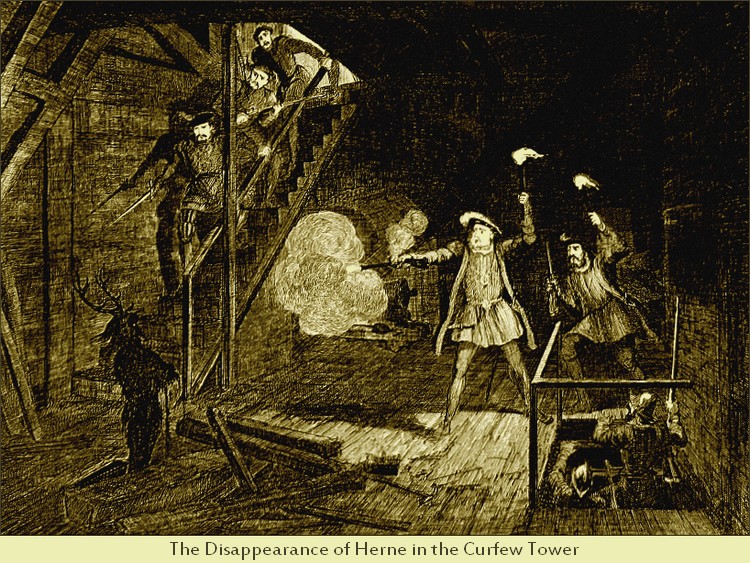
feeling his way with his sword. He had got about half-way down, when Henry
sprang upon the platform. The light of the torch fell upon the ghostly figure
of Herne, with his arms folded upon his breast, standing near the pile of
wood, lying between the two staircases. So appalling was the appearance of
the demon, that Henry stood still to gaze at him, while Bouchier and his men
remained irresolute on the stairs. In another moment, the Duke of Suffolk had
gained the platform, and the arquebusiers were seen near the head of the
stairs.
"At last, thou art in my power, accursed being!" cried Henry. "Thou art
hemmed in on all sides, and canst not escape!"
"Ho! ho! ho! "laughed Herne.
This shall prove whether thou art human or not," cried Henry, taking
deliberate aim at him with the dag.
"Ho! ho! ho!" laughed Herne. And as the report rang through the room, he
sank through the floor, and disappeared from view.
"Gone!" exclaimed Henry, as the smoke cleared off; "gone! Holy Mary! then
it must indeed be the fiend. I made the middle of his skull my aim, and if he
had not been invulnerable, the bullet must have pierced his brain.
"I heard it rebound from his horned helmet, and drop to the floor," said
Bouchier.
"What is that chest?" cried Henry, pointing to a strange coffin-shaped
box, lying, as it seemed, on the exact spot where the demon had
disappeared.
No one had seen it before, though all called to mind the mysterious
hammering; and they had no doubt that the coffin was the work of the
demon.
"Break it open," cried Henry; "for aught we know, Herne may be concealed
within it."
The order was reluctantly obeyed by the arquebusiers. But no force was
required, for the lid was not nailed down; and when it was removed, a human
body in the last stage of decay was discovered.
"Pah! close it up," cried Henry, turning away in disgust. "How came it
there?"
"It must have been brought by the powers of darkness," said Bouchier; "no
such coffin was here when I searched the chamber two hours ago. But see," he
suddenly added, stooping down, and picking up a piece of paper which had
fallen from the coffin, "here is a scroll."
"Give it me!" cried Henry; and holding it to the light, he read the words,
"The body of Mark Fytton, the butcher, the victim of a tyrant's
cruelty."
Uttering a terrible imprecation, Henry flung the paper from him; and
bidding the arquebusiers burn the body at the foot of the gallows without the
town, he quitted the tower without further search.