Windsor Castle by William Harrison Ainsworth
BOOK IV — CARDINAL WOLSEY
CHAPTER XII
How Wolsey was disgraced by the King.
On the following day, a reconciliation took place between
the king and Anne Boleyn. During a ride in the great park with his royal
brother, Suffolk not only convinced him of the groundlessness of his
jealousy, but contrived to incense him strongly against Wolsey. Thus the
queen and the cardinal lost the momentary advantage they had gained, while
Anne's power was raised yet higher. Yielding to her entreaties not to see
Catherine again, nor to hold further conference with Wolsey until the
sentence of the court should be pronounced, Henry left the castle that very
day, and proceeded to his palace of Bridewell. The distress of the unhappy
queen at this sudden revolution of affairs may be conceived. Distrusting
Wolsey, and putting her sole reliance on Heaven and the goodness of her
cause, she withdrew to Blackfriars, where she remained till the court met. As
to the cardinal himself, driven desperate by his situation, and exasperated
by the treatment he had experienced, he resolved, at whatever risk, to thwart
Henry's schemes, and revenge himself upon Anne Boleyn.
Thus matters continued till the court met as before in the Parliament-
chamber, at Blackfriars. On this occasion Henry was present, and took his
place under a cloth of estate,—the queen sitting at some distance below
him. Opposite them were the legates, with the Archbishop of Canterbury, and
the whole of the bishops. The aspect of the assemblage was grave and anxious.
Many eyes were turned on Henry, who looked gloomy and menacing, but the chief
object of interest was the queen, who, though pale as death, had never in her
highest days of power worn a more majestic and dignified air than on this
occasion.
The proceedings of the court then commenced, and the king being called by
the crier, he immediately answered to the summons. Catherine was next called,
and instead of replying, she marched towards the canopy beneath which the
king was seated, prostrated herself, and poured forth a most pathetic and
eloquent appeal to him, at the close of which she arose, and making a
profound reverence, walked out of the court, leaning upon the arm of her
general receiver, Griffith. Henry desired the crier to call her back, but she
would not return; and seeing the effect produced by her address upon the
auditory, he endeavoured to efface it by an eulogium on her character and
virtues, accompanied by an expression of deep regret at the step he was
compelled to take in separating himself from her. But his hypocrisy availed
him little, and his speech was received with looks of ill- disguised
incredulity. Some further discourse then took place between the Archbishop of
Canterbury and the Bishop of Rochester; but as the queen had absented
herself, the court was adjourned to the next day, when it again met, and as
she did not then appear, though summoned, she was pronounced contumacious.
After repeated adjournments, the last session was held, and judgment demanded
on the part of the king, when Campeggio, as had been arranged between him and
Wolsey, declined to pronounce it until he had referred the matter to the
Pope, and the court was dissolved.
About two months after this event, during which time the legate's
commission had been revoked, while Henry was revolving the expediency of
accomplishing the divorce through the medium of his own ecclesiastical
courts, and without reference to that of Rome, a despatch was received from
the Pope by the two cardinals, requiring them to cite the king to appear
before him by attorney on a certain day. At the time of the arrival of this
instrument, Campeggio chanced to be staying with Wolsey at his palace at
Esher, and as the king was then holding his court at Windsor, they both set
out for the castle on the following day, attended by a retinue of nearly a
hundred horsemen, splendidly equipped.
It was now the middle of September, and the woods, instead of presenting
one uniform mass of green, glowed with an infinite variety of lovely tints.
And yet, despite the beauty of the scene, there was something melancholy in
witnessing the decline of the year, as marked by those old woods, and by the
paths that led through them, so thickly strewn with leaves. Wolsey was
greatly affected. "These noble trees will ere long bereft of all their
glories," he thought, " and so, most likely, will it be with me, and perhaps
my winter may come sooner than theirs!"
The cardinal and his train had crossed Staines Bridge, and passing through
Egham, had entered the great park near Englefield Green. They were proceeding
along the high ridge overlooking the woody region between it and the castle,
when a joyous shout in the glades beneath reached them, and looking down,
they saw the king accompanied by Anne Boleyn, and attended by his falconers
and a large company of horsemen, pursuing the sport of hawking. The royal
party appeared so much interested in their sport that they did not notice the
cardinal and his train, and were soon out of sight. But as Wolsey descended
Snow Hill, and entered the long avenue, he heard the trampling of horses at a
little distance, and shortly afterwards, Henry and Anne issued from out the
trees. They were somewhat more than a bow-shot in advance of the cardinal;
but instead of halting till he came up, the king had no sooner ascertained
who it was, than, despatching a messenger to the castle, who was seen
galloping swiftly down the avenue, he rode off with Anne Boleyn towards the
opposite side of the park. Though deeply mortified by the slight, Wolsey
concealed his vexation from his brother cardinal, and pursued his way to the
castle, before which he presently arrived. The gate was thrown open at his
approach, but he had scarcely entered the lower ward when Sir Henry Norris,
the king's groom of the stole, advanced to meet him, and, with a sorrowful
expression of countenance, said that his royal master had so many guests at
the castle, that he could not accommodate him and his train.
"I understand your drift, sir," replied Wolsey; "you would tell me I am
not welcome. Well, then, his eminence Cardinal Campeggio and myself must take
up our lodging at some hostel in the town, for it is necessary we should see
the king."
"If your grace is content to dismiss your attendants," said Norris in a
low tone, "you and Cardinal Campeggio can be lodged in Henry the Third's
Tower. Thus much I will take upon me; but I dare not admit you to the royal
lodgings."
Wolsey tried to look unconcerned, and calling to his gentleman usher,
George Cavendish, gave him some instructions in a low voice, upon which the
other immediately placed himself at the head of the retinue, and ordered them
to quit the castle with him, leaving only the jester, Patch, to attend upon
his master. Campeggio's attendants being comparatively speaking, few in
number, were allowed to remain, and his litter was conveyed to Henry the
Third's Tower—a fortification standing, as already stated, in the south
side of the lower ward, near the edge of the dry moat surrounding the Round
Tower. At the steps of this tower Wolsey dismounted, and was about to follow
Campeggio into the doorway, when Will Sommers, who had heard of his arrival,
stepped forward, and with a salutation of mock formality, said, "I am sure it
will grieve the king, my master, not to be able to accommodate your grace's
train; but since it is larger than his own, you will scarce blame his want of
hospitality."
"Nor the courtesy of his attendants," rejoined Wolsey sharply. "I am in no
mood for thy jesting now. Stand aside, sirrah, or I will have the rod applied
to thy back!"
"Take care the king does not apply the rod to your own, lord cardinal,"
retorted Will Sommers. "If he scourges you according to your deserts, your
skin will be redder than your robe." And his mocking laugh pursued Wolsey
like the hiss of a snake into the tower.
Some two hours after this, Henry and his attendants returned from the
chase. The king seemed in a blithe humour, and Wolsey saw him laugh heartily
as Will Sommers pointed with his bauble towards Henry the Third's Tower. The
cardinal received no invitation to the royal banquet; and the answer to his
solicitation for an interview was, that he and Campeggio would be received in
the presence-chamber on the following morning, but not before.
That night a great revel was held in the castle. Masquing, dancing, and
feasting filled up the evening, and the joyous sounds and strains reached
Wolsey in his seclusion, and forced him to contrast it with his recent
position, when he would have been second only to the king in the
entertainment. He laid his head upon his pillow, but not to rest, and while
tossing feverishly about his couch, he saw the arras with which the walls
were covered, move, and a tall, dark figure step from behind it. The cardinal
would have awakened his jester, who slept in a small truckle-bed at his feet,
but the strange visitor motioned him to be still.
"You may conjecture who I am, cardinal," he said, "but in case you should
doubt, I will tell you. I am Herne the Hunter! And now to my errand. There is
a damsel, whom you once saw in the forest near the great lake, and whom you
promised to befriend. You can assist her now—to-morrow it may be out of
your power."
"I have enough to do to aid myself, without meddling with what concerns me
not," said Wolsey.
"This damsel does concern you," cried Herne. "Read this, and you will see
in what way."
And he tossed a letter to Wolsey, who glanced at it by the light of the
lamp.
"Ha!is it so?" he exclaimed. "Is she—"
"Hush!" cried Herne, "or you will wake this sleeper. It is as you suppose.
Will you not aid her now? Will you not bestow some of your treasure upon her
before it is wholly wrested from you by the king? I will do aught you wish,
secretly and swiftly."
"Go, then, to my palace at Esher," cried the cardinal. "Take this key to
my treasurer—it is the key of my coffers. Bid him deliver to you the
six caskets in the cabinet in the gilt chamber. Here is a token by which he
will know that you came from me," he added, delivering him a small chain of
gold, "for it has been so agreed between us. But you will be sure to give the
treasure to Mabel."
"Fear nothing," replied Herne. And stretching forth his hand to receive
the key and the chain, he glided behind the tapestry, and disappeared
This strange incident gave some diversion to Wolsey's thought; but ere
long they returned to their former channel. Sleep would not be summoned, and
as soon as the first glimpse of day appeared, he arose, and wrapping his robe
around him, left his room and ascended a winding staircase leading to the
roof of the tower.
The morning promised to be fine, but it was then hazy, and the greater
part of the forest was wrapped in mist. The castle, however, was seen to
great advantage. Above Wolsey rose the vast fabric of the Round Tower, on the
summit of which the broad standard was at that moment being unfurled; while
the different battlements and towers arose majestically around. But Wolsey's
gaze rested chiefly upon the exquisite mausoleum lying immediately beneath
him; in which he had partly prepared for himself a magnificent monument. A
sharp pang shook him as he contemplated it, and he cried aloud, "My very tomb
will be wrested from me by this rapacious monarch; and after all my care and
all my cost, I know not where I shall rest my bones!"
Saddened by the reflection, he descended to his chamber, and again threw
himself on the couch.
But Wolsey was not the only person in the castle who had passed a
sleepless night. Of the host of his enemies many had been kept awake by the
anticipation of his downfall on the morrow; and among these was Anne Boleyn,
who had received an assurance from the king that her enmity should at length
be fully gratified.
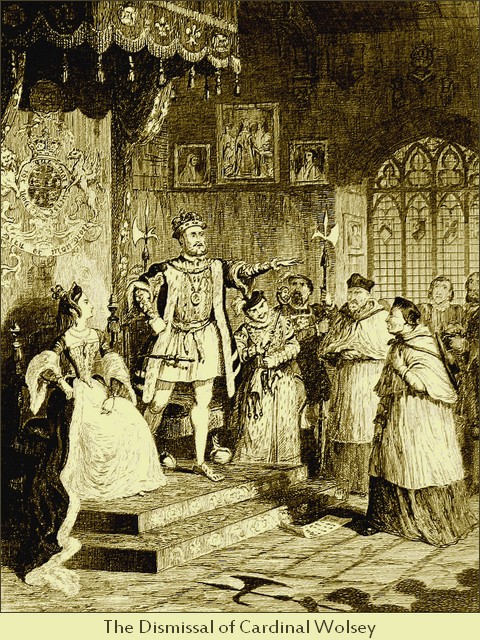
At the appointed hour, the two cardinals, proceeded to the royal lodgings.
They were detained for some time in the ante-chamber, where Wolsey was
exposed to the taunts and sneers of the courtiers, who had lately so
servilely fawned upon him. At length, they were ushered into the presence
chamber, at the upper end of which beneath a canopy emblazoned with the royal
arms woven in gold, sat Henry, with Anne Boleyn on his right hand. At the
foot of the throne stood Will Sommers, and near him the Dukes of Richmond and
Suffolk. Norfolk, Rochford, and a number of other nobles, all open enemies of
Wolsey, were also present. Henry watched the advance of the cardinals with a
stern look, and after they had made an obeisance to him, he motioned them to
rise.
"You have sought an interview with me, my lords," he said, with suppressed
rage. "What would you?"
"We have brought an instrument to you, my liege," said Wolsey, "which has
just been received from his holiness the Pope."
"Declare its nature," said Henry.
"It is a citation," replied Wolsey, "enjoining your high ness to appear by
attorney in the papal court, under a penalty of ten thousand ducats."
And he presented a parchment, stamped with the great seal of Rome, to the
king, who glanced his eye fiercely over it, and then dashed it to the ground,
with an explosion of fury terrible to hear and to witness.
"Ha! by Saint George!" he cried; "am I as nothing, that the Pope dares to
insult me thus?"
"It is a mere judicial form your majesty," interposed Campeggio, "and is
chiefly sent by his holiness to let you know we have no further jurisdiction
in the matter of the divorce."
"I will take care you have not, nor his holiness either," roared the king.
"By my father's head, he shall find I will be no longer trifled with."
"But,my liege," cried Campeggio.
"Peace!" cried the king. "I will hear no apologies nor excuses. The insult
has been offered, and cannot he effaced. As for you, Wolsey—"
"Sire!" exclaimed the cardinal, shrinking before the whirlwind of passion,
which seemed to menace his utter extermination.
"As for you, I say," pursued Henry, extending his hand towards him, while
his eyes flashed fire, "who by your outrageous pride have so long
overshadowed our honour—who by your insatiate avarice and appetite for
wealth have oppressed our subjects—who by your manifold acts of bribery
and extortion have impoverished our realm, and by your cruelty and partiality
have subverted the due course of justice and turned it to your ends—the
time is come when you shall receive due punishment for your offences."
"You wrong me, my dear liege," cried Wolsey abjectly. "These are the
accusations of my enemies. Grant me a patient hearing, and I will explain
all."
"I would not sharpen the king's resentment against you, lord cardinal,"
said Anne Boleyn, "for it is keen enough; but I cannot permit you to say that
these charges are merely hostile. Those who would support the king's honour
and dignity must desire to see you removed from his counsels."
"I am ready to take thy place, lord cardinal," said Will Sommers; "and
will exchange my bauble for thy chancellor's mace, and my fool's cap for thy
cardinal's hat."
"Peace!" thundered the king. "Stand not between me and the object of my
wrath. Your accusers are not one but many, Wolsey; nay, the whole of my
people cry out for justice against you. And they shall have it. But you shall
hear the charges they bring. Firstly, contrary to our prerogative, and for
your own advancement and profit, you have obtained authority legatine from
the Pope; by which authority you have not only spoiled and taken away their
substance from many religious houses, but have usurped much of our own
jurisdiction. You have also made a treaty with the King of France for the
Pope without our consent, and concluded another friendly treaty with the Duke
of Ferrara, under our great seal, and in our name, without our warrant. And
furthermore you have presumed to couple yourself with our royal self in your
letters and instructions, as if you were on an equality with us."
"Ha! ha! 'The king and I would have you do thus!' 'The king and I give you
our hearty thanks!' Ran it not so, cardinal?" cried Will Sommers. "You will
soon win the cap and bells."
"In exercise of your legatine authority," pursued the king, "you have
given away benefices contrary to our crown and dignity, for the which you are
in danger of forfeiture of your lands and goods."
"A premunire, cardinal," cried Will Sommers. "A premunire!—ha!
ha!"
"Then it has been your practice to receive all the ambassadors to our
court first at your own palace," continued Henry, "to hear their charges and
intentions, and to instruct them as you might see fit. You have also so
practised that all our letters sent from beyond sea have first come to your
own hands, by which you have acquainted yourself with their contents, and
compelled us and our council to follow your devices. You have also written to
all our ambassadors abroad in your own name concerning our affairs, without
our authority; and received letters in return from them by which you have
sought to compass your own purposes. By your ambition and pride you have
undone many of our poor subjects; have suppressed religious houses, and
received their possessions; have seized upon the goods of wealthy spiritual
men deceased; constrained all ordinaries yearly to compound with you; have
gotten riches for yourself and servants by subversion of the laws, and by
abuse of your authority in causing divers pardons of the Pope to be suspended
until you, by promise of a yearly pension, chose to revive them; and also by
crafty and untrue tales have sought to create dissention among our
nobles."
"That we can all avouch for," cried Suffolk. "It was never merry in
England while there were cardinals among us."
"Of all men in England your grace should be the last to say so," rejoined
Wolsey; "for if I had not been cardinal, you would not have had a head upon
your shoulders to utter the taunt."
"No more of this!" cried the king. "You have misdemeaned yourself in our
court by keeping up as great state in our absence as if we had been there in
person, and presumptuously have dared to join and imprint your badge, the
cardinal's hat, under our arms, graven on our coins struck at York. And
lastly, whenever in open Parliament allusion hath been made to heresies and
erroneous sects, you have failed to correct and notice them, to the danger of
the whole body of good and Christian people of this our realm."
"This last charge ought to win me favour in the eyes of one who professes
the Opinions of Luther," said Wolsey to Anne. "But I deny it, as I do all the
rest."
"I will listen to no defence, Wolsey," replied the king. "I will make you
a terrible example to others how they offend us and our laws hereafter."
"Do not condemn me unheard!" cried the cardinal, prostrating himself.
"I have heard too much, and I will hear no more!" cried the king fiercely.
"I dismiss you from my presence for ever. If you are innocent, as you aver,
justice will be done you.. If you are guilty, as I believe you to be, look
not for leniency from me, for I will show you none." And, seating himself, he
turned to Anne, and said, in a low tone, " Are you content, sweetheart?"
"I am," she replied. "I shall not now break my vow. False cardinal," she
added aloud, "your reign is at an end."
"Your own may not be much longer, madam," rejoined Wolsey bitterly. "The
shadow of the axe," he added, pointing to the reflection of a partisan on the
floor, "is at your feet. Ere long it may rise to the head."
And, accompanied by Campeggio, he slowly quitted the presence-chamber.