CHAPTER III.
IN THE TEMPORARY HOME.
I was left to begin my career as Nellie Brown, the insane
girl. As I walked down the avenue I tried to assume
the look which maidens wear in pictures entitled
“Dreaming.” “Far-away” expressions have a crazy air.
I passed through the little paved yard to the entrance of
the Home. I pulled the bell, which sounded loud enough
for a church chime, and nervously awaited the opening
of the door to the Home, which I intended should
ere long cast me forth and out upon the charity of the
police. The door was thrown back with a vengeance,
and a short, yellow-haired girl of some thirteen summers
stood before me.
“Is the matron in?” I asked, faintly.
“Yes, she’s in; she’s busy. Go to the back parlor,”
11answered the girl, in a loud voice, without one change in
her peculiarly matured face.
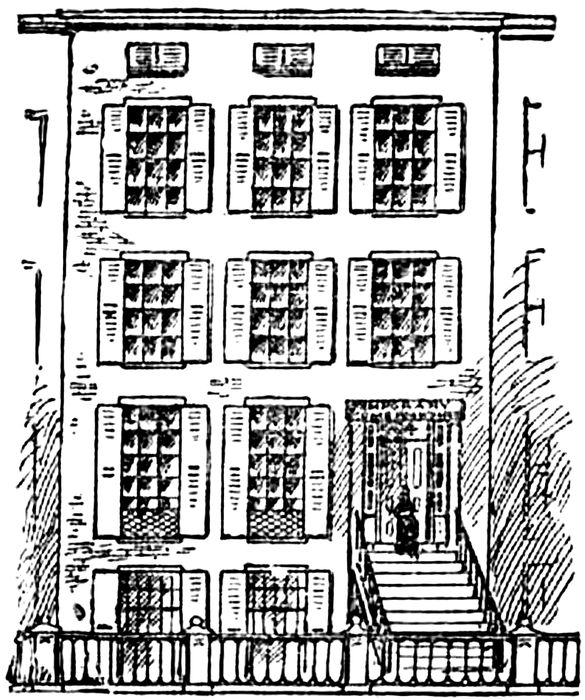
AT THE TEMPORARY HOME FOR WOMEN.
I followed these not overkind or polite instructions and
found myself in a dark, uncomfortable back-parlor.
There I awaited the arrival of my hostess. I had been
seated some twenty minutes at the least, when a slender
woman, clad in a plain, dark dress entered and, stopping
before me, ejaculated inquiringly, “Well?”
“Are you the matron?” I asked.
“No,” she replied, “the matron is sick; I am her
assistant. What do you want?”
“I want to stay here for a few days, if you can accommodate
me.”
“Well, I have no single rooms, we are so crowded; but
if you will occupy a room with another girl, I shall do
that much for you.”
“I shall be glad of that,” I answered. “How much
12do you charge?” I had brought only about seventy cents
along with me, knowing full well that the sooner my
funds were exhausted the sooner I should be put out, and
to be put out was what I was working for.
“We charge thirty cents a night,” was her reply to
my question, and with that I paid her for one night’s
lodging, and she left me on the plea of having something
else to look after. Left to amuse myself as best I
could, I took a survey of my surroundings.
They were not cheerful, to say the least. A wardrobe,
desk, book-case, organ, and several chairs completed the
furnishment of the room, into which the daylight barely
came.
By the time I had become familiar with my quarters a
bell, which rivaled the door-bell in its loudness, began
clanging in the basement, and simultaneously women
went trooping down-stairs from all parts of the house. I
imagined, from the obvious signs, that dinner was served,
but as no one had said anything to me I made no effort
to follow in the hungry train. Yet I did wish that some
one would invite me down. It always produces such a
lonely, homesick feeling to know others are eating, and
we haven’t a chance, even if we are not hungry. I was
glad when the assistant matron came up and asked me if
I did not want something to eat. I replied that I did,
and then I asked her what her name was. Mrs. Stanard,
she said, and I immediately wrote it down in a notebook
I had taken with me for the purpose of making memoranda,
and in which I had written several pages of utter
nonsense for inquisitive scientists.
Thus equipped I awaited developments. But my dinner—well,
I followed Mrs. Stanard down the uncarpeted
stairs into the basement, where a large number of women
were eating. She found room for me at a table with
three other women. The short-haired slavey who had
opened the door now put in an appearance as waiter.
13Placing her arms akimbo and staring me out of countenance,
she said:
“Boiled mutton, boiled beef, beans, potatoes, coffee
or tea?”
“Beef, potatoes, coffee and bread,” I responded.
“Bread goes in,” she explained, as she made her way
to the kitchen, which was in the rear. It was not very
long before she returned with what I had ordered on a
large, badly battered tray, which she banged down before
me. I began my simple meal. It was not very enticing,
so while making a feint of eating I watched the
others.
I have often moralized on the repulsive form charity
always assumes! Here was a home for deserving women
and yet what a mockery the name was. The floor was
bare, and the little wooden tables were sublimely ignorant
of such modern beautifiers as varnish, polish and table-covers.
It is useless to talk about the cheapness of linen
and its effect on civilization. Yet these honest workers,
the most deserving of women, are asked to call this spot
of bareness—home.
When the meal was finished each woman went to the
desk in the corner, where Mrs. Stanard sat, and paid her
bill. I was given a much-used, and abused, red check,
by the original piece of humanity in shape of my waitress.
My bill was about thirty cents.
After dinner I went up-stairs and resumed my former
place in the back parlor. I was quite cold and uncomfortable,
and had fully made up my mind that I could
not endure that sort of business long, so the sooner I
assumed my insane points the sooner I would be released
from enforced idleness. Ah! that was indeed the longest
day I had ever lived. I listlessly watched the women
in the front parlor, where all sat except myself.
One did nothing but read and scratch her head and
occasionally call out mildly, “Georgie,” without lifting
14her eyes from her book. “Georgie” was her over-frisky
boy, who had more noise in him than any child I ever
saw before. He did everything that was rude and unmannerly,
I thought, and the mother never said a word
unless she heard some one else yell at him. Another
woman always kept going to sleep and waking herself up
with her own snoring. I really felt wickedly thankful it
was only herself she awakened. The majority of the
women sat there doing nothing, but there were a few who
made lace and knitted unceasingly. The enormous door-bell
seemed to be going all the time, and so did the short-haired
girl. The latter was, besides, one of those girls
who sing all the time snatches of all the songs and
hymns that have been composed for the last fifty years.
There is such a thing as martyrdom in these days. The
ringing of the bell brought more people who wanted
shelter for the night. Excepting one woman, who was
from the country on a day’s shopping expedition, they
were working women, some of them with children.
As it drew toward evening Mrs. Stanard came to me
and said:
“What is wrong with you? Have you some sorrow or
trouble?”
“No,” I said, almost stunned at the suggestion.
“Why?”
“Oh, because,” she said, womanlike, “I can see it in
your face. It tells the story of a great trouble.”
“Yes, everything is so sad,” I said, in a haphazard
way, which I had intended to reflect my craziness.
“But you must not allow that to worry you. We all
have our troubles, but we get over them in good time.
What kind of work are you trying to get?”
“I do not know; it’s all so sad,” I replied.
“Would you like to be a nurse for children and wear a
nice white cap and apron?” she asked.
I put my handkerchief up to my face to hide a smile,
15and replied, in a muffled tone, “I never worked; I don’t
know how.”
“But you must learn,” she urged; “all these women
here work.”
“Do they?” I said, in a low, thrilling whisper. “Why,
they look horrible to me; just like crazy women. I am
so afraid of them.”
“They don’t look very nice,” she answered, assentingly,
“but they are good, honest working women. We do not
keep crazy people here.”
I again used my handkerchief to hide a smile, as I
thought that before morning she would at least think she
had one crazy person among her flock.
“They all look crazy,” I asserted again, “and I am
afraid of them. There are so many crazy people about,
and one can never tell what they will do. Then there
are so many murders committed, and the police never
catch the murderers,” and I finished with a sob that
would have broken up an audience of blase critics. She
gave a sudden and convulsive start, and I knew my first
stroke had gone home. It was amusing to see what a remarkably
short time it took her to get up from her chair
and to whisper hurriedly: “I’ll come back to talk with
you after awhile.” I knew she would not come back and
she did not.
When the supper-bell rang I went along with the
others to the basement and partook of the evening meal,
which was similar to dinner, except that there was a
smaller bill of fare and more people, the women who are
employed outside during the day having returned. After
the evening meal we all adjourned to the parlors, where
all sat, or stood, as there were not chairs enough to
go round.
It was a wretchedly lonely evening, and the light
which fell from the solitary gas jet in the parlor, and oil-lamp
in the hall, helped to envelop us in a dusky hue
16and dye our spirits a navy blue, I felt it would not require
many inundations of this atmosphere to make me
a fit subject for the place I was striving to reach.
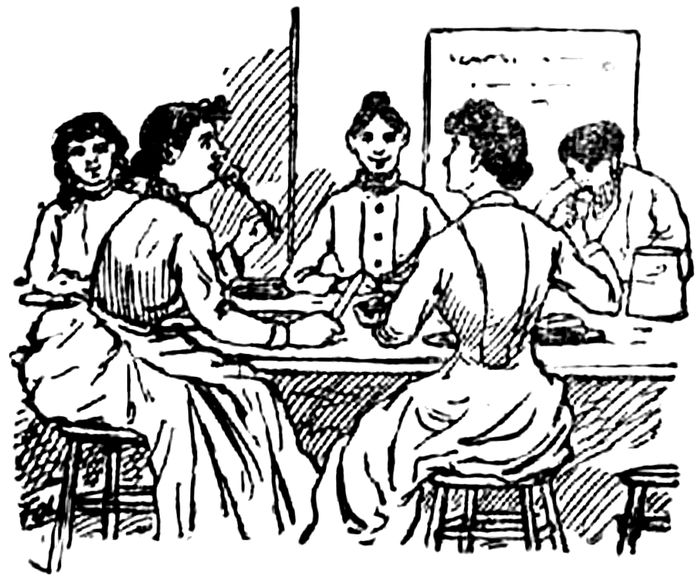
NELLIE’S FIRST MEAL AT THE HOME.
I watched two women, who seemed of all the crowd to
be the most sociable, and I selected them as the ones to
work out my salvation, or, more properly speaking, my
condemnation and conviction. Excusing myself and saying
that I felt lonely, I asked if I might join their company.
They graciously consented, so with my hat and
gloves on, which no one had asked me to lay aside, I sat
down and listened to the rather wearisome conversation,
in which I took no part, merely keeping up my sad look,
saying “Yes,” or “No,” or “I can’t say,” to their observations.
Several times I told them I thought everybody
in the house looked crazy, but they were slow to
catch on to my very original remark. One said her name
was Mrs. King and that she was a Southern woman. Then
she said that I had a Southern accent. She asked me
bluntly if I did not really come from the South. I said
“Yes.” The other woman got to talking about the Boston
boats and asked me if I knew at what time they
left.
For a moment I forgot my role of assumed insanity,
17and told her the correct hour of departure. She then
asked me what work I was going to do, or if I had ever
done any. I replied that I thought it very sad that
there were so many working people in the world. She
said in reply that she had been unfortunate and had
come to New York, where she had worked at correcting
proofs on a medical dictionary for some time, but that
her health had given way under the task, and that she
was now going to Boston again. When the maid came
to tell us to go to bed I remarked that I was afraid, and
again ventured the assertion that all the women in the
house seemed to be crazy. The nurse insisted on my
going to bed. I asked if I could not sit on the stairs,
but she said, decisively: “No; for every one in the
house would think you were crazy.” Finally I allowed
them to take me to a room.
Here I must introduce a new personage by name into
my narrative. It is the woman who had been a proofreader,
and was about to return to Boston. She was a
Mrs. Caine, who was as courageous as she was good-hearted.
She came into my room, and sat and talked
with me a long time, taking down my hair with gentle
ways. She tried to persuade me to undress and go to
bed, but I stubbornly refused to do so. During this time
a number of the inmates of the house had gathered
around us. They expressed themselves in various ways.
“Poor loon!” they said. “Why, she’s crazy enough!”
“I am afraid to stay with such a crazy being in the
house.” “She will murder us all before morning.”
One woman was for sending for a policeman to take me
away at once. They were all in a terrible and real state
of fright.
No one wanted to be responsible for me, and the
woman who was to occupy the room with me declared
that she would not stay with that “crazy woman” for
all the money of the Vanderbilts. It was then that Mrs.
18Caine said she would stay with me. I told her I would
like to have her do so. So she was left with me. She
didn’t undress, but lay down on the bed, watchful of my
movements. She tried to induce me to lie down, but I
was afraid to do this. I knew that if I once gave way I
should fall asleep and dream as pleasantly and peacefully
as a child. I should, to use a slang expression, be liable to
“give myself dead away.” I had made up my mind to stay
awake all night. So I insisted on sitting on the side of
the bed and staring blankly at vacancy. My poor companion
was put into a wretched state of unhappiness.
Every few moments she would rise up to look at me.
She told me that my eyes shone terribly brightly and
then began to question me, asking me where I had lived,
how long I had been in New York, what I had been
doing, and many things besides. To all her questionings
I had but one response—I told her that I had
forgotten everything, that ever since my headache had
come on I could not remember.
Poor soul! How cruelly I tortured her, and what a
kind heart she had! But how I tortured all of them!
One of them dreamed of me—as a nightmare. After I
had been in the room an hour or so, I was myself startled
by hearing a woman screaming in the next room. I
began to imagine that I was really in an insane asylum.
Mrs. Caine woke up, looked around, frightened, and
listened. She then went out and into the next room,
and I heard her asking another woman some questions.
When she came back she told me that the woman had
had a hideous nightmare. She had been dreaming of
me. She had seen me, she said, rushing at her with a
knife in my hand, with the intention of killing her. In
trying to escape me she had fortunately been able to
scream, and so to awaken herself and scare off her nightmare.
Then Mrs. Caine got into bed again, considerably
agitated, but very sleepy.
19I was weary, too, but I had braced myself up to the
work, and was determined to keep awake all night so as
to carry on my work of impersonation to a successful end
in the morning. I heard midnight. I had yet six hours
to wait for daylight. The time passed with excruciating
slowness. Minutes appeared hours. The noises in the
house and on the avenue ceased.
Fearing that sleep would coax me into its grasp, I commenced
to review my life. How strange it all seems! One
incident, if never so trifling, is but a link more to chain
us to our unchangeable fate. I began at the beginning,
and lived again the story of my life. Old friends were recalled
with a pleasurable thrill; old enmities, old heartaches,
old joys were once again present. The turned-down
pages of my life were turned up, and the past was
present.
When it was completed, I turned my thoughts bravely
to the future, wondering, first, what the next day would
bring forth, then making plans for the carrying out of
my project. I wondered if I should be able to pass over
the river to the goal of my strange ambition, to become
eventually an inmate of the halls inhabited by my mentally
wrecked sisters. And then, once in, what would be
my experience? And after? How to get out? Bah! I
said, they will get me out.
That was the greatest night of my existence. For a
few hours I stood face to face with “self!”
I looked out toward the window and hailed with joy
the slight shimmer of dawn. The light grew strong and
gray, but the silence was strikingly still. My companion
slept. I had still an hour or two to pass over. Fortunately
I found some employment for my mental activity.
Robert Bruce in his captivity had won confidence in the
future, and passed his time as pleasantly as possible
under the circumstances, by watching the celebrated
spider building his web. I had less noble vermin to interest
20me. Yet I believe I made some valuable discoveries
in natural history. I was about dropping off to sleep
in spite of myself when I was suddenly startled to wakefulness.
I thought I heard something crawl and fall
down upon the counterpane with an almost inaudible
thud.
I had the opportunity of studying these interesting
animals very thoroughly. They had evidently come for
breakfast, and were not a little disappointed to find that
their principal plat was not there. They scampered up
and down the pillow, came together, seemed to hold interesting
converse, and acted in every way as if they were
puzzled by the absence of an appetizing breakfast. After
one consultation of some length they finally disappeared,
seeking victims elsewhere, and leaving me to pass the
long minutes by giving my attention to cockroaches,
whose size and agility were something of a surprise to
me.
My room companion had been sound asleep for a long
time, but she now woke up, and expressed surprise at seeing
me still awake and apparently as lively as a cricket.
She was as sympathetic as ever. She came to me and
took my hands and tried her best to console me, and asked
me if I did not want to go home. She kept me up-stairs
until nearly everybody was out of the house, and then
took me down to the basement for coffee and a bun.
After that, partaken in silence, I went back to my room,
where I sat down, moping. Mrs. Caine grew more and
more anxious. “What is to be done?” she kept exclaiming.
“Where are your friends?” “No,” I answered,
“I have no friends, but I have some trunks. Where are
they? I want them.” The good woman tried to pacify
me, saying that they would be found in good time. She
believed that I was insane.
Yet I forgive her. It is only after one is in trouble
that one realizes how little sympathy and kindness there
21is in the world. The women in the Home who were
not afraid of me had wanted to have some amusement at
my expense, and so they had bothered me with questions
and remarks that had I been insane would have been
cruel and inhumane. Only this one woman among the
crowd, pretty and delicate Mrs. Caine, displayed true
womanly feeling. She compelled the others to cease
teasing me and took the bed of the woman who refused
to sleep near me. She protested against the suggestion
to leave me alone and to have me locked up for the night
so that I could harm no one. She insisted on remaining
with me in order to administer aid should I need it.
She smoothed my hair and bathed my brow and talked as
soothingly to me as a mother would do to an ailing child.
By every means she tried to have me go to bed and rest,
and when it drew toward morning she got up and
wrapped a blanket around me for fear I might get
cold; then she kissed me on the brow and whispered,
compassionately:
“Poor child, poor child!”
How much I admired that little woman’s courage and
kindness. How I longed to reassure her and whisper
that I was not insane, and how I hoped that, if any poor
girl should ever be so unfortunate as to be what I was
pretending to be, she might meet with one who possessed
the same spirit of human kindness possessed by Mrs.
Ruth Caine.