CHAPTER IV.
JUDGE DUFFY AND THE POLICE.
But to return to my story. I kept up my role until
the assistant matron, Mrs. Stanard, came in. She tried
to persuade me to be calm. I began to see clearly that
she wanted to get me out of the house at all hazards,
quietly if possible. This I did not want. I refused to
22move, but kept up ever the refrain of my lost trunks.
Finally some one suggested that an officer be sent for.
After awhile Mrs. Stanard put on her bonnet and went
out. Then I knew that I was making an advance toward
the home of the insane. Soon she returned, bringing
with her two policemen—big, strong men—who entered
the room rather unceremoniously, evidently expecting to
meet with a person violently crazy. The name of one of
them was Tom Bockert.
When they entered I pretended not to see them. “I
want you to take her quietly,” said Mrs. Stanard. “If
she don’t come along quietly,” responded one of the men,
“I will drag her through the streets.” I still took no
notice of them, but certainly wished to avoid raising a
scandal outside. Fortunately Mrs. Caine came to my
rescue. She told the officers about my outcries for my
lost trunks, and together they made up a plan to get me
to go along with them quietly by telling me they would
go with me to look for my lost effects. They asked me
if I would go. I said I was afraid to go alone. Mrs.
Stanard then said she would accompany me, and she arranged
that the two policemen should follow us at a respectful
distance. She tied on my veil for me, and we
left the house by the basement and started across town,
the two officers following at some distance behind. We
walked along very quietly and finally came to the station-house,
which the good woman assured me was the express
office, and that there we should certainly find my
missing effects. I went inside with fear and trembling,
for good reason.
A few days previous to this I had met Captain McCullagh
at a meeting held in Cooper Union. At that time
I had asked him for some information which he had
given me. If he were in, would he not recognize me?
And then all would be lost so far as getting to the island
was concerned. I pulled my sailor hat as low down over
23my face as I possibly could, and prepared for the ordeal.
Sure enough there was sturdy Captain McCullagh standing
near the desk.
He watched me closely as the officer at the desk conversed
in a low tone with Mrs. Stanard and the policeman
who brought me.
“Are you Nellie Brown?” asked the officer. I said I
supposed I was. “Where do you come from?” he asked.
I told him I did not know, and then Mrs. Stanard gave
him a lot of information about me—told him how
strangely I had acted at her home; how I had not slept a
wink all night, and that in her opinion I was a poor unfortunate
who had been driven crazy by inhuman treatment.
There was some discussion between Mrs. Stanard
and the two officers, and Tom Bockert was told to take
us down to the court in a car.
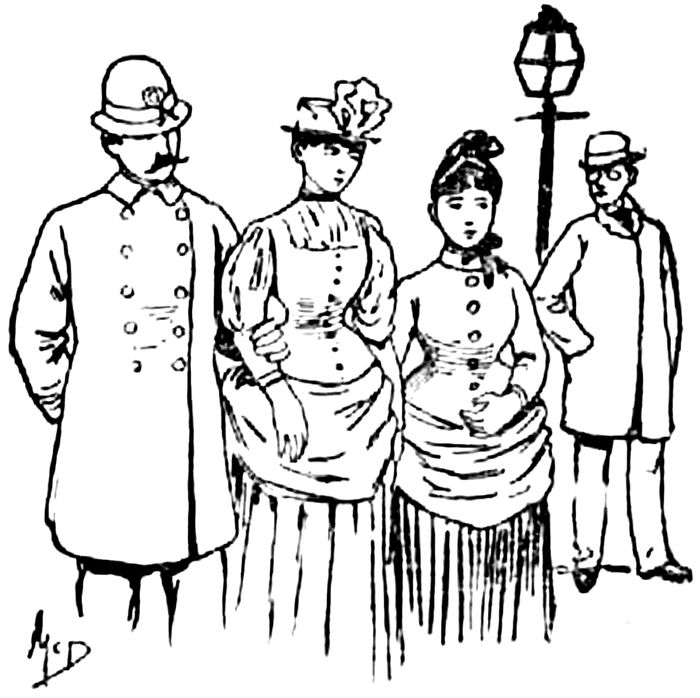
IN THE HANDS OF THE POLICE.
“Come along,” Bockert said, “I will find your trunk
for you.” We all went together, Mrs. Stanard, Tom
Bockert, and myself. I said it was very kind of them to
go with me, and I should not soon forget them. As we
walked along I kept up my refrain about my trunks, interjecting
24occasionally some remark about the dirty condition
of the streets and the curious character of the people
we met on the way. “I don’t think I have ever seen
such people before,” I said. “Who are they?” I asked,
and my companions looked upon me with expressions of
pity, evidently believing I was a foreigner, an immigrant
or something of the sort. They told me that the people
around me were working people. I remarked once more
that I thought there were too many working people in
the world for the amount of work to be done, at which remark
Policeman P. T. Bockert eyed me closely, evidently
thinking that my mind was gone for good. We passed
several other policemen, who generally asked my sturdy
guardians what was the matter with me. By this time
quite a number of ragged children were following us too,
and they passed remarks about me that were to me
original as well as amusing.
“What’s she up for?” “Say, kop, where did ye get
her?” “Where did yer pull ’er?” “She’s a daisy!”
Poor Mrs. Stanard was more frightened than I was.
The whole situation grew interesting, but I still had
fears for my fate before the judge.
At last we came to a low building, and Tom Bockert
kindly volunteered the information: “Here’s the express
office. We shall soon find those trunks of yours.”
The entrance to the building was surrounded by a
curious crowd and I did not think my case was bad enough
to permit me passing them without some remark, so I asked
if all those people had lost their trunks.
“Yes,” he said, “nearly all these people are looking
for trunks.”
I said, “They all seem to be foreigners, too.” “Yes,”
said Tom, “they are all foreigners just landed. They
have all lost their trunks, and it takes most of our time
to help find them for them.”
We entered the courtroom. It was the Essex Market
25Police Courtroom. At last the question of my sanity or
insanity was to be decided. Judge Duffy sat behind the
high desk, wearing a look which seemed to indicate that
he was dealing out the milk of human kindness by wholesale.
I rather feared I would not get the fate I sought,
because of the kindness I saw on every line of his face,
and it was with rather a sinking heart that I followed
Mrs. Stanard as she answered the summons to go up to
the desk, where Tom Bockert had just given an account
of the affair.
“Come here,” said an officer. “What is your name?”
“Nellie Brown,” I replied, with a little accent. “I
have lost my trunks, and would like if you could find
them.”
“When did you come to New York?” he asked.
“I did not come to New York,” I replied (while I
added, mentally, “because I have been here for some
time.”)
“But you are in New York now,” said the man.
“No,” I said, looking as incredulous as I thought a
crazy person could, “I did not come to New York.”
“That girl is from the west,” he said, in a tone that
made me tremble. “She has a western accent.”
Some one else who had been listening to the brief dialogue
here asserted that he had lived south and that my
accent was southern, while another officer was positive it
was eastern. I felt much relieved when the first spokesman
turned to the judge and said:
“Judge, here is a peculiar case of a young woman who
doesn’t know who she is or where she came from. You
had better attend to it at once.”
I commenced to shake with more than the cold, and I
looked around at the strange crowd about me, composed
of poorly dressed men and women with stories printed on
their faces of hard lives, abuse and poverty. Some were
consulting eagerly with friends, while others sat still with
26a look of utter hopelessness. Everywhere was a sprinkling
of well-dressed, well-fed officers watching the scene
passively and almost indifferently. It was only an old
story with them. One more unfortunate added to a long
list which had long since ceased to be of any interest or
concern to them.
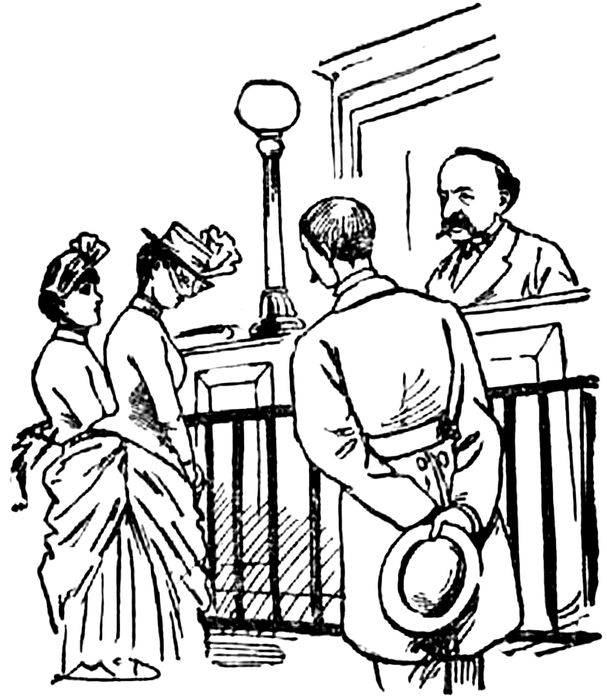
NELLIE BEFORE JUDGE DUFFY.
“Come here, girl, and lift your veil,” called out Judge
Duffy, in tones which surprised me by a harshness which
I did not think from the kindly face he possessed.
“Who are you speaking to?” I inquired, in my stateliest
manner.
“Come here, my dear, and lift your veil. You know
the Queen of England, if she were here, would have to
lift her veil,” he said, very kindly.
“That is much better,” I replied. “I am not the
Queen of England, but I’ll lift my veil.”
As I did so the little judge looked at me, and then, in
a very kind and gentle tone, he said:
“My dear child, what is wrong?”
27“Nothing is wrong except that I have lost my trunks,
and this man,” indicating Policeman Bockert, “promised
to bring me where they could be found.”
“What do you know about this child?” asked the
judge, sternly, of Mrs. Stanard, who stood, pale and
trembling, by my side.
“I know nothing of her except that she came to the
home yesterday and asked to remain overnight.”
“The home! What do you mean by the home?” asked
Judge Duffy, quickly.
“It is a temporary home kept for working women at
No. 84 Second Avenue.”
“What is your position there?”
“I am assistant matron.”
“Well, tell us all you know of the case.”
“When I was going into the home yesterday I noticed
her coming down the avenue. She was all alone. I had
just got into the house when the bell rang and she came
in. When I talked with her she wanted to know if she
could stay all night, and I said she could. After awhile
she said all the people in the house looked crazy, and
she was afraid of them. Then she would not go to bed,
but sat up all the night.”
“Had she any money?”
“Yes,” I replied, answering for her, “I paid her for
everything, and the eating was the worst I ever tried.”
There was a general smile at this, and some murmurs
of “She’s not so crazy on the food question.”
“Poor child,” said Judge Duffy, “she is well dressed,
and a lady. Her English is perfect, and I would stake
everything on her being a good girl. I am positive she
is somebody’s darling.”
At this announcement everybody laughed, and I put
my handkerchief over my face and endeavored to choke
the laughter that threatened to spoil my plans, in despite
of my resolutions.
28“I mean she is some woman’s darling,” hastily amended
the judge. “I am sure some one is searching for her.
Poor girl, I will be good to her, for she looks like my
sister, who is dead.”
There was a hush for a moment after this announcement,
and the officers glanced at me more kindly, while
I silently blessed the kind-hearted judge, and hoped that
any poor creatures who might be afflicted as I pretended
to be should have as kindly a man to deal with as Judge
Duffy.
“I wish the reporters were here,” he said at last.
“They would be able to find out something about her.”
I got very much frightened at this, for if there is any
one who can ferret out a mystery it is a reporter. I felt
that I would rather face a mass of expert doctors, policemen,
and detectives than two bright specimens of my
craft, so I said:
“I don’t see why all this is needed to help me find my
trunks. These men are impudent, and I do not want to
be stared at. I will go away. I don’t want to stay here.”
So saying, I pulled down my veil and secretly hoped
the reporters would be detained elsewhere until I was
sent to the asylum.
“I don’t know what to do with the poor child,” said
the worried judge. “She must be taken care of.”
“Send her to the Island,” suggested one of the officers.
“Oh, don’t!” said Mrs. Stanard, in evident alarm.
“Don’t! She is a lady and it would kill her to be put on
the Island.”
For once I felt like shaking that good woman. To
think the Island was just the place I wanted to reach and
here she was trying to keep me from going there! It
was very kind of her, but rather provoking under the
circumstances.
“There has been some foul work here,” said the judge.
“I believe this child has been drugged and brought to
29this city. Make out the papers and we will send her to
Bellevue for examination. Probably in a few days the
effect of the drug will pass off and she will be able to tell
us a story that will be startling. If the reporters would
only come!”
I dreaded them, so I said something about not wishing
to stay there any longer to be gazed at. Judge Duffy
then told Policeman Bockert to take me to the back
office. After we were seated there Judge Duffy came in
and asked me if my home was in Cuba.
“Yes,” I replied, with a smile. “How did you
know?”
“Oh, I knew it, my dear. Now, tell me where was it?
In what part of Cuba?”
“On the hacienda,” I replied.
“Ah,” said the judge, “on a farm. Do you remember
Havana?”
“Si, senor,” I answered; “it is near home. How did
you know?”
“Oh, I knew all about it. Now, won’t you tell me the
name of your home?” he asked, persuasively.
“That’s what I forget,” I answered, sadly. “I have
a headache all the time, and it makes me forget things.
I don’t want them to trouble me. Everybody is asking
me questions, and it makes my head worse,” and in truth
it did.
“Well, no one shall trouble you any more. Sit down
here and rest awhile,” and the genial judge left me alone
with Mrs. Stanard.
Just then an officer came in with a reporter. I was so
frightened, and thought I would be recognized as a journalist,
so I turned my head away and said, “I don’t want
to see any reporters; I will not see any; the judge said I
was not to be troubled.”
“Well, there is no insanity in that,” said the man who
had brought the reporter, and together they left the room.
30Once again I had a fit of fear. Had I gone too far in not
wanting to see a reporter, and was my sanity detected?
If I had given the impression that I was sane, I was determined
to undo it, so I jumped up and ran back and
forward through the office, Mrs. Stanard clinging terrified
to my arm.
“I won’t stay here; I want my trunks! Why do they
bother me with so many people?” and thus I kept on until
the ambulance surgeon came in, accompanied by the
judge.